Translational Pulmonary Science Center, Children's Hospital Medical Center, Cincinnati, OH, USA.
Division of Pulmonary, Critical Care, and Sleep Medicine, University of Cincinnati College of Medicine, Cincinnati, OH, USA.
Orphanet J Rare Dis. 2018 Jul 31;13(1):129. doi: 10.1186/s13023-018-0846-y.
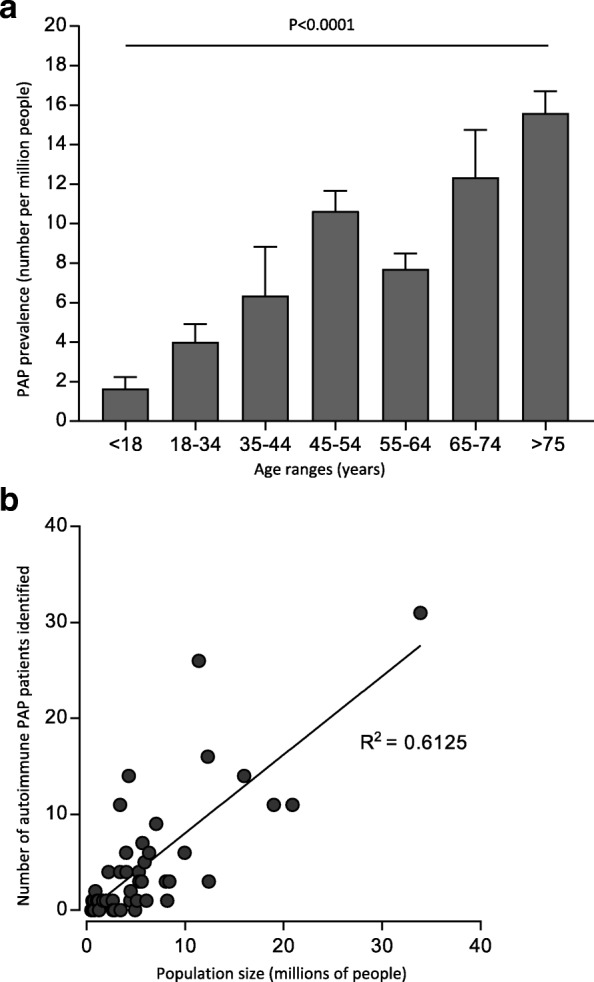
Pulmonary alveolar proteinosis (PAP) is a rare syndrome of alveolar surfactant accumulation, resulting hypoxemic respiratory failure, and increased infection risk. Despite advances in our understanding of disease pathogenesis and the availability of improved diagnostics, the epidemiology and healthcare burden of PAP remain poorly defined. To determine the prevalence, and healthcare utilization and costs associated with PAP, we interrogated a large health insurance claims database containing comprehensive data for approximately 15 million patients in the United States. We also evaluated data from a referral-based diagnostic testing program collected over a 15-year period. The prevalence of PAP was determined to be 6.87 ± 0.33 per million in the general population, similar in males and females, and increased with age, however considering difficulties and delays in diagnosing this is likely a minimum estimate of true prevalence. PAP patients had significantly more comorbidities, health care utilization and associated costs compared to control patients precisely matched for age and gender. Between 2004 and 2018, 249 patients confirmed to have PAP were evaluated to identify the PAP-causing disease; 91.5% had autoimmune PAP, 3% had hereditary PAP caused by GM-CSF receptor mutations, 4% had secondary PAP, and 1.5% had congenital PAP. Considering the high diagnostic accuracy of serum GM-CSF autoantibody testing and predominance of autoimmune PAP, these results emphasize the importance of utilizing blood-based testing in PAP syndrome to identify the PAP-causing disease rather than invasive lung biopsies, resulting in earlier diagnosis, reduced morbidity and lower healthcare costs.
肺泡蛋白沉积症(PAP)是一种罕见的肺泡表面活性物质蓄积综合征,导致低氧性呼吸衰竭和感染风险增加。尽管我们对疾病发病机制的理解有所提高,并且有了改进的诊断方法,但 PAP 的流行病学和医疗保健负担仍未得到明确界定。为了确定 PAP 的患病率以及与 PAP 相关的医疗保健利用和成本,我们查询了一个包含美国约 1500 万患者综合数据的大型医疗保险索赔数据库,并评估了一个基于转诊的诊断测试计划在 15 年期间收集的数据。PAP 的患病率在普通人群中为 6.87±0.33/百万人,在男性和女性中相似,且随年龄增长而增加,但考虑到诊断 PAP 的困难和延迟,这可能是真实患病率的最低估计。与年龄和性别精确匹配的对照患者相比,PAP 患者的合并症、医疗保健利用和相关成本显著更多。在 2004 年至 2018 年间,对 249 名确诊 PAP 的患者进行了评估,以确定 PAP 的致病疾病;91.5%为自身免疫性 PAP,3%为 GM-CSF 受体突变引起的遗传性 PAP,4%为继发性 PAP,1.5%为先天性 PAP。鉴于血清 GM-CSF 自身抗体检测的高诊断准确性和自身免疫性 PAP 的优势,这些结果强调了在 PAP 综合征中利用基于血液的检测来识别 PAP 致病疾病的重要性,而不是进行侵入性肺活检,从而实现更早的诊断、降低发病率和降低医疗保健成本。