Kereszt Attila, Mergaert Peter, Montiel Jesús, Endre Gabriella, Kondorosi Éva
Institute of Plant Biology, Biological Research Centre, Hungarian Academy of Sciences, Szeged, Hungary.
Institute of Integrative Biology of the Cell, UMR 9198, CNRS - CEA - Université Paris-Sud, Gif-sur-Yvette, France.
Front Plant Sci. 2018 Jul 17;9:1026. doi: 10.3389/fpls.2018.01026. eCollection 2018.
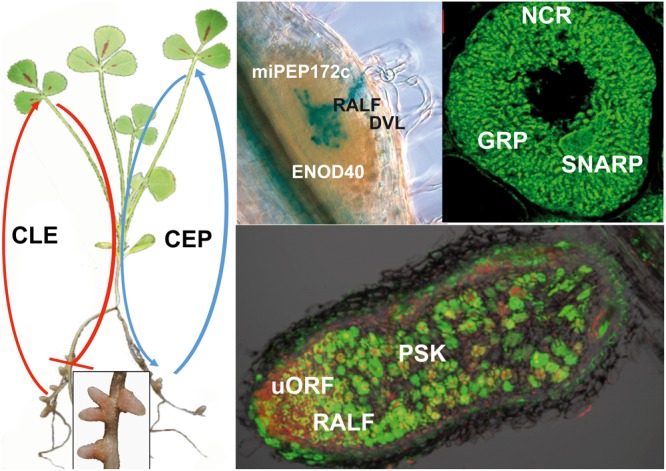
Ribosomally synthesized peptides have wide ranges of functions in plants being, for example, signal molecules, transporters, alkaloids, or antimicrobial agents. Legumes are an unprecedented rich source of peptides, which are used to control the symbiosis of these plants with the nitrogen-fixing bacteria. Here, we discuss the function and the evolution of these peptides playing an important role in the formation or functioning of the symbiotic organs, the root nodules. We distinguish peptides that can be either cell-autonomous or secreted short-range or long-range signals, carrying messages in or between plant cells or that can act as effectors interacting with the symbiotic bacteria. Peptides are further classified according to the stage of the symbiotic process where they act. Several peptide classes, including RALF, DLV, ENOD40, and others, control infection and the initiation of cell divisions and the formation of nodule primordia. CLE and CEP peptides are implicated in systemic and local control of nodule initiation during autoregulation of nodulation and in response to the nutritional demands of the plant. Still other peptides act at later stages of the symbiosis. The PSK peptide is thought to be involved in the suppression of immunity in nodules and the nodule-specific cysteine-rich, GRP, and SNARP (LEED..PEED) peptide families are essential in the functioning of the nitrogen fixing root nodules. The NCRs and possibly also the GRP and SNARPs are targeted to the endosymbionts and play essential roles in the terminal differentiation of these bacteria.
核糖体合成的肽在植物中具有广泛的功能,例如作为信号分子、转运蛋白、生物碱或抗菌剂。豆科植物是肽的一个前所未有的丰富来源,这些肽用于控制这些植物与固氮细菌的共生关系。在这里,我们讨论了这些肽在共生器官根瘤的形成或功能中发挥重要作用的功能和进化。我们区分了可以是细胞自主的、分泌的短程或长程信号的肽,它们在植物细胞内或细胞间传递信息,或者可以作为与共生细菌相互作用的效应物。肽还根据它们作用的共生过程阶段进行分类。包括RALF、DLV、ENOD40等在内的几类肽控制感染、细胞分裂的起始以及根瘤原基的形成。CLE和CEP肽在结瘤的自动调节过程中以及对植物营养需求的响应中参与结瘤起始的系统和局部控制。还有其他肽在共生的后期阶段起作用。PSK肽被认为参与了根瘤中免疫的抑制,而根瘤特异性富含半胱氨酸的肽、GRP和SNARP(LEED..PEED)肽家族在固氮根瘤的功能中至关重要。NCRs以及可能还有GRP和SNARPs靶向内共生体,并在这些细菌的终末分化中发挥重要作用。