Menon Bindu, Krishnan Ramalingam
Department of Neurology, Apollo Speciality Hospitals, Nellore, Andhra Pradesh, India.
Department of Biochemistry, Narayana Medical College, Nellore, Andhra Pradesh, India.
J Neurosci Rural Pract. 2018 Jul-Sep;9(3):376-380. doi: 10.4103/jnrp.jnrp_5_18.
Leptin has been implicated as a pathogenetic contributor to atherosclerosis. We aimed to investigate the association of leptin level with ischemic stroke.
We prospectively enrolled 52 patients with acute ischemic stroke and measured leptin levels and compared with age- and sex-matched healthy controls. Risk factors, body mass index (BMI), biochemical parameters, intima-media thickness (IMT) on carotid vertebral Doppler and neuroimaging was done. Data were entered into MS-Excel and appropriate statistical analysis was done using SPSS software version 21.0. = 0.05 was considered statistically significant.
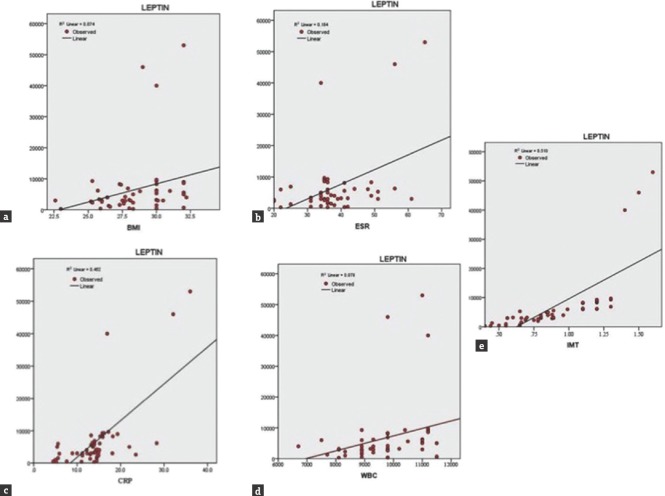
Serum leptin was significantly elevated in stroke patients (6598.1 ± 1035.1) compared to controls (3090.7 ± 698.86) ( < 0.01). Patients had higher BMI (26.9 ± 1.7) than controls (26.9 ± 1.7) ( < 0.00). BMI, total cholesterol, low-density lipoprotein (LDL) cholesterol, white blood cell (WBC) count, erythrocyte sedimentation rate (ESR), and C reactive protein (CRP) were significantly elevated in stroke patients than controls. Correlation analysis among patient group showed that serum leptin positively correlated with CRP ( - 0.41, - <0.05), WBCs ( - 0.28, - <0.05), ESR ( - 0.429, - <0.01) total cholesterol ( - 0.31, - <0.05), LDL-cholesterol ( - 0.19, - <0.05), and IMT ( - 0.714, - <0.001).
Our study showed high leptin levels in patients with stroke. Stroke patients with high leptin had higher BMI and inflammatory markers. The results of our study indicate that leptin may have a role in atherosclerosis mediated through inflammation. Future research should be directed toward understanding the role of leptin in the pathogenesis of cerebrovascular diseases and its potential role in preventive treatment of ischemic stroke.
瘦素被认为是动脉粥样硬化发病机制的一个促成因素。我们旨在研究瘦素水平与缺血性中风的关联。
我们前瞻性纳入了52例急性缺血性中风患者,测量其瘦素水平,并与年龄和性别匹配的健康对照者进行比较。对危险因素、体重指数(BMI)、生化参数、颈动脉椎动脉多普勒超声检查的内膜中层厚度(IMT)以及神经影像学进行了评估。数据录入MS-Excel,并使用SPSS 21.0软件进行了适当的统计分析。P<0.05被认为具有统计学意义。
与对照组(3090.7±698.86)相比,中风患者的血清瘦素水平显著升高(6598.1±1035.1)(P<0.01)。患者的BMI(26.9±1.7)高于对照组(26.9±1.7)(P<0.00)。中风患者的BMI、总胆固醇、低密度脂蛋白(LDL)胆固醇、白细胞(WBC)计数、红细胞沉降率(ESR)和C反应蛋白(CRP)均显著高于对照组。患者组的相关性分析表明,血清瘦素与CRP(r=-0.41,P<0.05)、WBC(r=-0.28,P<0.05)、ESR(r=-0.429,P<0.01)、总胆固醇(r=-0.31,P<0.05)、LDL胆固醇(r=-0.19,P<0.05)和IMT(r=-0.714,P<0.001)呈正相关。
我们的研究表明中风患者的瘦素水平较高。瘦素水平高的中风患者具有更高的BMI和炎症标志物。我们的研究结果表明,瘦素可能通过炎症在动脉粥样硬化中起作用。未来的研究应致力于了解瘦素在脑血管疾病发病机制中的作用及其在缺血性中风预防性治疗中的潜在作用。