Sun Wei, Chan Stephen Y
Division of Cardiology, Department of Medicine, Center for Pulmonary Vascular Biology and Medicine, Pittsburgh Heart, Lung, Blood, and Vascular Medicine Institute, University of Pittsburgh School of Medicine and University of Pittsburgh Medical Center, Pittsburgh, PA, United States.
Front Med (Lausanne). 2018 Jul 18;5:204. doi: 10.3389/fmed.2018.00204. eCollection 2018.
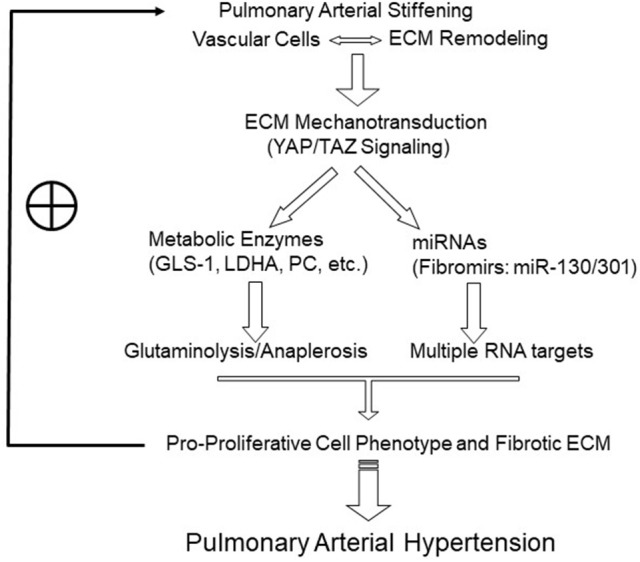
Pulmonary arterial hypertension (PAH) is a historically neglected and highly morbid vascular disease that leads to right heart failure and, in some cases, death. The molecular origins of this disease have been poorly defined, and as such, current pulmonary vasodilator therapies do not cure or reverse this disease. Although extracellular matrix (ECM) remodeling and pulmonary arterial stiffening have long been associated with end-stage PAH, recent studies have reported that such vascular stiffening can occur early in pathogenesis. Furthermore, there is emerging evidence that ECM stiffening may represent a key first step in pathogenic reprogramming and molecular crosstalk among endothelial, smooth muscle, and fibroblast cells in the remodeled pulmonary vessel. Such processes represent the convergence of activation of a number of specific mechanoactivated signaling pathways, microRNAs, and metabolic pathways in pulmonary vasculature. In this review, we summarize the contemporary understanding of vascular stiffening as a driver of PAH, its mechanisms, potential therapeutic targets and clinical perspectives. Of note, early intervention targeting arterial stiffness may break the vicious cycle of PAH progression, leading to outcome improvement which has not been demonstrated by current vasodilator therapy.
肺动脉高压(PAH)是一种长期被忽视且具有高发病率的血管疾病,可导致右心衰竭,在某些情况下还会导致死亡。这种疾病的分子起源尚未明确界定,因此,目前的肺血管扩张剂疗法无法治愈或逆转该疾病。尽管细胞外基质(ECM)重塑和肺动脉僵硬长期以来一直与终末期PAH相关,但最近的研究报告称,这种血管僵硬可能在发病机制的早期就会出现。此外,越来越多的证据表明,ECM僵硬可能是重塑肺血管中内皮细胞、平滑肌细胞和成纤维细胞之间致病重编程和分子串扰的关键第一步。这些过程代表了肺血管中许多特定机械激活信号通路、微小RNA和代谢通路激活的汇聚。在本综述中,我们总结了对血管僵硬作为PAH驱动因素的当代理解、其机制、潜在治疗靶点和临床前景。值得注意的是,针对动脉僵硬的早期干预可能会打破PAH进展的恶性循环,从而改善目前血管扩张剂疗法尚未证实的治疗效果。