Yesildag Cigdem, Bartsch Christoph, Lensen Marga C
Technische Universität Berlin, Nanopatterned Biomaterials, Sekr. TC 1, Strasse des 17. Juni 124, 10623 Berlin, Germany.
ACS Omega. 2018 Jul 31;3(7):7214-7223. doi: 10.1021/acsomega.8b00863. Epub 2018 Jul 3.
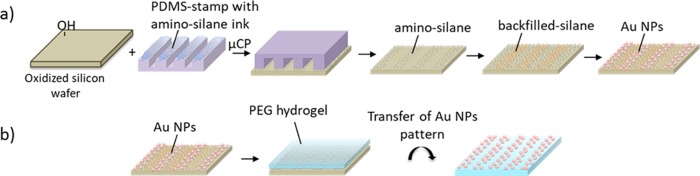
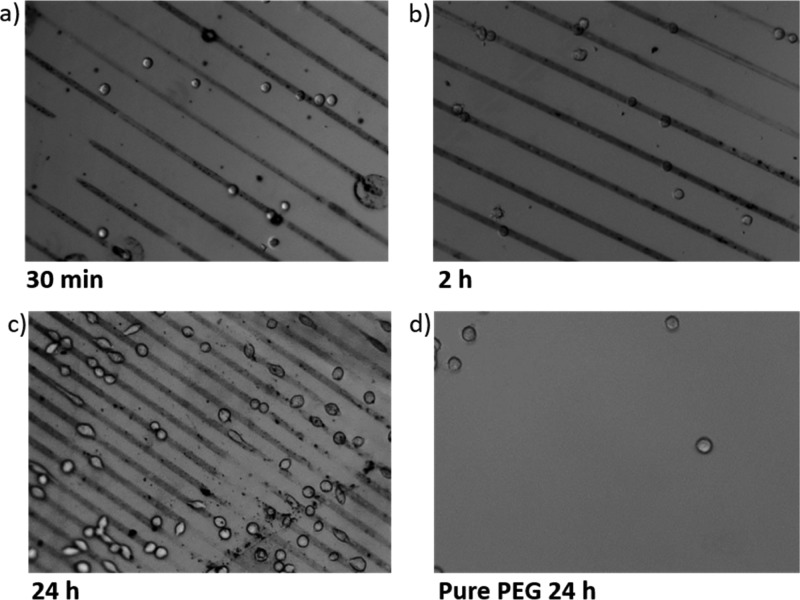
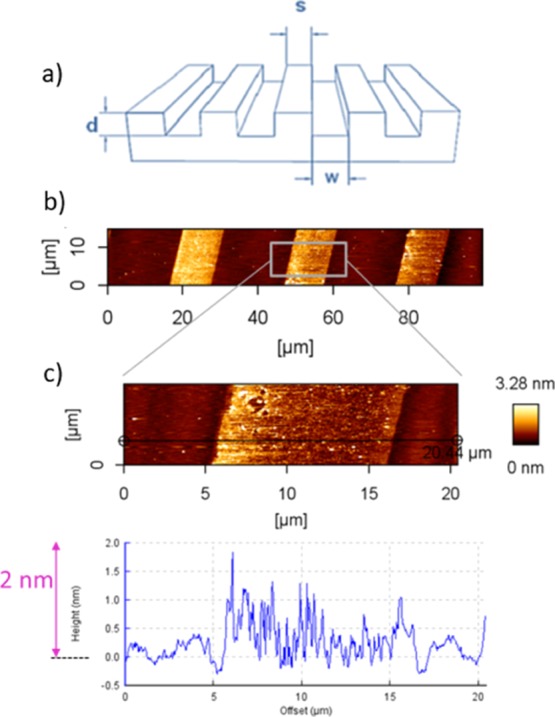
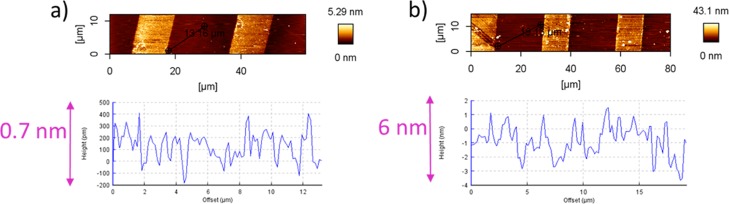
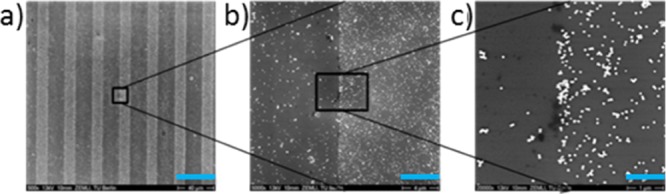
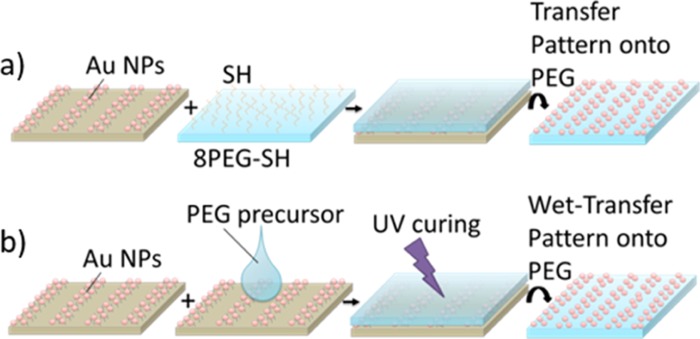
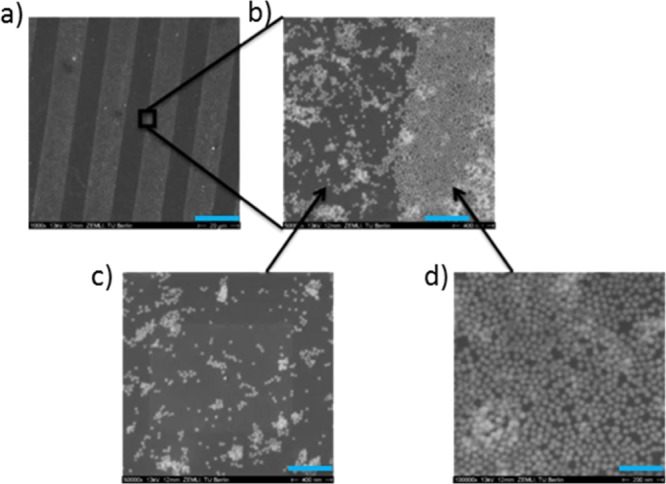
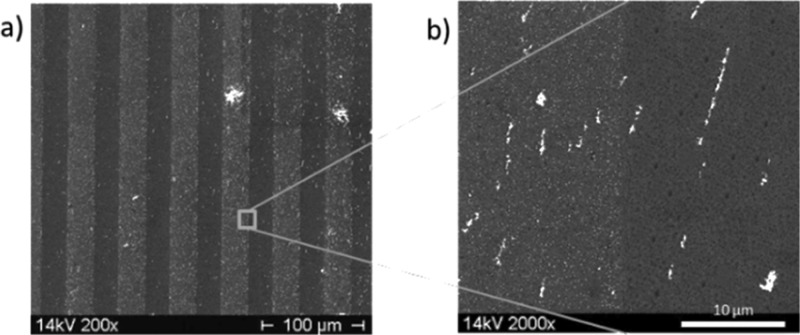
Amino-silanization of silica-based substrates has proven to be effective in guiding the immobilization of citrate-stabilized Au NPs in a good, homogeneous fashion. This accomplishment has formed the basis of fabricating micropatterns of Au NPs on such substrates by patterning of oxidized silicon wafers with (3-aminopropyl)trimethoxysilane (amino-silane) using the microcontact printing (μCP) process. This micropattern of amino-silane is used to specifically adsorb Au NPs. To avoid unspecific adsorption to the nonsilanized areas on the silicon wafers, the nonstamped areas were backfilled with self-assembled monolayers of organosilanes, for example, with methyl- or perfluoro-end-groups. Finally, after having fabricated a micropattern of Au NPs on silicon wafers, the Au NP patterns were transferred onto poly(ethylene glycol) hydrogels by our newly developed procedures, and on these nanocomposite materials, controlled cell adhesion has been achieved. Furthermore, these materials are great candidates for plasmon-based biosensor applications and also for various medical applications, such as for drug delivery systems or photothermal therapies.
基于二氧化硅的基底进行氨基硅烷化已被证明能有效地以良好、均匀的方式引导柠檬酸盐稳定的金纳米颗粒的固定。这一成果构成了通过使用微接触印刷(μCP)工艺用(3-氨丙基)三甲氧基硅烷(氨基硅烷)对氧化硅晶片进行图案化处理,从而在这类基底上制造金纳米颗粒微图案的基础。这种氨基硅烷微图案用于特异性吸附金纳米颗粒。为避免硅晶片上未硅烷化区域的非特异性吸附,未压印区域用有机硅烷的自组装单分子层进行回填,例如带有甲基或全氟端基的单分子层。最后,在硅晶片上制造出金纳米颗粒微图案后,通过我们新开发的程序将金纳米颗粒图案转移到聚乙二醇水凝胶上,并且在这些纳米复合材料上实现了可控的细胞黏附。此外,这些材料是基于等离子体激元的生物传感器应用以及各种医学应用(如药物递送系统或光热疗法)的理想候选材料。