Politecnico di Torino - Dept. of Environment, Land and Infrastructure Engineering, Corso Duca degli Abruzzi 24, 10129 Torino, Italy.
University of Trento, Department of Economics and Management, Trento, Italy.
PLoS One. 2018 Aug 8;13(8):e0200639. doi: 10.1371/journal.pone.0200639. eCollection 2018.
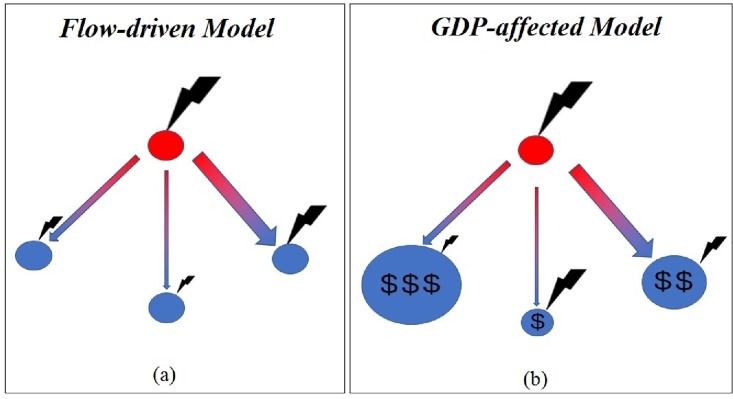
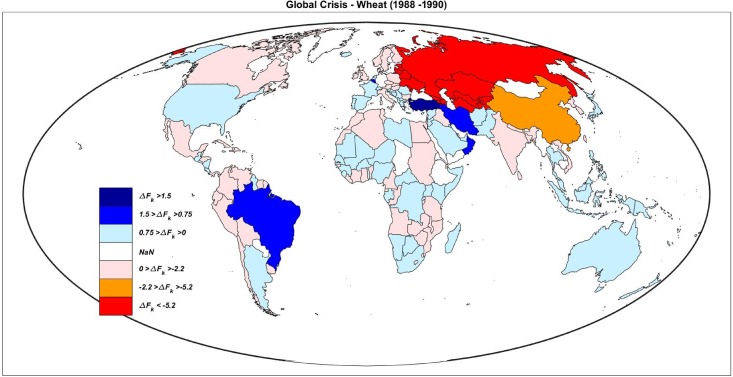
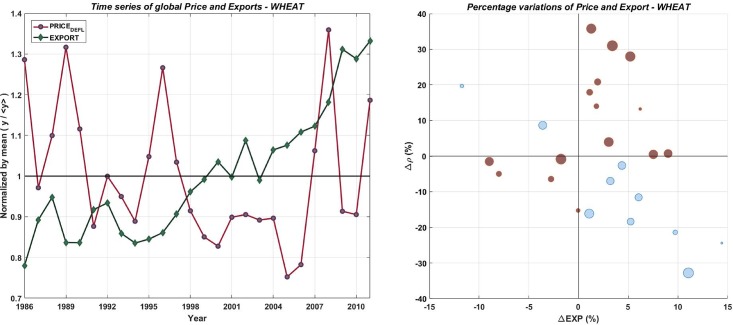
Food Security is a long-standing concern worldwide. The expansion of global food markets brings benefits but also risks, such as shock transmission within the global network of trade relations. We focus on this last issue, from an empirical point of view, by analysing the diffusion of trade shocks-defined as relevant drops in exported quantities-during the period 1986-2011, for four major staples (wheat, maize, rice, and soy-beans) both at country level and at global scale. We find that: (i) income per capita of importing countries is relevant in shock propagation; (ii) developing countries tend to absorb most of the negative export variation (i.e., the trade shock), and (iii) global food prices and real (tonnes) flows of commodities are only weakly correlated, meaning that a quantity-based investigation provides additional information with respect to a price-based analysis. This work offers a novel framework, complementary to the price-based literature, for the measurement of the propagation of international food shocks.
食品安全是全球长期关注的问题。全球食品市场的扩张带来了好处,但也带来了风险,例如在全球贸易关系网络内的冲击传递。我们从经验的角度关注最后一个问题,通过分析 1986-2011 年期间四种主要主食(小麦、玉米、大米和大豆)在国家和全球层面上的贸易冲击(定义为出口量的相关下降)的扩散。我们发现:(i)进口国的人均收入在冲击传播中很重要;(ii)发展中国家往往吸收了大部分负面的出口变化(即贸易冲击);(iii)全球粮食价格和实际(吨)商品流量之间的相关性较弱,这意味着基于数量的调查相对于基于价格的分析提供了额外的信息。这项工作提供了一个新的框架,补充了基于价格的文献,用于衡量国际粮食冲击的传播。