Romero Heather R, Monsch Andreas U, Hayden Kathleen M, Plassman Brenda L, Atkins Alexandra S, Keefe Richard S E, Brewster Shyama, Chiang Carl, O'Neil Janet, Runyan Grant, Atkinson Mark J, Crawford Stephen, Budur Kumar, Burns Daniel K, Welsh-Bohmer Kathleen A
Joseph & Kathleen Bryan Alzheimer's Disease Research Center (Bryan ADRC), Duke University, Durham, NC, USA.
Department of Psychiatry, Duke University, Durham, NC, USA.
Alzheimers Dement (N Y). 2018 Jul 14;4:314-323. doi: 10.1016/j.trci.2018.06.009. eCollection 2018.
Assessment of preclinical Alzheimer's disease (AD) requires reliable and validated methods to detect subtle cognitive changes. The battery of standardized cognitive assessments that is used for diagnostic criteria for mild cognitive impairment due to AD in the TOMMORROW study have only been fully validated in English-speaking countries. We conducted a validation and normative study of the German language version of the TOMMORROW neuropsychological test battery, which tests episodic memory, language, visuospatial ability, executive function, and attention.
German-speaking cognitively healthy controls (NCs) and subjects with AD were recruited from a memory clinic at a Swiss medical center. Construct validity, test-retest, and alternate form reliability were assessed in NCs. Criterion and discriminant validities of the cognitive measures were tested using logistic regression and discriminant analysis. Cross-cultural equivalency of performance of the German language tests was compared with English language tests.
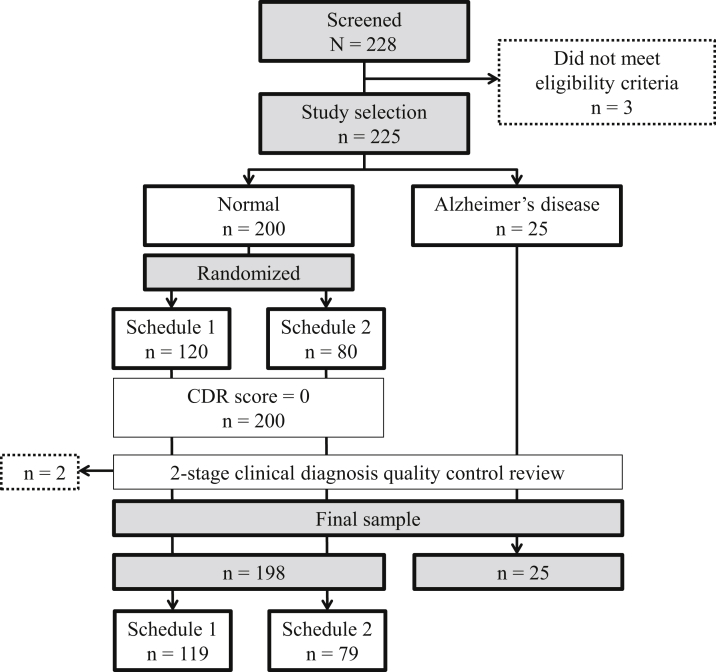
A total of 198 NCs and 25 subjects with AD (aged 65-88 years) were analyzed. All German language tests discriminated NCs from persons with AD. Episodic memory tests had the highest potential to discriminate with almost twice the predictive power of any other domain. Test-retest reliability of the test battery was adequate, and alternate form reliability for episodic memory tests was supported. For most tests, age was a significant predictor of group effect sizes; therefore, normative data were stratified by age. Validity and reliability results were similar to those in the published US cognitive testing literature.
This study establishes the reliability and validity of the German language TOMMORROW test battery, which performed similarly to the English language tests. Some variations in test performance underscore the importance of regional normative values. The German language battery and normative data will improve the precision of measuring cognition and diagnosing incident mild cognitive impairment due to AD in clinical settings in German-speaking countries.
临床前阿尔茨海默病(AD)的评估需要可靠且经过验证的方法来检测细微的认知变化。在“明日”研究中用于AD所致轻度认知障碍诊断标准的一系列标准化认知评估仅在英语国家得到了充分验证。我们对“明日”神经心理测试组的德语版本进行了验证和常模研究,该测试组用于测试情景记忆、语言、视觉空间能力、执行功能和注意力。
从瑞士一家医疗中心的记忆诊所招募了讲德语的认知健康对照者(NCs)和AD患者。在NCs中评估了结构效度、重测信度和复本信度。使用逻辑回归和判别分析测试了认知测量的效标效度和判别效度。将德语测试的表现与英语测试的跨文化等效性进行了比较。
共分析了198名NCs和25名AD患者(年龄65 - 88岁)。所有德语测试都能区分NCs和AD患者。情景记忆测试具有最高的区分潜力,其预测能力几乎是其他任何领域的两倍。测试组的重测信度足够,情景记忆测试的复本信度得到了支持。对于大多数测试,年龄是组效应大小的显著预测因素;因此,常模数据按年龄分层。效度和信度结果与已发表的美国认知测试文献中的结果相似。
本研究确立了德语版“明日”测试组的信度和效度,其表现与英语测试相似。测试表现的一些差异凸显了区域常模值的重要性。德语测试组和常模数据将提高德语国家临床环境中测量认知和诊断AD所致新发轻度认知障碍的准确性。