Centre for Forest Research, Université du Québec à Montréal, Case Postale 8888, Succ. Centre-Ville, Montreal, QC, H3C 3P8, Canada.
Faculty of Forestry and Environmental Sciences, University of New Brunswick, 28 Dineen Drive, Fredericton, NB, E3B 5A3, Canada.
Nat Commun. 2018 Aug 10;9(1):3213. doi: 10.1038/s41467-018-05705-4.
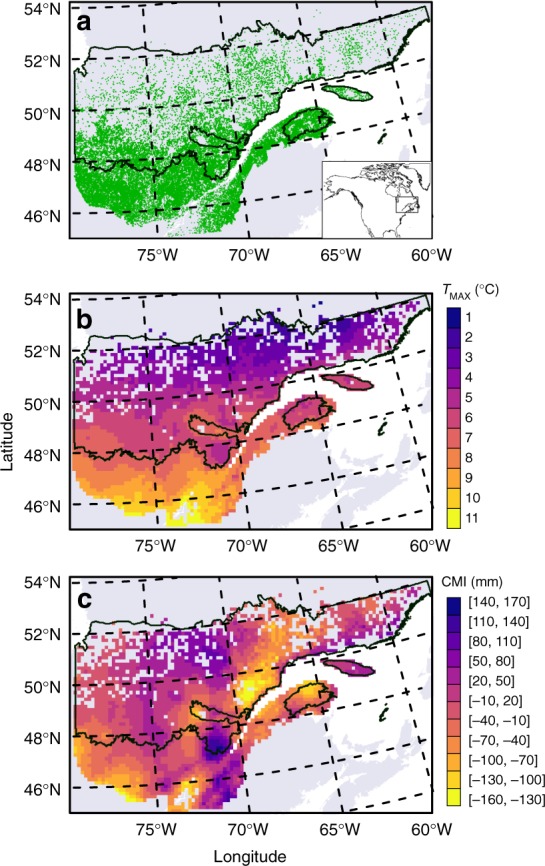
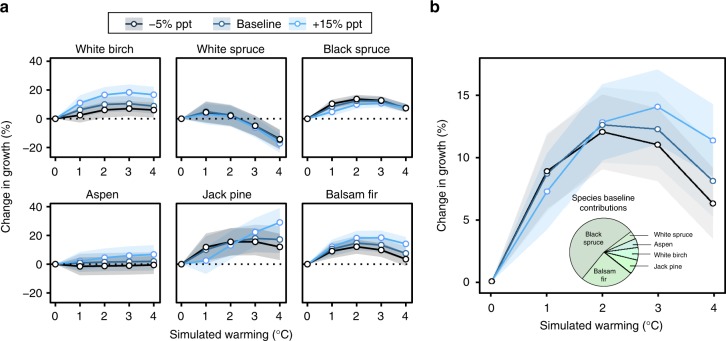
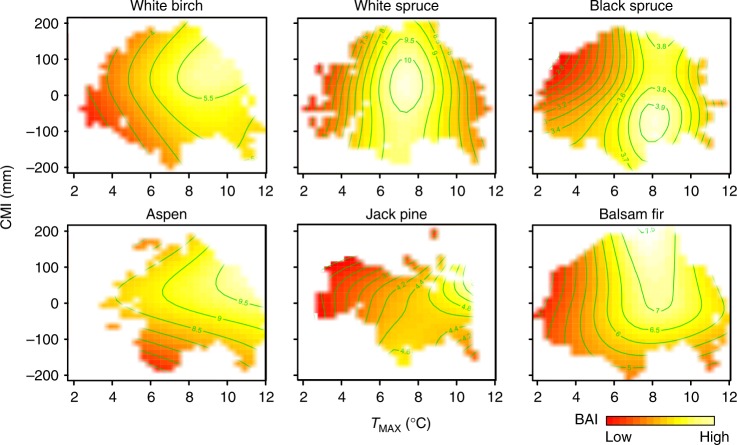
Predicted increases in temperature and aridity across the boreal forest region have the potential to alter timber supply and carbon sequestration. Given the widely-observed variation in species sensitivity to climate, there is an urgent need to develop species-specific predictive models that can account for local conditions. Here, we matched the growth of 270,000 trees across a 761,100 km region with detailed site-level data to quantify the growth responses of the seven most common boreal tree species in Eastern Canada to changes in climate. Accounting for spatially-explicit species-specific responses, we find that while 2 °C of warming may increase overall forest productivity by 13 ± 3% (mean ± SE) in the absence of disturbance, additional warming could reverse this trend and lead to substantial declines exacerbated by reductions in water availability. Our results confirm the transitory nature of warming-induced growth benefits in the boreal forest and highlight the vulnerability of the ecosystem to excess warming and drying.
预测的北方森林地区温度和干旱程度的增加有可能改变木材供应和碳固存。鉴于广泛观察到的物种对气候的敏感性变化,迫切需要开发能够考虑到当地条件的特定物种的预测模型。在这里,我们将 761,100 平方公里区域内的 27 万棵树木的生长情况与详细的现场数据相匹配,以量化加拿大东部七种最常见的北方树种对气候变化的生长反应。考虑到空间上特定物种的反应,我们发现,在没有干扰的情况下,2°C 的变暖可能会使整个森林生产力增加 13±3%(平均值±标准差),但额外的变暖可能会逆转这一趋势,并导致因水分可用性降低而加剧的大量减少。我们的结果证实了北方森林中变暖引起的生长效益的短暂性,并强调了生态系统对过度变暖变干的脆弱性。