Institute of Epidemiology, Helmholtz Zentrum München, German Research Center for Environmental Health, Neuherberg, Germany.
Independent Research Group Clinical Epidemiology, Helmholtz Zentrum München, German Research Center for Environmental Health, Neuherberg, Germany.
Sci Rep. 2018 Aug 10;8(1):11981. doi: 10.1038/s41598-018-30350-8.
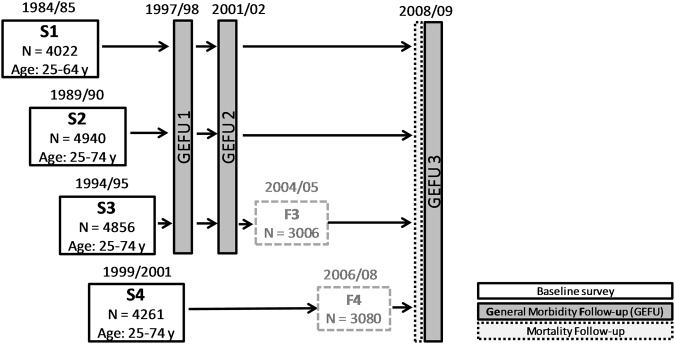
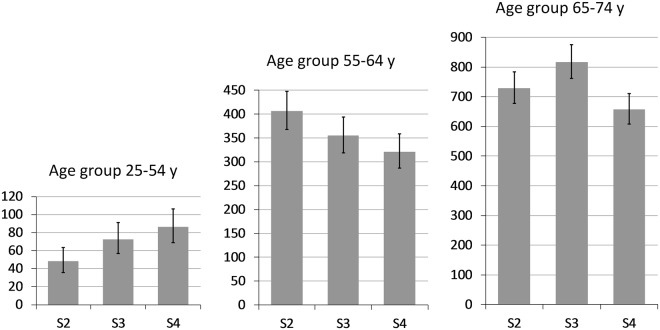
In prior studies, stroke incidence has mainly shown either declining time trends or stable rates in high-income countries. Changes could partially be linked to trends in classic cardiovascular disease (CVD) risk factors. In the present study, we analyzed the incidence of stroke in parallel with the prevalence of CVD risk factors over time in a German population. Data from three independent population-based MONICA/KORA Augsburg surveys conducted in 1989/90 (S2), 1994/95 (S3), and 1999/2001 (S4) were used to calculate age-standardized incidence rates (IR) of first-ever stroke over eight years from each baseline survey. Furthermore, the age-standardized prevalence rates of CVD risk factors were analyzed for these surveys. Changes in IR or prevalence were considered significantly different if their 95% confidence intervals (CI) did not overlap. The age-standardized IR of stroke showed no significant time trend (S2: IR = 203.4 per 100,000 person-years; CI 176.4-233.4, S3: IR = 225.6; 197.1-257.0, S4: IR = 209.9; CI 182.4-240.3). In agreement, the prevalence of the CVD risk factors was quite stable over time, showing divergent, but mostly non-significant changes. However, due to the aging Western societies and the longer survival time of stroke patients, the total number of stroke patients in the population will increase even with a stable IR.
在先前的研究中,高收入国家的中风发病率主要表现出下降的趋势或稳定的水平。这种变化可能部分与经典心血管疾病(CVD)风险因素的趋势有关。在本研究中,我们分析了德国人群中风发病率与 CVD 风险因素流行率随时间变化的情况。该研究使用了三个独立的基于人群的 MONICA/KORA 奥格斯堡调查(1989/90 年 S2 期、1994/95 年 S3 期和 1999/2001 年 S4 期)的数据,以计算每个基线调查后 8 年内首次发生中风的年龄标准化发病率(IR)。此外,还分析了这些调查中 CVD 风险因素的年龄标准化流行率。如果它们的 95%置信区间(CI)没有重叠,则认为发病率或流行率的变化有显著差异。中风的年龄标准化发病率没有明显的时间趋势(S2:IR=203.4/100,000 人年;CI 176.4-233.4,S3:IR=225.6;197.1-257.0,S4:IR=209.9;CI 182.4-240.3)。与之一致的是,CVD 风险因素的流行率在一段时间内相当稳定,表现出不同但大多无显著变化。然而,由于西方社会的老龄化和中风患者生存时间的延长,即使发病率保持稳定,人群中中风患者的总数也会增加。