Department of Orthopedics, Zhujiang Hospital, Southern Medical University, 253 Gongye Road, Guangzhou, 510282, China.
Department of Orthopedics, Guangdong Key Lab of Orthopedic Technology and Implant, Key Laboratory of Trauma & Tissue Repair of Tropical Area of PLA, Guangzhou General Hospital of Guangzhou Military Command of PLA, 111 Liuhua Road, Guangzhou, Guangdong, 510010, China.
Adv Healthc Mater. 2018 Oct;7(19):e1800602. doi: 10.1002/adhm.201800602. Epub 2018 Aug 13.
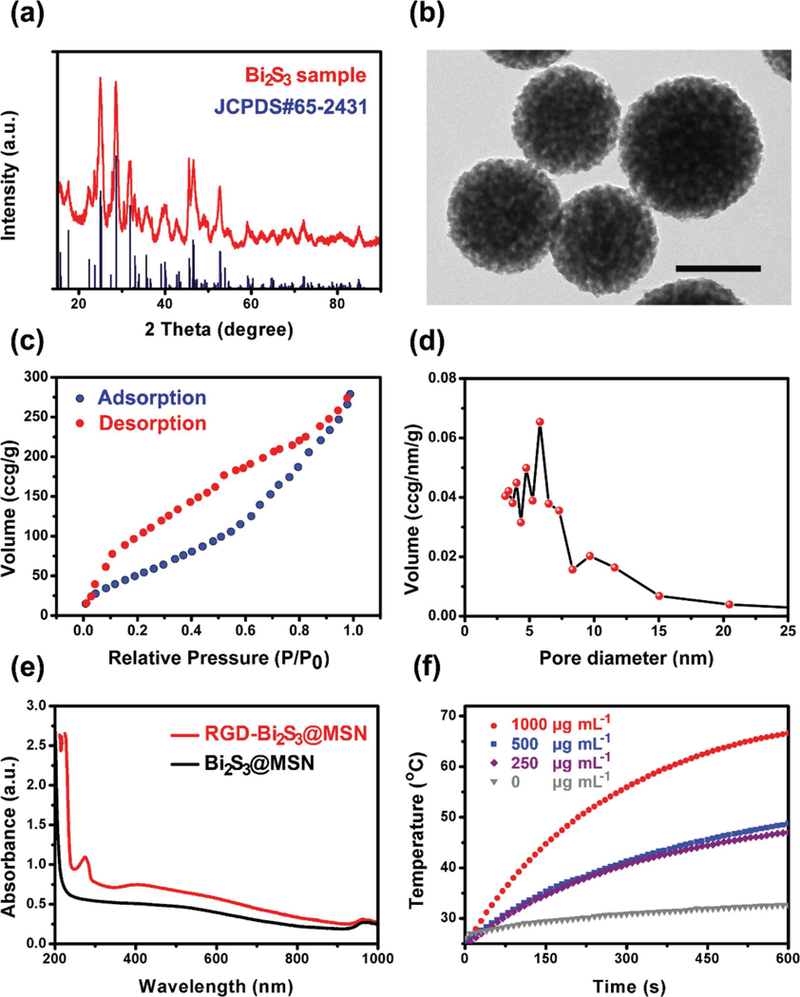
Despite its 5-year event-free survival rate increasing to 60-65% due to surgery and chemotherapy, osteosarcoma (OS) remains one of the most threatening malignant human tumors, especially in young patients. Therefore, a new approach that combines early diagnosis with efficient tumor eradication and bioimaging is urgently needed. Here, a new type of mesoporous silica-coated bismuth sulfide nanoparticles (Bi S @MSN NPs) is developed. The well distributed mesoporous pores and large surface areas hold great promise for drug protection and encapsulation (doxorubicin (DOX), 99.85%). Moreover, the high photothermal efficiency of Bi S @MSNs (36.62%) offers great possibility for cancer synergistic treatment and highly near-infrared-triggered drug release (even at an ultralow power density of 0.3 W cm ). After covalently conjugated to arginine-glycine-aspartic acid (RGD) peptide [c(RGDyC)], the NPs exhibit a high specificity for osteosarcoma and finally accumulate in the tumor cells (tenfold more than peritumoral tissues) for computed tomography (CT) imaging and tumor ablation. Importantly, the synergistic photothermal therapy-chemotherapy of the RGD-Bi S @MSN/DOX significantly ablates the highly malignant OS. It is further proved that the superior combined killing effect is achieved by activating the mitochondrial apoptosis pathway. Hence, the smart RGD-Bi S @MSN/DOX theranostic platform is a promising candidate for future applications in CT monitoring and synergistic treatment of malignant tumors.
尽管手术和化疗使骨肉瘤(OS)的 5 年无事件生存率提高到 60-65%,但它仍然是威胁人类健康的最具侵袭性的恶性肿瘤之一,尤其是在年轻患者中。因此,迫切需要一种新的方法,将早期诊断与高效的肿瘤消除和生物成像相结合。在这里,开发了一种新型的介孔硅包覆的硫化铋纳米粒子(Bi S@MSN NPs)。均匀分布的介孔孔和大的表面积为药物保护和封装(阿霉素(DOX),99.85%)提供了巨大的可能性。此外,Bi S@MSNs 的高光热效率(36.62%)为癌症协同治疗和高近红外触发药物释放提供了巨大的可能性(即使在超低功率密度为 0.3 W cm-2 时)。与精氨酸-甘氨酸-天冬氨酸(RGD)肽[c(RGDyC)]共价连接后,纳米粒子对骨肉瘤表现出很高的特异性,最终在肿瘤细胞中积累(比肿瘤周围组织多十倍),用于计算机断层扫描(CT)成像和肿瘤消融。重要的是,RGD-Bi S@MSN/DOX 的协同光热化疗显著消融了高度恶性的 OS。进一步证明,通过激活线粒体凋亡途径实现了优越的联合杀伤效果。因此,智能 RGD-Bi S@MSN/DOX 治疗平台是未来用于 CT 监测和协同治疗恶性肿瘤的有前途的候选者。