Department of Mucosal Immunology, IMSUT Distinguished Professor Unit, The Institute of Medical Science, The University of Tokyo, Tokyo 108-8639, Japan.
International Research and Development Center for Mucosal Vaccines, The Institute of Medical Science, The University of Tokyo, Tokyo 108-8639, Japan.
Int J Mol Sci. 2018 Aug 12;19(8):2371. doi: 10.3390/ijms19082371.
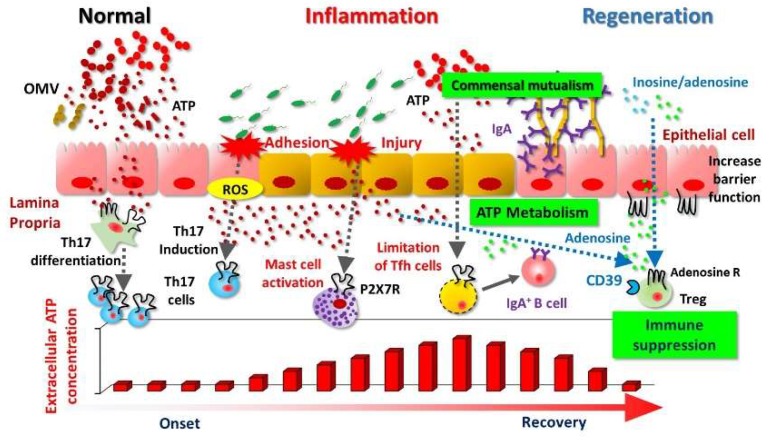
Extracellular nucleotides, such as adenosine triphosphate (ATP), are released from host cells including nerve termini, immune cells, injured or dead cells, and the commensal bacteria that reside in the gut lumen. Extracellular ATP interacts with the host through purinergic receptors, and promotes intercellular and bacteria-host communication to maintain the tissue homeostasis. However, the release of massive concentrations of ATP into extracellular compartments initiates acute and chronic inflammatory responses through the activation of immunocompetent cells (e.g., T cells, macrophages, and mast cells). In this review, we focus on the functions of ATP as a pathophysiologic mediator that is required for the induction and resolution of inflammation and inter-species communication.
细胞外核苷酸,如三磷酸腺苷 (ATP),从包括神经末梢、免疫细胞、受损或死亡细胞以及栖息在肠道腔中的共生细菌的宿主细胞中释放出来。细胞外 ATP 通过嘌呤能受体与宿主相互作用,并促进细胞间和细菌-宿主通讯,以维持组织内稳态。然而,大量浓度的 ATP 释放到细胞外腔室中,通过激活免疫活性细胞(例如 T 细胞、巨噬细胞和肥大细胞)引发急性和慢性炎症反应。在这篇综述中,我们重点介绍了 ATP 作为一种病理生理介质的功能,它是诱导和解决炎症和种间通讯所必需的。