Ali Akhtar, Khan Irfan Ullah, Jan Masood, Khan Haris Ali, Hussain Shah, Nisar Muhammad, Chung Woo Sik, Yun Dae-Jin
Department of Biomedical Science and Engineering, Konkuk University, Seoul, South Korea.
Division of Applied Life Science (BK21plus program), Gyeongsang National University, Jinju, South Korea.
Front Plant Sci. 2018 Jul 30;9:1108. doi: 10.3389/fpls.2018.01108. eCollection 2018.
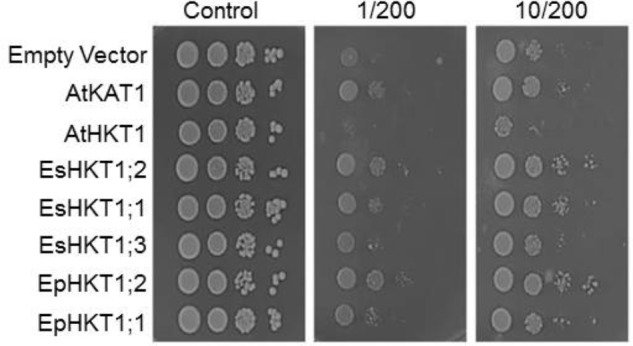
To survive salt stress, plants must maintain a balance between sodium and potassium ions. High-affinity potassium transporters (HKTs) play a key role in reducing Na toxicity through K uptake. (formerly known as ), a halophyte closely related to , has two genes that encode EpHKT1;1 and EpHKT1;2. In response to high salinity, the transcript level increased rapidly; by contrast, the transcript increased more slowly in response to salt treatment. Yeast cells expressing EpHKT1;2 were able to tolerate high concentrations of NaCl, whereas EpHKT1;1-expressing yeast cells remained sensitive to NaCl. Amino acid sequence alignment with other plant HKTs showed that EpHKT1;1 contains an asparagine residue (Asn-213) in the second pore-loop domain, but EpHKT1;2 contains an aspartic acid residue (Asp-205) at the same position. Yeast cells expressing EpHKT1;1, in which Asn-213 was substituted with Asp, were able to tolerate high concentrations of NaCl. In contrast, substitution of Asp-205 by Asn in EpHKT1;2 did not enhance salt tolerance and rather resulted in a similar function to that of AtHKT1 (Na influx but no K influx), indicating that the presence of Asn or Asp determines the mode of cation selectivity of the HKT1-type transporters. Moreover, plants (Col-) overexpressing showed significantly higher tolerance to salt stress and accumulated less Na and more K compared to those overexpressing or . Taken together, these results suggest that EpHKT1;2 mediates tolerance to Na ion toxicity in and is a major contributor to its halophytic nature.
为了在盐胁迫下生存,植物必须维持钠和钾离子之间的平衡。高亲和力钾转运蛋白(HKTs)在通过吸收钾来降低钠毒性方面发挥着关键作用。(以前称为 ),一种与 密切相关的盐生植物,有两个 基因编码EpHKT1;1和EpHKT1;2。响应高盐度时, 转录水平迅速增加;相比之下, 转录本对盐处理的响应增加得更慢。表达EpHKT1;2的酵母细胞能够耐受高浓度的NaCl,而表达EpHKT1;1的酵母细胞对NaCl仍然敏感。与其他植物HKTs的氨基酸序列比对表明,EpHKT1;1在第二个孔环结构域中含有一个天冬酰胺残基(Asn-213),但EpHKT1;2在相同位置含有一个天冬氨酸残基(Asp-205)。表达EpHKT1;1的酵母细胞中,Asn-213被Asp取代后,能够耐受高浓度的NaCl。相反,EpHKT1;2中Asp-205被Asn取代并没有增强耐盐性,反而导致了与AtHKT1类似的功能(钠内流但无钾内流),表明Asn或Asp的存在决定了HKT1型转运蛋白的阳离子选择性模式。此外,与过表达 或 的 植物(Col-)相比,过表达 的 植物对盐胁迫表现出显著更高的耐受性,并且积累的钠更少,钾更多。综上所述,这些结果表明EpHKT1;2介导了 对钠离子毒性的耐受性,并且是其盐生特性的主要贡献者。