Bhimji Khadija Murtaza, Naburi Helga, Aboud Said, Manji Karim
Departments of Paediatrics and Child Health, Muhimbili University of Health and Allied Sciences, Tanzania.
Microbiology and Immunology, Muhimbili University of Health and Allied Sciences. P.O. Box 65001, Dar es Salaam, Tanzania.
Int J Pediatr. 2018 Jul 5;2018:9614975. doi: 10.1155/2018/9614975. eCollection 2018.
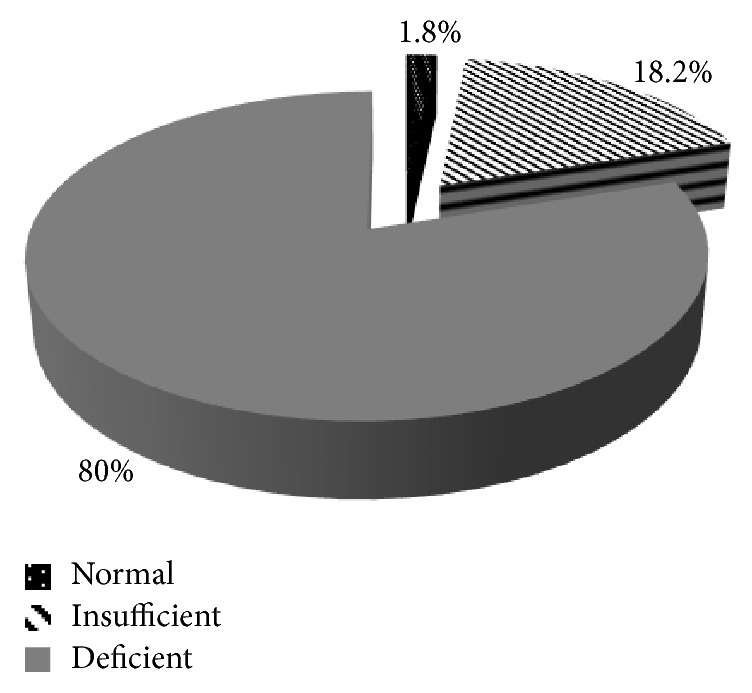
Vitamin D deficiency (VDD) is emerging as a serious public health problem globally; however due to lack of resources, vitamin D levels are not routinely measured among neonates. The study was conducted to determine vitamin D levels in neonates and factors associated with the same. A cross-sectional study was conducted among neonates admitted at neonatal ward of a tertiary care hospital. Means and proportions were calculated from summarized data in frequency tables. Chi square test was used to determine association between vitamin D and various associated factors such as sex, infant birth weight, gestation age, parity of the mother, maternal age, and HIV status of the mother. A total of 170 neonates were studied, out of which 80% had vitamin D deficiency. Neonates born to HIV-infected mothers were significantly less likely to have vitamin D deficiency (OR 0.21, 95% CI 0.06 - 0.77, p = 0.009). Subgroup analysis revealed the association to be stronger in terms neonates (p = 0.005). The association was not observed among preterm newborns. The prevalence of vitamin D deficiency in neonates was observed to be very high and needs more attention.
维生素D缺乏症(VDD)正在成为一个全球性的严重公共卫生问题;然而,由于资源匮乏,新生儿的维生素D水平并未常规检测。开展这项研究以确定新生儿的维生素D水平及其相关因素。在一家三级护理医院的新生儿病房对新生儿进行了一项横断面研究。从频率表中的汇总数据计算均值和比例。采用卡方检验来确定维生素D与各种相关因素之间的关联,这些因素包括性别、婴儿出生体重、胎龄、母亲的产次、母亲年龄以及母亲的艾滋病毒感染状况。总共研究了170名新生儿,其中80%患有维生素D缺乏症。感染艾滋病毒母亲所生的新生儿患维生素D缺乏症的可能性显著降低(比值比0.21,95%置信区间0.06 - 0.77,p = 0.009)。亚组分析显示,在足月新生儿中这种关联更强(p = 0.005)。在早产儿中未观察到这种关联。新生儿维生素D缺乏症的患病率非常高,需要更多关注。