Ergür Ayça Törel, Berberoğlu Merih, Atasay Begüm, Şıklar Zeynep, Bilir Pelin, Arsan Saadet, Söylemez Feride, Öcal Gönül
Ankara University, School of Medicine, Department of Pediatric Endocrinology, Ankara, Turkey.
J Clin Res Pediatr Endocrinol. 2009;1(6):266-9. doi: 10.4274/jcrpe.v1i6.266. Epub 2009 Nov 3.
Materno-fetal vitamin D deficiency (VDD) may occur in the early neonatal period. We aimed to evaluate the vitamin D (vitD) status and risk factors for VDD in healthy newborns and their mothers, and also in fertile women.
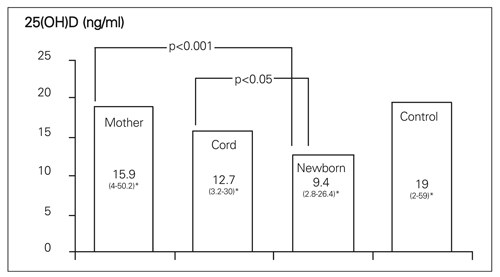
Serum 25 hydroxyvitamin D3 (25(OH)D), calcium (Ca), phosphorus (P) and alkaline phosphatase (ALP) levels were measured in 70 mothers (study group) and their newborns, and in umbilical cord samples. 104 nonpregnant fertile women comprised the control group. Demographic factors such as education and clothing habits of the mother, number of pregnancies and month of delivery were recorded. A serum 25(OH)D level below 11 ng/ml was accepted as severe, 11-25 ng/ml as moderate VDD, and a value over 25 ng/ml as normal.
Severe VDD was found in 27% of the mothers, and moderate deficiency in 54.3%. Severe VDD was detected in 64.3% of the neonates, and moderate deficiency in 32.9%. Only 18.6% of the mothers and 2.9% of the neonates had normal vitD levels. In the control group, severe VDD was observed in 26.9%, and moderate deficiency in 45.2%. Only 27.8% of the controls had normal vitD levels. In the control group, the 25(OH)D levels of the women dressed in modern clothes were significantly higher than those of the women wearing traditional clothes. This difference was not observed in the study group because 75% of these 70 mothers wore modern clothes. Mothers giving birth during the summer months and their neonates had significantly higher serum 25(OH)D levels than those of the mothers giving birth during the winter months and their neonates.
The study has shown that in Turkey VDD is an important problem in women of reproductive age, in mothers and their neonates. The 25(OH)D levels obtained from the cord may serve as a guide in the determination of the high risk groups.
母婴维生素D缺乏(VDD)可能在新生儿早期出现。我们旨在评估健康新生儿及其母亲以及育龄妇女的维生素D(vitD)状态和VDD的危险因素。
测量了70名母亲(研究组)及其新生儿以及脐带样本中的血清25羟维生素D3(25(OH)D)、钙(Ca)、磷(P)和碱性磷酸酶(ALP)水平。104名未怀孕的育龄妇女组成对照组。记录了母亲的教育程度、着装习惯、怀孕次数和分娩月份等人口统计学因素。血清25(OH)D水平低于11 ng/ml被视为严重缺乏,11 - 25 ng/ml为中度VDD,超过25 ng/ml为正常。
27%的母亲存在严重VDD,54.3%为中度缺乏。64.3%的新生儿存在严重VDD,32.9%为中度缺乏。只有18.6%的母亲和2.9%的新生儿vitD水平正常。对照组中,26.9%存在严重VDD,45.2%为中度缺乏。只有27.8%的对照组vitD水平正常。在对照组中,穿着现代服装的女性的25(OH)D水平显著高于穿着传统服装的女性。研究组未观察到这种差异,因为这70名母亲中有75%穿着现代服装。夏季分娩的母亲及其新生儿的血清25(OH)D水平显著高于冬季分娩的母亲及其新生儿。
该研究表明,在土耳其,VDD是育龄妇女、母亲及其新生儿中的一个重要问题。从脐带获得的25(OH)D水平可为确定高危人群提供指导。