Department of Psychiatry, Tri-Service General Hospital, National Defense Medical Center, Taipei, Taiwan.
Student Counseling Center, National Defense Medical Center, Taipei, Taiwan.
Int J Neuropsychopharmacol. 2018 Nov 1;21(11):979-987. doi: 10.1093/ijnp/pyy074.
The efficacy of fronto-temporal transcranial direct current stimulation in treating auditory verbal hallucinations and other psychopathological symptoms of schizophrenia patients has been examined in a small number of clinical trials with limited sample sizes, but the results are mixed. Fronto-temporal transcranial direct current stimulation has also been demonstrated to enhance patients' insight into their mental illness in an open-label pilot study. The current investigation aimed to investigate the therapeutic effects of fronto-temporal transcranial direct current stimulation on the severity of auditory verbal hallucinations, other schizophrenia symptoms, and insight in a large double blind, randomized, sham-controlled trial.
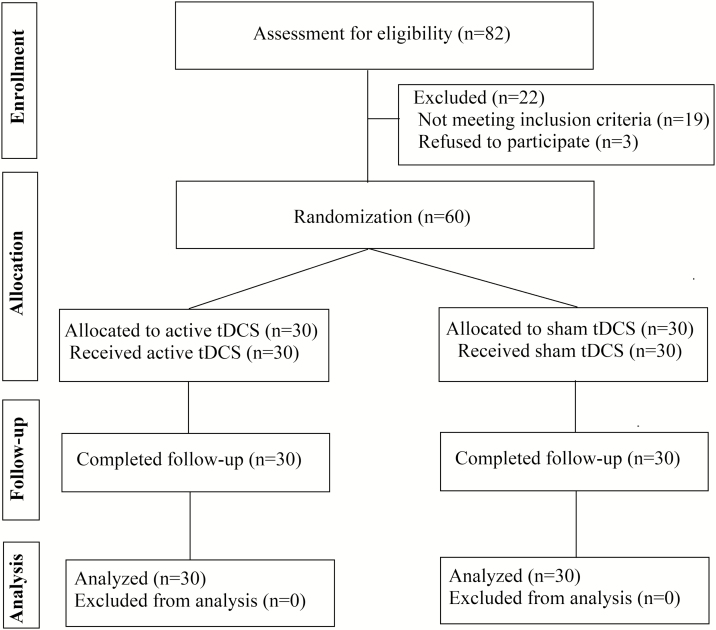
Sixty patients with medication-refractory auditory verbal hallucinations were randomized over 2 conditions: transcranial direct current stimulation with 2-mA, twice-daily sessions for 5 consecutive days, with anodal stimulation to the left prefrontal cortex and cathodal stimulation to the left temporo-parietal junction, and sham treatment.
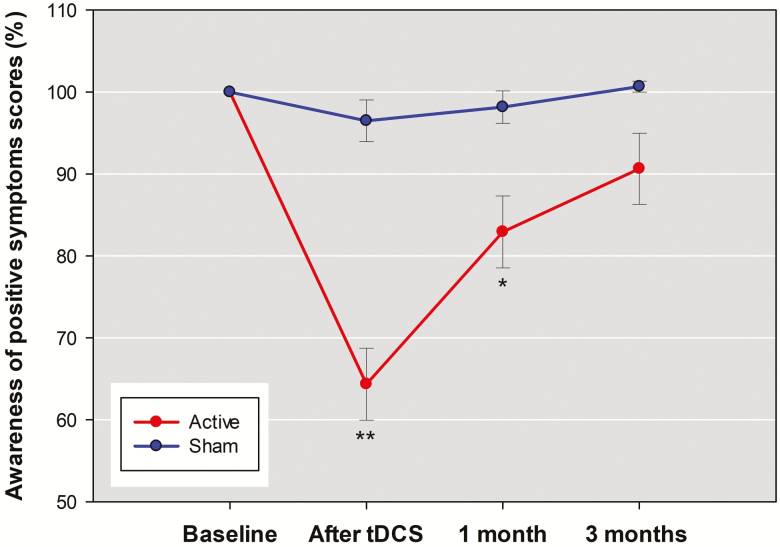
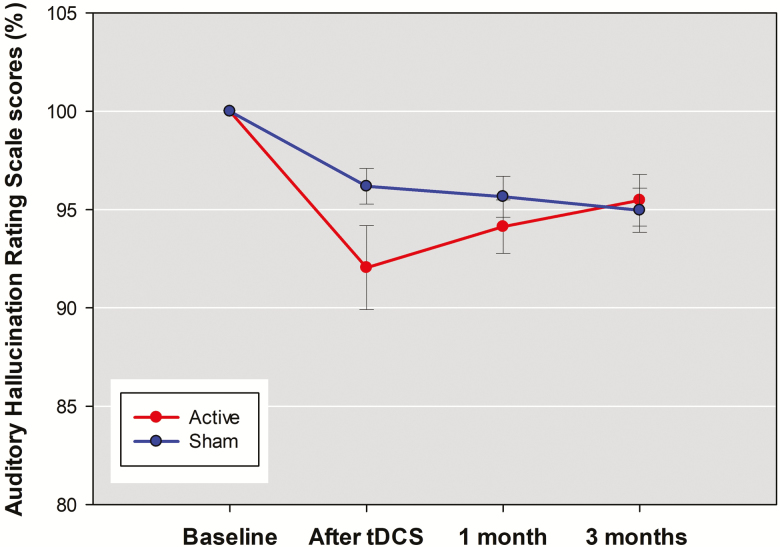
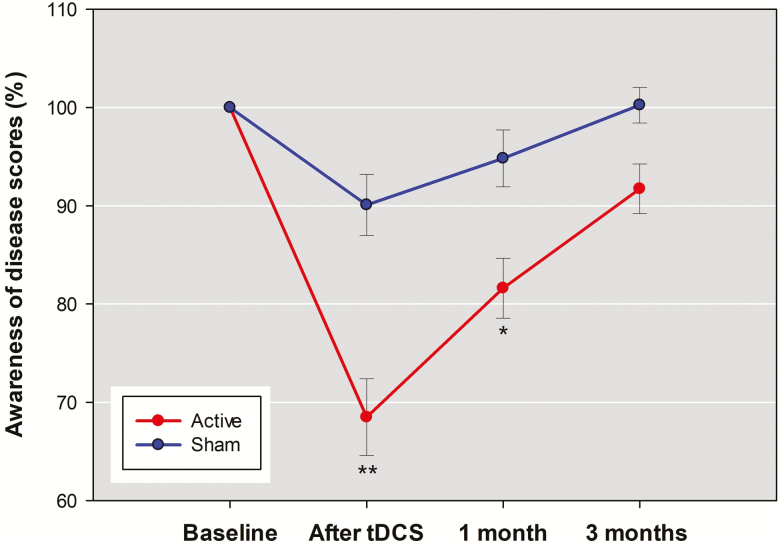
Fronto-temporal transcranial direct current stimulation failed to cause significant changes in the severity of auditory verbal hallucinations and other schizophrenia symptoms. The levels of insight into illness (effect size=0.511, P<.001) and positive symptoms (effect size=0.781, P<.001) were largely promoted by 5 days of transcranial direct current stimulation relative to sham treatment. The beneficial effects on the 2 insight dimensions remained 1 month after transcranial direct current stimulation.
Fronto-temporal transcranial direct current stimulation is not more effective for auditory verbal hallucinations and other schizophrenia symptoms than sham treatment. But the results of transcranial direct current stimulation-associated improvement in awareness of illness and positive symptoms show promise and provide a new direction for future research into insight promotion interventions in schizophrenia.
已有少量临床试验采用小样本量评估了额颞部经颅直流电刺激治疗精神分裂症患者听觉言语幻觉和其他精神病理学症状的疗效,但结果不一。一项开放性先导研究表明,额颞部经颅直流电刺激还可增强患者对自身精神疾病的认识。本研究旨在一项大样本、双盲、随机、假刺激对照试验中,调查额颞部经颅直流电刺激对听觉言语幻觉严重程度、其他精神分裂症症状和认识的治疗效果。
将 60 例药物难治性听觉言语幻觉患者随机分为 2 组:每天 2 次、连续 5 天给予 2 mA 经颅直流电刺激,左前额皮质给予阳极刺激,左颞顶交界处给予阴极刺激,或给予假刺激。
额颞部经颅直流电刺激并未引起听觉言语幻觉和其他精神分裂症症状严重程度的显著变化。对疾病认识(效应量=0.511,P<.001)和阳性症状(效应量=0.781,P<.001)的认识水平在经颅直流电刺激后相对于假刺激有很大提高。经颅直流电刺激后 2 个认识维度的有益作用在刺激后 1 个月仍持续存在。
与假刺激相比,额颞部经颅直流电刺激对听觉言语幻觉和其他精神分裂症症状的疗效并不更好。但经颅直流电刺激相关的疾病意识和阳性症状改善的结果显示出一定的前景,为今后研究精神分裂症认识促进干预措施提供了新方向。