Ropka-Molik K, Stefaniuk-Szmukier M, Piórkowska K, Szmatoła T, Bugno-Poniewierska M
Department of Animal Molecular Biology, National Research Institute of Animal Production, Kraków, Poland.
Laboratory of Genomics, National Research Institute of Animal Production, Krakowska 1, 32-083, Balice, Poland.
BMC Vet Res. 2018 Aug 14;14(1):237. doi: 10.1186/s12917-018-1567-0.
Apoptosis plays an important role in the regulation of healthy tissue growth and development as well as in controlling the maintenance of homeostasis in exercising muscles. During an intensive physical effort, the regulation of cell death by apoptosis results in the replacement of unaccustomed muscle cells by new cells that are better suited to exercise. The aim of this study was to determine the expression of two genes (SH3FR1 and SH3RF2) that control apoptosis in muscle tissues during training periods characterized by different intensities. The gene expression levels were estimated using real-time PCR method in skeletal muscle biopsies collected from 15 Arabian horses (untrained, after an intense gallop phase, and at the end of the racing season). An association study was performed on 250 Arabian horses to assess the effect of the SH3RF2:c.796 T > C (p.Ser266Pro) variant on race performance traits in flat gallop-racing.
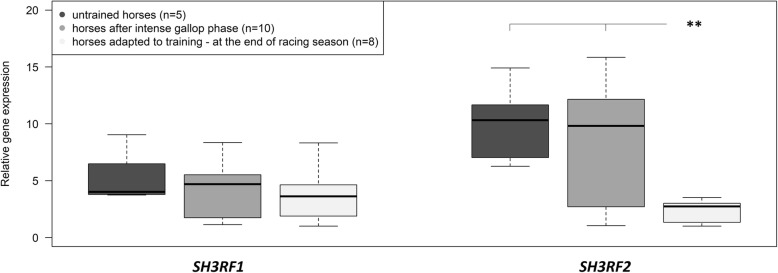
A gene expression analysis confirmed a significant decrease (p < 0.01) in the anti-apoptotic SH3RF2 (POSHER) gene during training periods that differed in intensity. The highest SH3RF2 expression level was detected in the muscles of untrained horses, whereas the lowest expression was identified at the end of the racing season in horses that were fully adapted to the exercise. A non-significant decrease in SH3RF1 gene expression following the training periods was observed. Moreover, a serine substitution by proline at amino acid position 266 (CC genotype) was negatively associated with the probability of winning races, the number of races in which a horse occurred and the financial value of the prizes. Horses with the TT genotype achieved the highest financial benefits, both for total winnings and for winnings per race in which the horses participated.
The present study showed the supposed regulation mechanism of exercise-induced apoptosis in horses at the molecular level. The identified SH3RF2: c.796 T > C missense variant was associated with selected racing performance traits, which is important information during the evaluation of horses' exercise predisposition. The association results and frequencies of the CT and TT genotypes suggest the possibility of using SH3RF2 variant in selection to improve the racing performance of Arabian horses.
细胞凋亡在健康组织的生长发育调节以及运动肌肉内稳态维持的控制中发挥着重要作用。在高强度体力活动期间,通过细胞凋亡对细胞死亡进行调节,会导致不适应运动的肌肉细胞被更适合运动的新细胞所取代。本研究的目的是确定在不同强度训练期间控制肌肉组织细胞凋亡的两个基因(SH3FR1和SH3RF2)的表达情况。采用实时PCR方法对15匹阿拉伯马(未训练、经历激烈疾驰阶段后以及赛季结束时)采集的骨骼肌活检样本中的基因表达水平进行了评估。对250匹阿拉伯马进行了关联研究,以评估SH3RF2:c.796 T>C(p.Ser266Pro)变异对平地赛马比赛成绩性状的影响。
基因表达分析证实,在强度不同的训练期间,抗凋亡的SH3RF2(POSHER)基因显著下降(p<0.01)。在未训练马匹的肌肉中检测到最高的SH3RF2表达水平,而在完全适应运动的马匹赛季结束时,其表达水平最低。训练期后观察到SH3RF1基因表达有不显著的下降。此外,氨基酸位置266处丝氨酸被脯氨酸取代(CC基因型)与获胜概率、参赛马匹所参加比赛的数量以及奖金的经济价值呈负相关。TT基因型的马匹在总奖金和每场参赛奖金方面都获得了最高的经济收益。
本研究在分子水平上展示了运动诱导马匹细胞凋亡的推测调节机制。所鉴定的SH3RF2:c.796 T>C错义变异与选定的比赛成绩性状相关,这在评估马匹运动易感性时是重要信息。CT和TT基因型的关联结果及频率表明,有可能在选育中使用SH3RF2变异来提高阿拉伯马的比赛成绩。