Glueckert Rudolf, Johnson Chacko Lejo, Schmidbauer Dominik, Potrusil Thomas, Pechriggl Elisabeth J, Hoermann Romed, Brenner Erich, Reka Alen, Schrott-Fischer Anneliese, Handschuh Stephan
Department of Otolaryngology, Medical University of Innsbruck, Innsbruck, Austria.
University Clinics Innsbruck, Tirol Kliniken, University Clinic for Ear, Nose and Throat Medicine Innsbruck, Innsbruck, Austria.
Front Neurosci. 2018 Jul 31;12:501. doi: 10.3389/fnins.2018.00501. eCollection 2018.
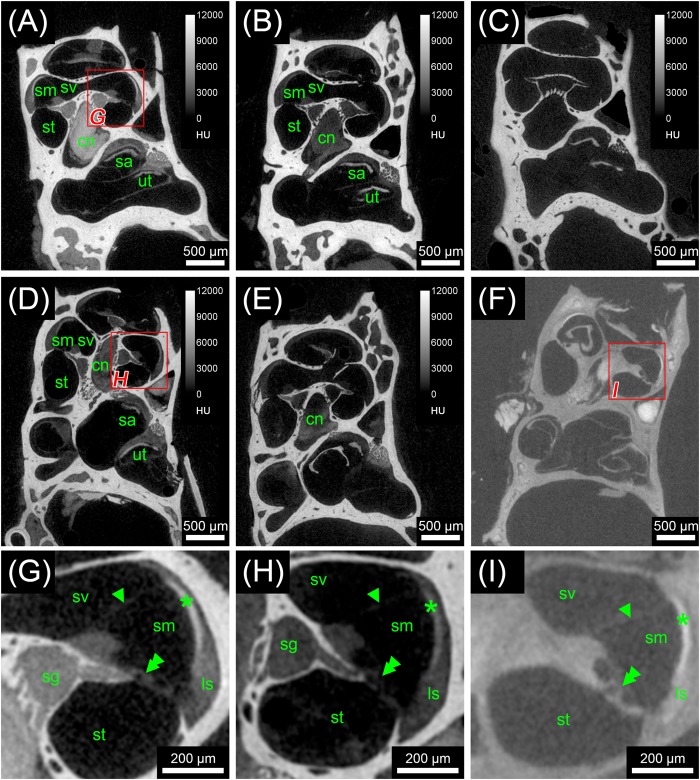
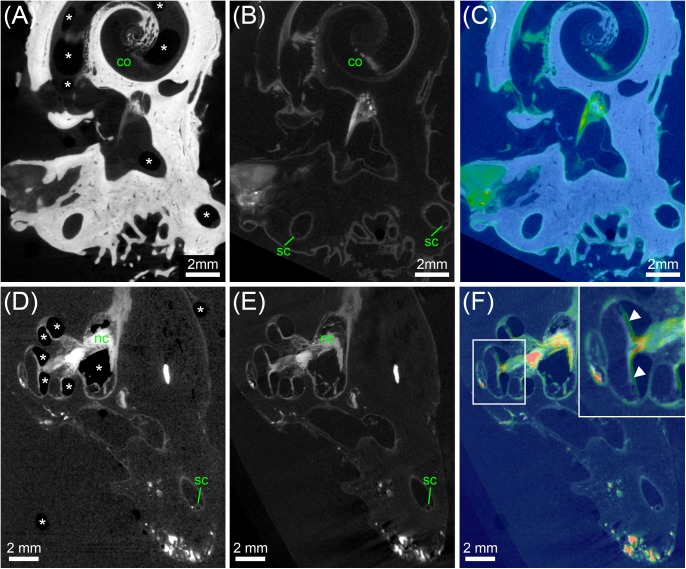
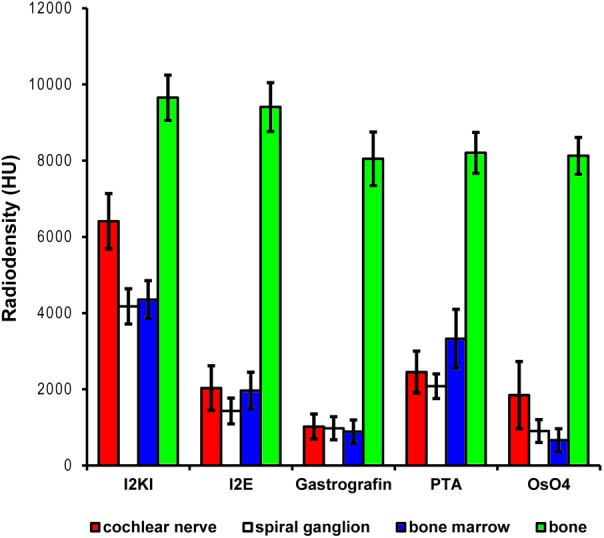
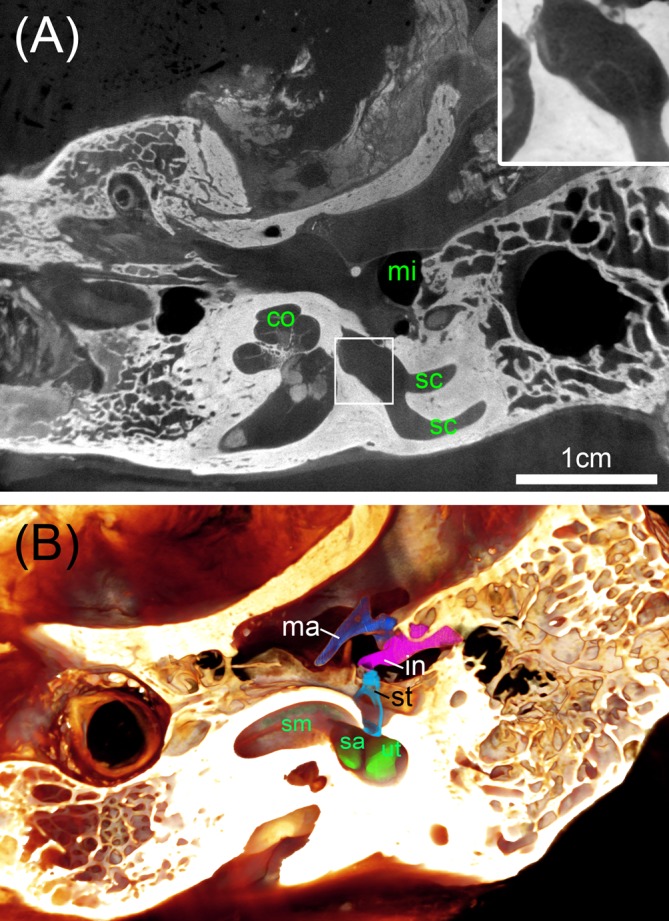
Design and implantation of bionic implants for restoring impaired hair cell function relies on accurate knowledge about the microanatomy and nerve fiber pathways of the human inner ear and its variation. Non-destructive isotropic imaging of soft tissues of the inner ear with lab-based microscopic X-ray computed tomography (microCT) offers high resolution but requires contrast enhancement using compounds with high X-ray attenuation. We evaluated different contrast enhancement techniques in mice, cat, and human temporal bones to differentially visualize the membranous labyrinth, sensory epithelia, and their innervating nerves together with the facial nerve and middle ear. Lugol's iodine potassium iodine (IKI) gave high soft tissue contrast in ossified specimens but failed to provide unambiguous identification of smaller nerve fiber bundles inside small bony canals. Fixation or post-fixation with osmium tetroxide followed by decalcification in EDTA provided superior contrast for nerve fibers and membranous structures. We processed 50 human temporal bones and acquired microCT scans with 15 μm voxel size. Subsequently we segmented sensorineural structures and the endolymphatic compartment for 3D representations to serve for morphometric variation analysis. We tested higher resolution image acquisition down to 3.0 μm voxel size in human and 0.5 μm in mice, which provided a unique level of detail and enabled us to visualize single neurons and hair cells in the mouse inner ear, which could offer an alternative quantitative analysis of cell numbers in smaller animals. Bigger ossified human temporal bones comprising the middle ear and mastoid bone can be contrasted with IKI and imaged in toto at 25 μm voxel size. These data are suitable for surgical planning for electrode prototype placements. A preliminary assessment of geometric changes through tissue processing resulted in 1.6% volume increase caused during decalcification by EDTA and 0.5% volume increase caused by partial dehydration to 70% ethanol, which proved to be the best mounting medium for microCT image acquisition.
用于恢复受损毛细胞功能的仿生植入物的设计与植入依赖于对人类内耳及其变异的微观解剖结构和神经纤维通路的准确了解。基于实验室的微观X射线计算机断层扫描(microCT)对内耳软组织进行无损各向同性成像可提供高分辨率,但需要使用具有高X射线衰减的化合物进行对比增强。我们在小鼠、猫和人类颞骨中评估了不同的对比增强技术,以分别可视化膜迷路、感觉上皮及其支配神经以及面神经和中耳。卢戈氏碘钾碘(IKI)在骨化标本中提供了高软组织对比度,但未能明确识别小骨管内较小的神经纤维束。用四氧化锇固定或后固定,然后在乙二胺四乙酸(EDTA)中脱钙,可为神经纤维和膜结构提供更好的对比度。我们处理了50块人类颞骨,并以15μm的体素大小获取了microCT扫描图像。随后,我们对感觉神经结构和内淋巴腔进行分割以进行三维重建,用于形态计量变异分析。我们测试了更高分辨率的图像采集,人类的体素大小低至3.0μm,小鼠的低至0.5μm,这提供了独特的细节水平,使我们能够在小鼠内耳中可视化单个神经元和毛细胞,这可为较小动物中的细胞数量提供另一种定量分析方法。包含中耳和乳突骨的较大骨化人类颞骨可用IKI进行对比,并以25μm的体素大小进行整体成像。这些数据适用于电极原型放置的手术规划。通过组织处理对几何变化的初步评估表明,EDTA脱钙过程中导致体积增加了1.6%,部分脱水至70%乙醇导致体积增加了0.5%,70%乙醇被证明是microCT图像采集的最佳固定介质。