Sengupta Somoshree, Balla Vamsi K
Bioceramics and Coating Division, CSIR-Central Glass and Ceramic Research Institute, 196 Raja S.C. Mullick Road, Kolkata 700032, India.
Academy of Scientific and Innovative Research (AcSIR), CSIR-Central Glass and Ceramic Research Institute Campus, 196 Raja S.C. Mullick Road, Kolkata 700032, India.
J Adv Res. 2018 Jun 20;14:97-111. doi: 10.1016/j.jare.2018.06.003. eCollection 2018 Nov.
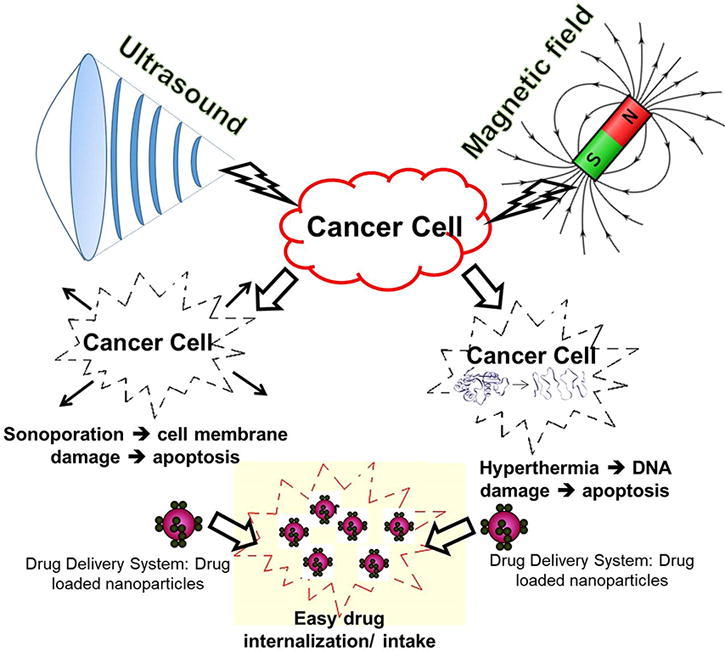
Current popular cancer treatment options, include tumor surgery, chemotherapy, and hormonal treatment. These treatments are often associated with some inherent limitations. For instances, tumor surgery is not effective in mitigating metastases; the anticancer drugs used for chemotherapy can quickly spread throughout the body and is ineffective in killing metastatic cancer cells. Therefore, several drug delivery systems (DDS) have been developed to target tumor cells, and release active biomolecule at specific site to eliminate the side effects of anticancer drugs. However, common challenges of DDS used for cancer treatment, include poor site-specific accumulation, difficulties in entering the tumor microenvironment, poor metastases and treatment efficiency. In this context, non-invasive cancer treatment approaches, with or without DDS, involving the use of light, heat, magnetic field, electrical field and ultrasound appears to be very attractive. These approaches can potentially improve treatment efficiency, reduce recovery time, eliminate infections and scar formation. In this review we focus on the effects of magnetic fields and ultrasound on cancer cells and their application for cancer treatment in the presence of drugs or DDS.
当前流行的癌症治疗选择包括肿瘤手术、化疗和激素治疗。这些治疗方法往往存在一些固有的局限性。例如,肿瘤手术在减轻转移方面效果不佳;用于化疗的抗癌药物会迅速扩散到全身,对杀死转移性癌细胞无效。因此,已经开发了几种药物递送系统(DDS)来靶向肿瘤细胞,并在特定部位释放活性生物分子以消除抗癌药物的副作用。然而,用于癌症治疗的DDS的常见挑战包括特异性位点积累差、进入肿瘤微环境困难、转移和治疗效率低。在这种情况下,无论有无DDS的非侵入性癌症治疗方法,包括使用光、热、磁场、电场和超声波,似乎都非常有吸引力。这些方法有可能提高治疗效率、缩短恢复时间、消除感染和疤痕形成。在这篇综述中,我们重点关注磁场和超声波对癌细胞的影响以及它们在存在药物或DDS的情况下在癌症治疗中的应用。