Sharma Mrityunjay K, Acharya Roopashri B, Shukla Chinmay A, Kulkarni Amol A
Academy of Scientific and Innovative Research (AcSIR), CSIR-National Chemical Laboratory (NCL) Campus, Pune 411008, India.
Chem. Eng. & Proc. Dev. Div., CSIR-National Chemical Laboratory, Dr. Homi Bhaba Road, Pashan, Pune 411008, India.
Beilstein J Org Chem. 2018 Jul 26;14:1917-1936. doi: 10.3762/bjoc.14.166. eCollection 2018.
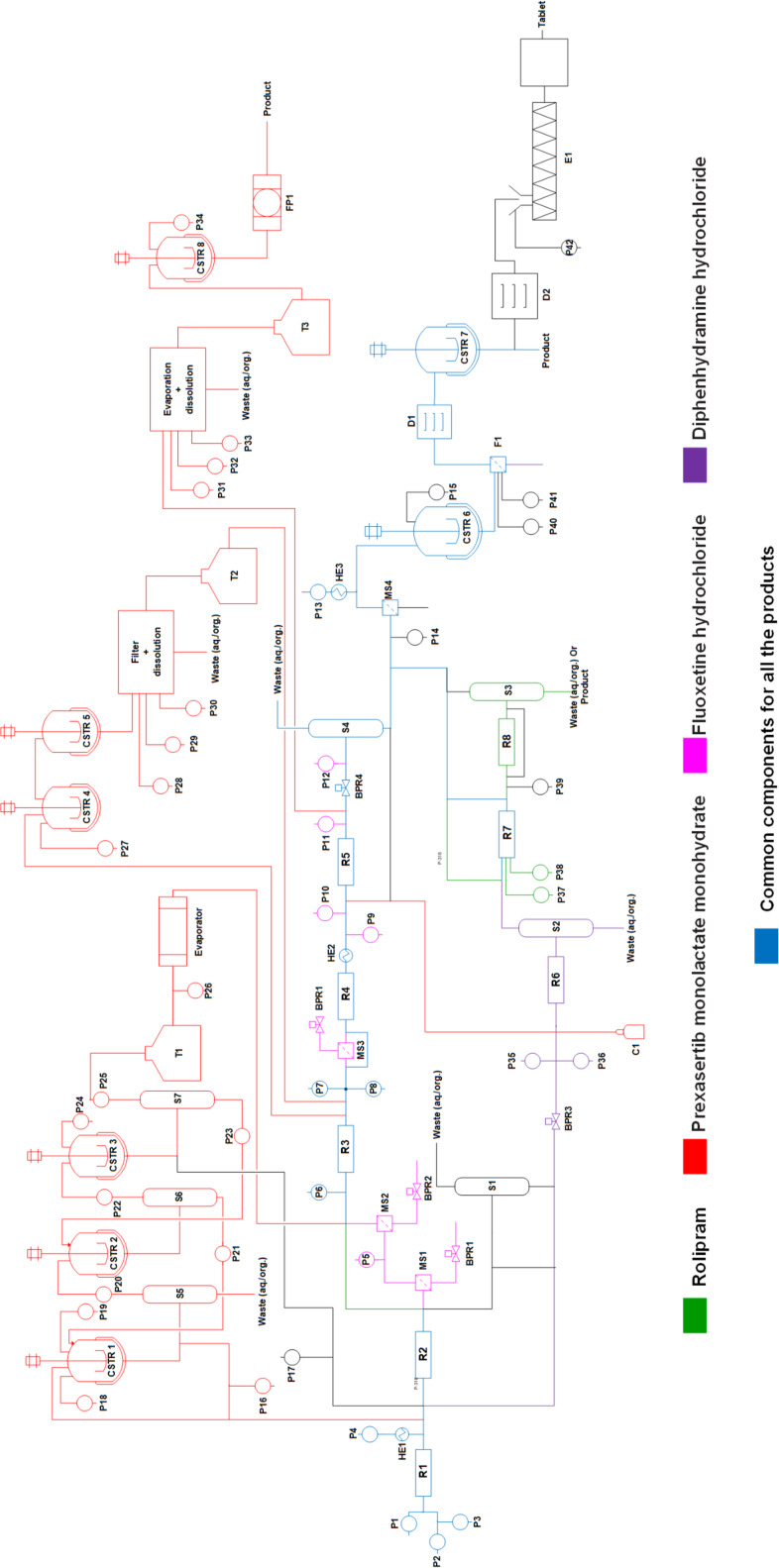
The multistep flow synthesis of complex molecules has gained momentum over the last few years. A wide range of reaction types and conditions have been integrated seamlessly on a single platform including in-line separation as well as monitoring. Beyond merely getting considered as 'flow version' of conventional 'one-pot synthesis', multistep flow synthesis has become the next generation tool for creating libraries of new molecules. Here we give a more 'engineering' look at the possibility of developing a 'unified multistep flow synthesis platform'. A detailed analysis of various scenarios is presented considering 4 different classes of drugs already reported in the literature. The possible complexities that an automated and controlled platform needs to handle are also discussed in detail. Three different design approaches are proposed: (i) one molecule at a time, (ii) many molecules at a time and (iii) cybernetic approach. Each approach would lead to the effortless integration of different synthesis stages and also at different synthesis scales. While one may expect such a platform to operate like a 'driverless car' or a 'robo chemist' or a 'transformer', in reality, such an envisaged system would be much more complex than these examples.
在过去几年中,复杂分子的多步流动合成发展势头迅猛。包括在线分离和监测在内的多种反应类型及条件已在单一平台上无缝整合。多步流动合成已不仅仅被视为传统“一锅法合成”的“流动版本”,它已成为创建新分子库的下一代工具。在此,我们从更“工程学”的角度审视开发一个“统一多步流动合成平台”的可能性。针对文献中已报道的4类不同药物,对各种情况进行了详细分析。还详细讨论了自动化和可控平台需要处理的可能复杂性。提出了三种不同的设计方法:(i)一次一个分子,(ii)一次多个分子,以及(iii)控制论方法。每种方法都将实现不同合成阶段以及不同合成规模的轻松整合。虽然人们可能期望这样一个平台能像“无人驾驶汽车”“机器人化学家”或“变形金刚”那样运行,但实际上,这样一个设想的系统要比这些例子复杂得多。