Military Institution of Hepatopancreatobiliary Surgery, Second Department of Hepatopancreatobiliary Surgery, Chinese People's Liberation Army (PLA) General Hospital, 28 Fuxing Road, Beijing, 100853, China.
Department of Urology, Chinese People's Liberation Army (PLA) General Hospital, 28 Fuxing Road, Beijing, 100853, China.
World J Surg Oncol. 2018 Aug 16;16(1):171. doi: 10.1186/s12957-018-1468-5.
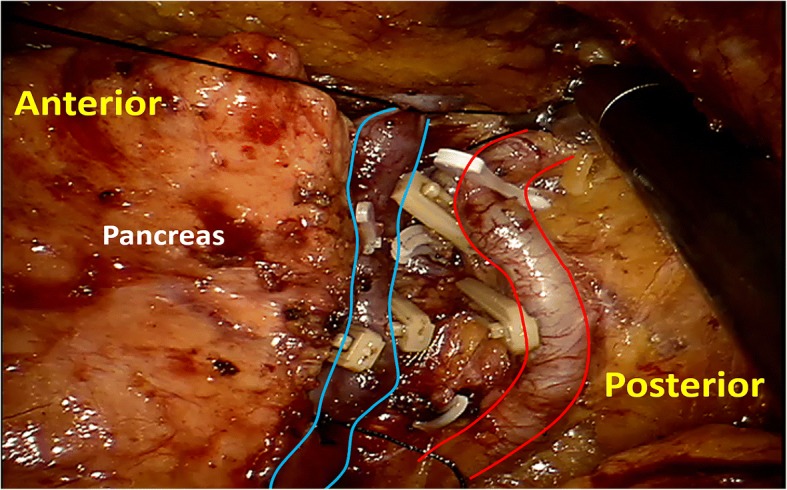
Retroperitoneoscopic surgery has shown advantages in urological surgery. However, its application in pancreatic surgery for neoplasm is rare. Robotic surgical system with its magnified view and flexible instruments may provide a superior alternative to conventional laparoscopic system in retroperitoneoscopic surgery. We aimed to evaluate the safety, feasibility, and short-term outcomes in a series of patients treated by robotic retroperitoneoscopic pancreatic surgery.
Between March 2016 and May 2016, four patients with solitary pancreatic neuroendocrine neoplasms were treated with robotic retroperitoneoscopic surgery. Prospective collected clinical data were retrospectively analyzed. Three patients underwent distal pancreatectomy (one combined with resection of left adrenal adenoma), and one patient enucleation. The mean operative time was 80 min (range 30-110 min). The estimated blood loss was insignificant. There was no conversion to open procedure. The mean postoperative hospital stay was 5.25 days (range 4-6 days). The mean tumor size was 1.375 cm (range 1.0-1.8 cm) in diameter. All patients' blood glucose level returned to normal range within 1 week postoperatively. Two patients had pancreatic biochemical leak. No patients underwent subsequent treatment, and no recurrence occurred during the 12-month follow-up period.
This study preliminarily indicates that robotic retroperitoneoscopic pancreatic surgery is safe and feasible for neoplasms in the dorsal portion of distal pancreas in selected patients, with some potential advantages of straightforward access, simple and fine manipulation, short operative time, and fast recovery.
后腹腔镜手术在泌尿外科手术中显示出优势。然而,其在胰腺肿瘤外科中的应用较为少见。机器人手术系统具有放大的视野和灵活的器械,可能为后腹腔镜手术提供优于传统腹腔镜系统的选择。我们旨在评估一系列接受机器人后腹腔镜胰腺手术治疗的患者的安全性、可行性和短期结果。
2016 年 3 月至 2016 年 5 月,4 例单发胰腺神经内分泌肿瘤患者接受了机器人后腹腔镜手术治疗。回顾性分析了前瞻性收集的临床资料。3 例患者接受了胰体尾切除术(1 例合并左肾上腺腺瘤切除术),1 例患者接受了肿瘤剜除术。手术时间平均为 80 分钟(范围 30-110 分钟)。估计出血量微不足道。无中转开腹。术后平均住院时间为 5.25 天(范围 4-6 天)。肿瘤平均直径为 1.375 厘米(范围 1.0-1.8 厘米)。所有患者术后 1 周内血糖水平均恢复正常。2 例患者出现胰周生化漏。无患者接受后续治疗,在 12 个月的随访期间无复发。
本研究初步表明,机器人后腹腔镜胰腺手术对于选择的远端胰腺背部肿瘤是安全且可行的,具有直接入路、操作简单精细、手术时间短、恢复快等潜在优势。