Morgenstern M, Vallejo A, McNally M A, Moriarty T F, Ferguson J Y, Nijs S, Metsemakers W J
Department of Orthopaedic Surgery and Traumatology, University Hospital Basel, Basel, Switzerland.
Orthopaedic and Traumatology Department, Clinica Leon Trece, Universidad Pontificia Bolivariana, Medellin, Columbia and AO Research Institute, Davos, Switzerland.
Bone Joint Res. 2018 Aug 4;7(7):447-456. doi: 10.1302/2046-3758.77.BJR-2018-0043.R1. eCollection 2018 Jul.
As well as debridement and irrigation, soft-tissue coverage, and osseous stabilization, systemic antibiotic prophylaxis is considered the benchmark in the management of open fractures and considerably reduces the risk of subsequent fracture-related infections (FRI). The direct application of antibiotics in the surgical field (local antibiotics) has been used for decades as additional prophylaxis in open fractures, although definitive evidence confirming a beneficial effect is scarce. The purpose of the present study was to review the clinical evidence regarding the effect of prophylactic application of local antibiotics in open limb fractures.
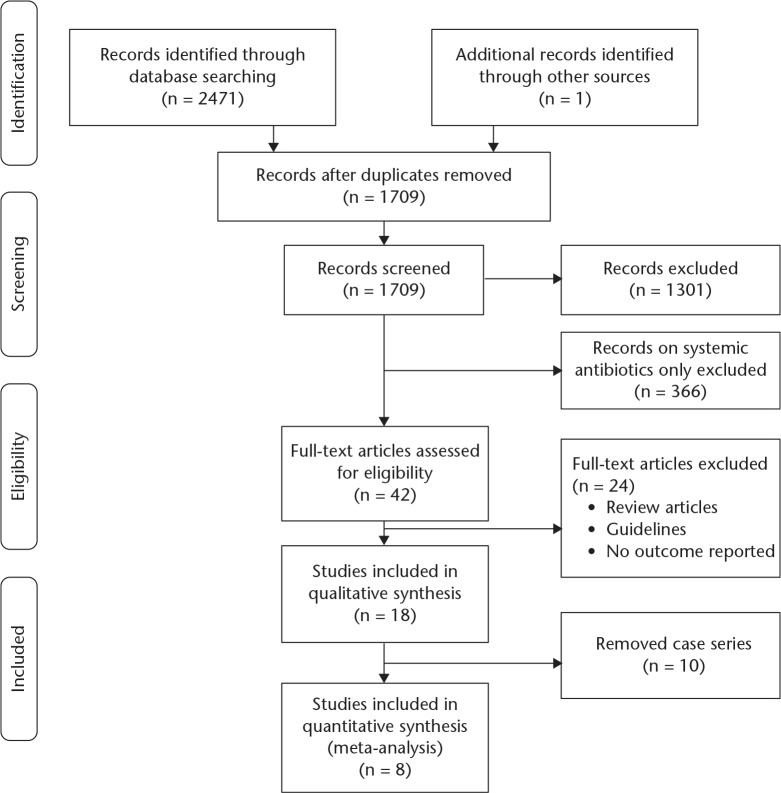
A comprehensive literature search was performed in PubMed, Web of Science, and Embase. Cohort studies investigating the effect of additional local antibiotic prophylaxis compared with systemic prophylaxis alone in the management of open fractures were included and the data were pooled in a meta-analysis.
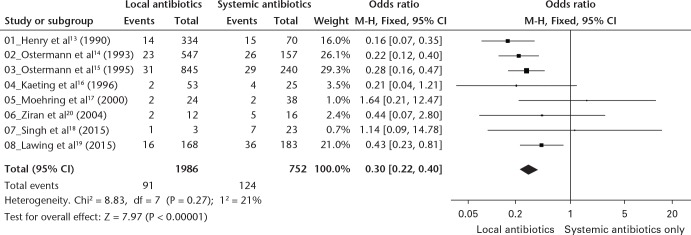
In total, eight studies which included 2738 patients were eligible for quantitative synthesis. The effect of antibiotic-loaded poly(methyl methacrylate) beads was investigated by six of these studies, and two studies evaluated the effect of local antibiotics applied without a carrier. Meta-analysis showed a significantly lower infection rate when local antibiotics were applied (4.6%; 91/1986) than in the control group receiving standard systemic prophylaxis alone (16.5%; 124/752) (p < 0.001) (odds ratio 0.30; 95% confidence interval 0.22 to 0.40).
This meta-analysis suggests a risk reduction in FRI of 11.9% if additional local antibiotics are given prophylactically for open limb fractures. However, due to limited quality, heterogeneity, and considerable risk of bias, the pooling of data from primary studies has to be interpreted with caution.: M. Morgenstern, A. Vallejo, M. A. McNally, T. F. Moriarty, J. Y. Ferguson, S. Nijs, WJ. Metsemakers. 2018;7:447-456. The effect of local antibiotic prophylaxis when treating open limb fractures: A systematic review and meta-analysis. DOI: 10.1302/2046-3758.77.BJR-2018-0043.R1.
除清创、冲洗、软组织覆盖及骨稳定外,全身抗生素预防被视为开放性骨折治疗的基准,且能显著降低后续骨折相关感染(FRI)的风险。尽管确凿证据证实其有益效果的并不多,但在手术区域直接应用抗生素(局部抗生素)作为开放性骨折的额外预防措施已使用数十年。本研究的目的是回顾关于预防性应用局部抗生素对开放性四肢骨折影响的临床证据。
在PubMed、科学网和Embase进行了全面的文献检索。纳入了调查在开放性骨折治疗中与单纯全身预防相比额外局部抗生素预防效果的队列研究,并将数据汇总进行荟萃分析。
共有八项研究(涉及2738例患者)符合定量综合分析的条件。其中六项研究调查了载抗生素的聚甲基丙烯酸甲酯珠的效果,两项研究评估了无载体应用局部抗生素的效果。荟萃分析显示,应用局部抗生素时的感染率(4.6%;91/1986)显著低于仅接受标准全身预防的对照组(16.5%;124/752)(p<0.001)(比值比0.30;95%置信区间0.22至0.40)。
这项荟萃分析表明,如果对开放性四肢骨折预防性给予额外的局部抗生素,FRI风险可降低11.9%。然而,由于质量有限、存在异质性且偏倚风险较大,对来自原始研究的数据汇总必须谨慎解读。:M. 摩根施特恩、A. 巴列霍、M. A. 麦克纳利、T. F. 莫里亚蒂、J. Y. 弗格森、S. 尼伊斯、WJ. 梅茨梅克斯。2018年;7:447 - 456。治疗开放性四肢骨折时局部抗生素预防的效果:一项系统评价和荟萃分析。DOI: 10.1302/2046 - 3758.77.BJR - 2018 - 0043.R1。