Beaty Roger E, Seli Paul, Schacter Daniel L
Department of Psychology, Pennsylvania State University, 140 Moore Building, University Park, PA, 16801, USA.
Department of Psychology and Neuroscience, Duke University, Durham, USA.
Psychol Res. 2019 Jun;83(4):805-816. doi: 10.1007/s00426-018-1075-7. Epub 2018 Aug 20.
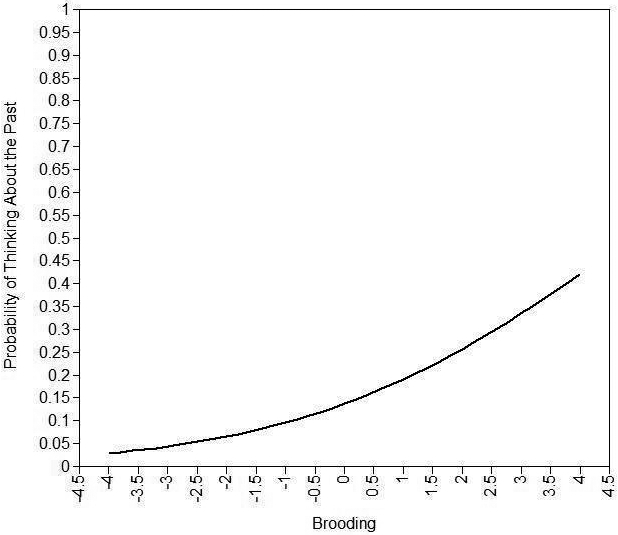
Remembering the past and imagining the future are hallmarks of mental time travel. We provide evidence that such experiences are influenced by individual differences in temporal and affective biases in cognitive style, particularly brooding rumination (a negative past-oriented bias) and optimism (a positive future-oriented bias). Participants completed a 7-day, cellphone-based experience-sampling study of temporal orientation and mental imagery. Multilevel models showed that individual differences in brooding rumination predicted less vivid and positive past- and future-oriented thoughts, even after controlling for depressed mood. People high in brooding rumination were also more likely to report thinking about a past experience when probed at random during the day. Conversely, optimists were more likely to report more vivid and positive future-oriented, but not past-oriented thoughts, although they did not report thinking more or less often about the past and future. The results suggest that temporal and affective biases in cognitive style influence how people think about the past and future in daily life.
回忆过去和想象未来是心理时间旅行的标志。我们提供的证据表明,此类体验会受到认知风格中时间和情感偏差方面个体差异的影响,尤其是沉思反刍(一种消极的面向过去的偏差)和乐观主义(一种积极的面向未来的偏差)。参与者完成了一项为期7天、基于手机的关于时间取向和心理意象的经验抽样研究。多层次模型显示,即使在控制了抑郁情绪之后,沉思反刍方面的个体差异仍预示着过去和未来导向的想法不那么生动和积极。沉思反刍程度高的人在白天被随机询问时,也更有可能报告正在思考过去的经历。相反,乐观主义者更有可能报告更生动、积极的未来导向的想法,但不是过去导向的想法,尽管他们并未报告对过去和未来的思考频率是更高还是更低。结果表明,认知风格中的时间和情感偏差会影响人们在日常生活中对过去和未来的思考方式。