Emerg Infect Dis. 2018 Sep;24(9):1642-1648. doi: 10.3201/eid2409.171709.
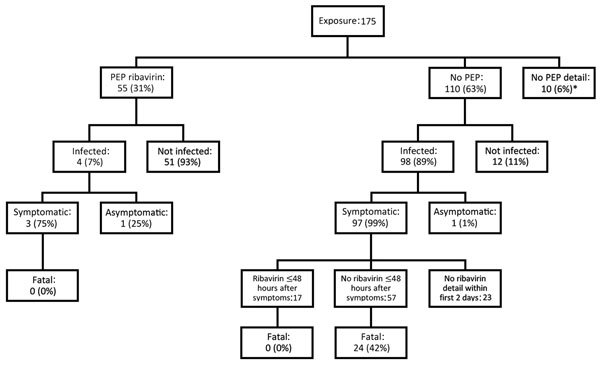
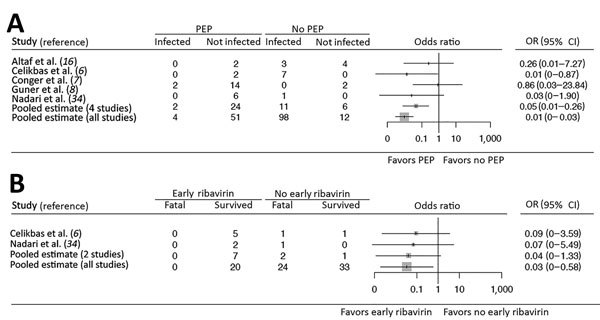
We performed a systematic review and meta-analysis on the effectiveness of ribavirin use for the prevention of infection and death of healthcare workers exposed to patients with Crimean-Congo hemorrhagic fever virus (CCHFV) infection. Splashes with blood or bodily fluids (odds ratio [OR] 4.2), being a nurse or physician (OR 2.1), and treating patients who died from CCHFV infection (OR 3.8) were associated with healthcare workers acquiring CCHFV infection; 7% of the workers who received postexposure prophylaxis (PEP) with ribavirin and 89% of those who did not became infected. PEP with ribavirin reduced the odds of infection (OR 0.01, 95% CI 0-0.03), and ribavirin use <48 hours after symptom onset reduced the odds of death (OR 0.03, 95% CI 0-0.58). The odds of death increased 2.4-fold every day without ribavirin treatment. Ribavirin should be recommended as PEP and early treatment for workers at medium-to-high risk for CCHFV infection.
我们对利巴韦林用于预防接触克里米亚-刚果出血热病毒(CCHFV)感染患者的医护人员感染和死亡的效果进行了系统评价和荟萃分析。医护人员接触血液或体液飞溅(比值比[OR]4.2)、护士或医生(OR 2.1)以及治疗死于 CCHFV 感染的患者(OR 3.8)与医护人员感染 CCHFV 相关;接受利巴韦林暴露后预防(PEP)的医护人员中 7%感染,而未接受 PEP 的医护人员中 89%感染。利巴韦林 PEP 降低了感染的几率(OR 0.01,95%CI 0-0.03),并且在症状出现后 48 小时内使用利巴韦林降低了死亡的几率(OR 0.03,95%CI 0-0.58)。没有接受利巴韦林治疗的情况下,每天的死亡风险增加 2.4 倍。应推荐利巴韦林作为医护人员接触 CCHFV 感染的中高危人群的 PEP 和早期治疗药物。