Sun PengMing, Mao XiaoDan, Gao Min, Huang MeiMei, Chen LiLi, Ruan GuanYu, Huang WeiYi, Braicu Elena Ioana, Sehouli Jalid
Laboratory of Gynecologic Oncology, Fujian Provincial Maternity and Children's Hospital, Affiliated Hospital of Fujian Medical University, Fuzhou 350001, People's Republic of China,
Department of Gynecology Oncology, Beijing Cancer Hospital, Beijing 100142, People's Republic of China.
Cancer Manag Res. 2018 Aug 10;10:2521-2535. doi: 10.2147/CMAR.S168043. eCollection 2018.
To explore the targeted therapy of estrogen-related receptor α (ERRα) in endometrial cancer (EC) cells and its potential mechanisms.
The mRNA and protein expression levels of ERRα and estrogen receptor α (ERα) were detected by qPCR and Western blotting in RL-952, AN3-CA, HEC-1A, and HEC-1B EC cell lines. After treatment with the ERRα-specific antagonist XCT790 or infection with lentivirus-mediated small interfering RNA (siRNA) targeting the ERRα (siRNA-ERRα), cell proliferation and apoptosis were evaluated by MTS assay and flow cytometry. After treatment with siRNA-ERRα, the expression profiles of transcription factors (TFs) were analyzed by protein/DNA arrays in EC cells.
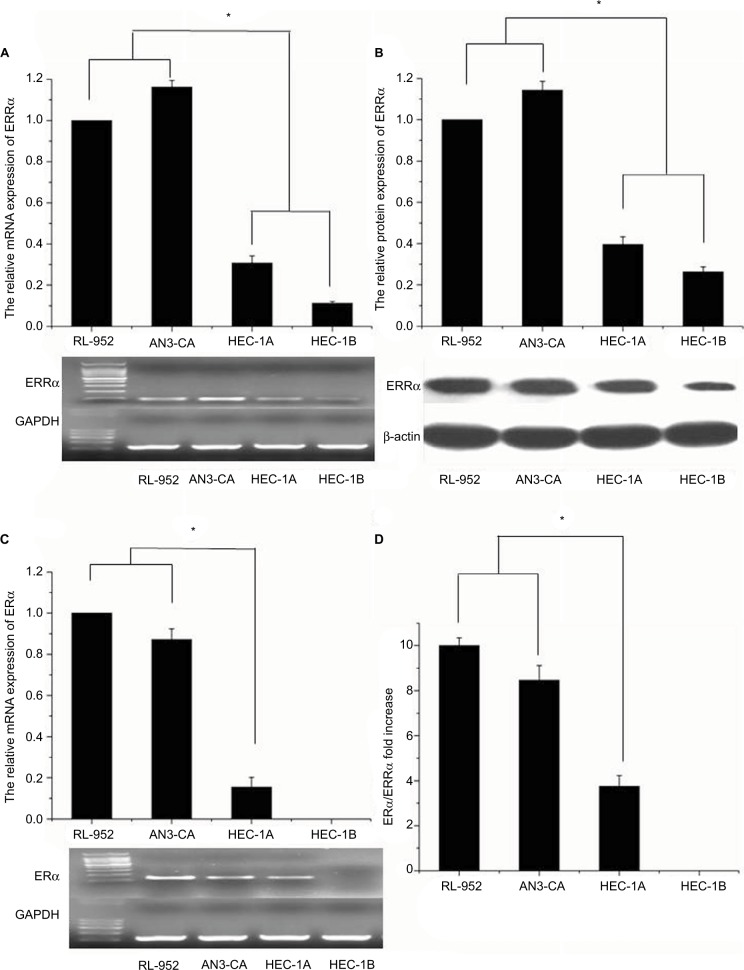
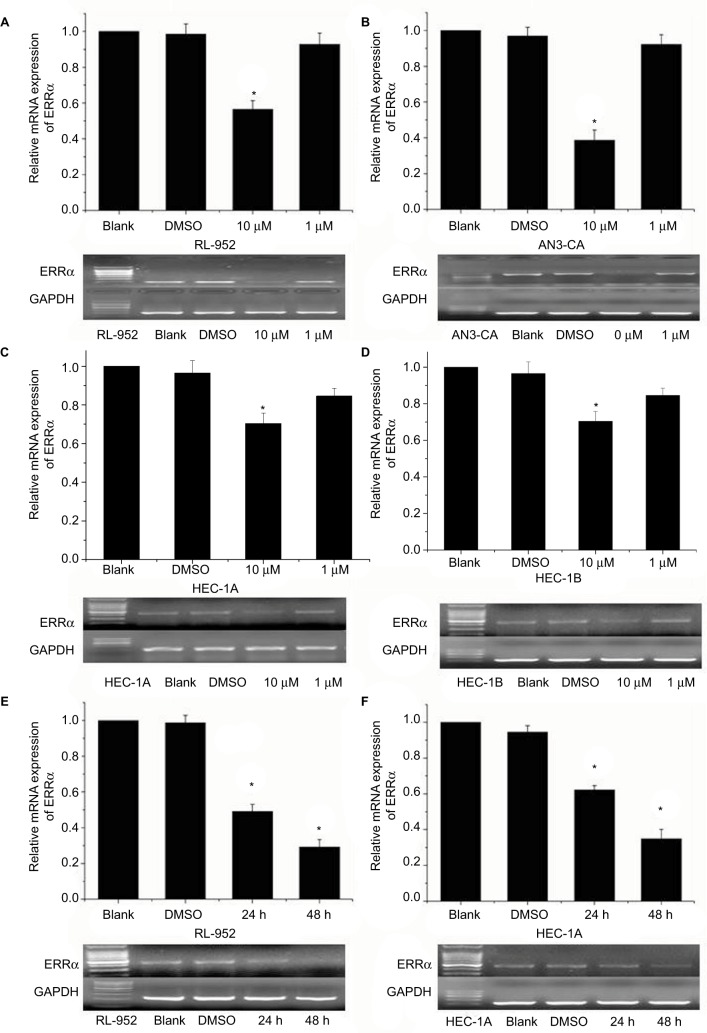
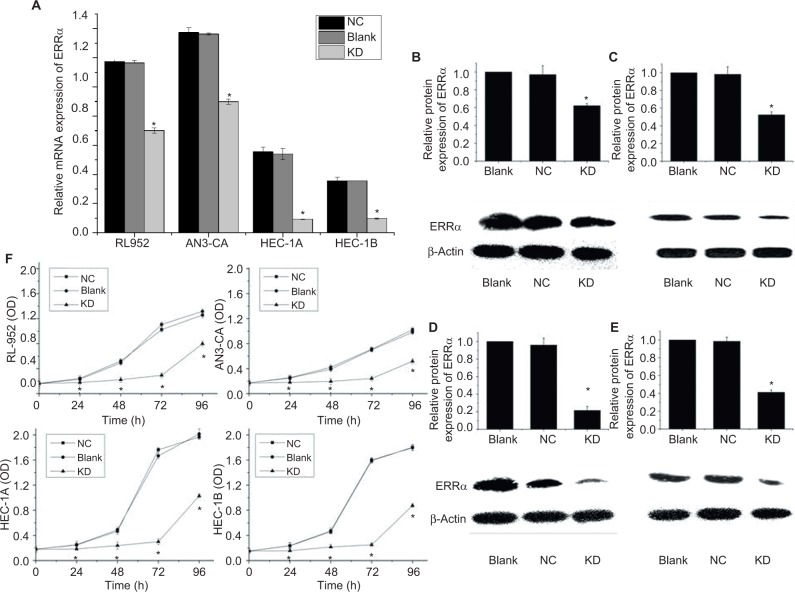
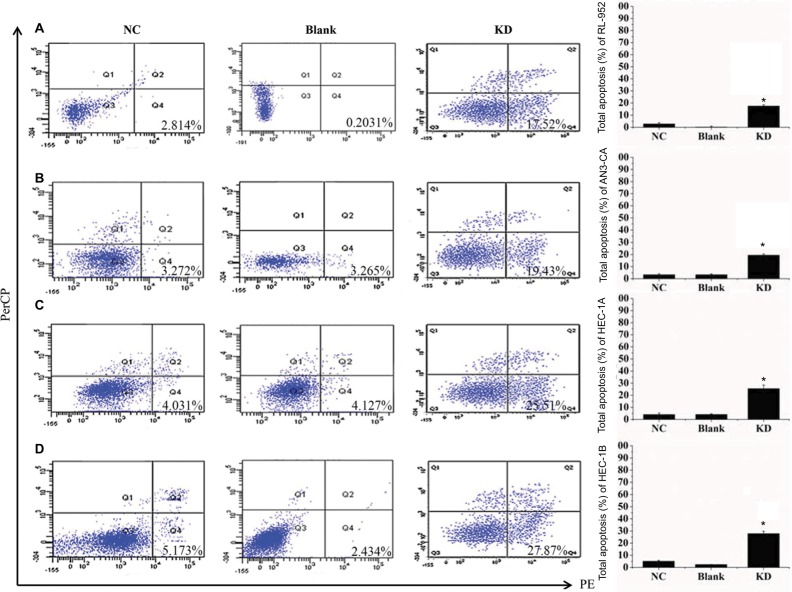
The relative mRNA levels of in RL-952 (1±0.0831) and AN3-CA (1.162±0.0325) were significantly higher than those in HEC-1A (0.3081±0.0339) and HEC-1B (0.1119±0.0091) (<0.05), and similar results were observed for ERRα protein levels. A higher ratio of was observed in ERα-positive RL-952 (10-fold) and ANC-3A (8.5-fold) cells, whereas a lower ratio was observed in ERα-negative HEC-1A (3.75-fold) and HEC-1B cells (0-fold). Both - exogenous XCT790 and endogenous siRNA-ERRα - can decrease the expression of ERRα, thereby inhibiting proliferation but promoting apoptosis in both ERα-positive and -negative EC cells. The XCT790 presented higher proliferation-inhibition and apoptosis rates in the ERα-positive than ERα-negative cells, whereas the siRNA-ERRα exhibited higher proliferation-inhibition and apoptosis rates in the ERα-negative than in ERα-positive cells. In total, 3 upregulated and 17 downregulated TFs were screened out by knocked-down expression of ERRα in all EC cells. Among them, the upregulated TFs organic cation transporter 3/4(Oct3/4), hepatic nuclear factor 4 (HNF4), HNF4 and chicken ovalbumin upstream TF (COUP-TF) as well as downregulated transcription factor EB (TFEB) were found to be statistically significant (<0.05).
Targeting ERRα provides a promising novel endocrine therapeutic strategy.
探讨雌激素相关受体α(ERRα)在子宫内膜癌(EC)细胞中的靶向治疗及其潜在机制。
采用qPCR和蛋白质免疫印迹法检测RL-952、AN3-CA、HEC-1A和HEC-1B EC细胞系中ERRα和雌激素受体α(ERα)的mRNA和蛋白表达水平。用ERRα特异性拮抗剂XCT790处理或用慢病毒介导的靶向ERRα的小干扰RNA(siRNA-ERRα)感染后,通过MTS法和流式细胞术评估细胞增殖和凋亡。用siRNA-ERRα处理后,通过蛋白质/DNA阵列分析EC细胞中转录因子(TFs)的表达谱。
RL-952(1±0.0831)和AN3-CA(1.162±0.0325)中ERRα的相对mRNA水平显著高于HEC-1A(0.3081±0.0339)和HEC-1B(0.1119±0.0091)(P<0.05),ERRα蛋白水平也有类似结果。在ERα阳性的RL-952(10倍)和ANC-3A(8.5倍)细胞中观察到较高的ERRα/ERα比值,而在ERα阴性的HEC-1A(3.75倍)和HEC-1B细胞(0倍)中观察到较低的比值。外源性XCT790和内源性siRNA-ERRα均可降低ERRα的表达,从而抑制ERα阳性和阴性EC细胞的增殖,但促进其凋亡。XCT790在ERα阳性细胞中的增殖抑制率和凋亡率高于ERα阴性细胞,而siRNA-ERRα在ERα阴性细胞中的增殖抑制率和凋亡率高于ERα阳性细胞。通过敲低所有EC细胞中ERRα的表达,共筛选出3个上调和17个下调的TFs。其中,上调的TFs有机阳离子转运体3/4(Oct3/4)、肝细胞核因子4(HNF4)、HNF4和鸡卵清蛋白上游TF(COUP-TF)以及下调的转录因子EB(TFEB)具有统计学意义(P<0.05)。
靶向ERRα提供了一种有前景的新型内分泌治疗策略。