Department of Dermatology, Children's Hospital of Chongqing Medical University, Chongqing, 400014, China.
Ministry of Education Key Laboratory of Child Development and Disorders, Chongqing, 400014, China.
Mol Med. 2018 Jun 5;24(1):28. doi: 10.1186/s10020-018-0025-6.
Chronic autoimmune urticaria (CAU) is a common skin disease and remains unclear understanding of pathogenesis in the vast majority of cases. In order to explore a new therapy for CAU, the current study was performed to investigate the possible functioning of the Oncostatin M receptor (OSMR) gene in the autoimmunity of CAU via regulation of the JAK/STAT3 signaling pathway.
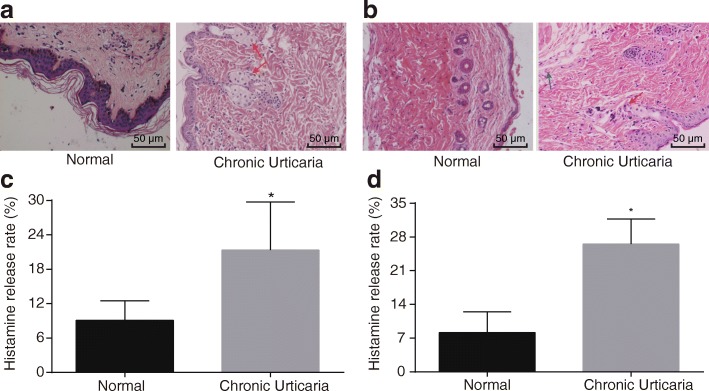
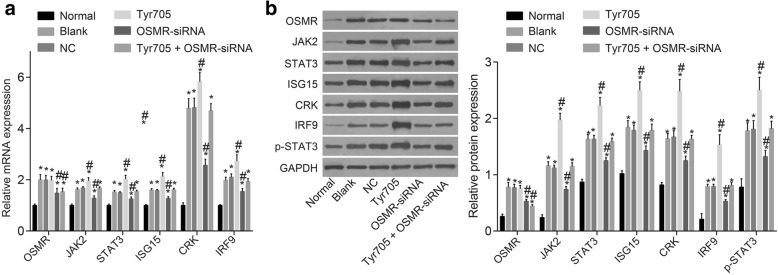
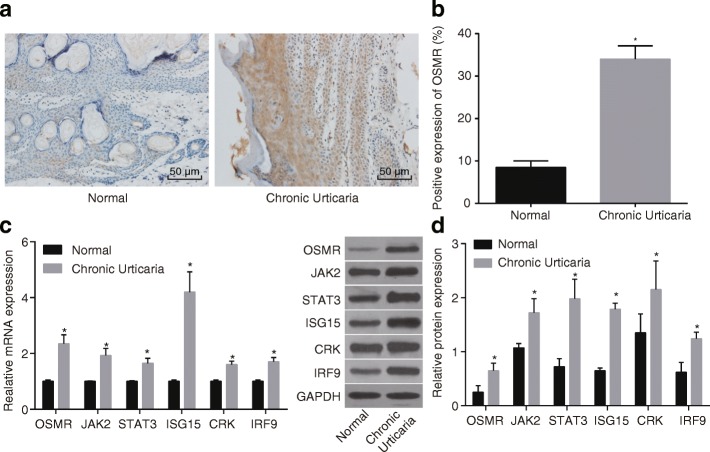
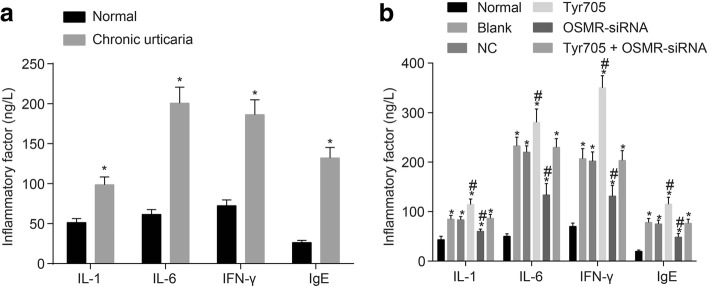
CAU skin tissues from 24 CAU patients and normal skin tissues from normal subjects were collected. Hematoxylin-eosin (HE) staining was conducted to count eosinophils, and immunohistochemistry was carried out to detect the positive rate of OSMR expression in two kinds of skin tissues. A total of 72 Kunming (KM) mice were selected, and 60 mice were used for establishing CAU models and later transfected with different plasmids. The expression of inflammatory factors was evaluated by enzyme-linked immunosorbent assays (ELISA). Expressions of janus kinase (JAK), signal transducer and activator of transcription 3 (STAT3), interferon-stimulated gene 15 (ISG15), CT10-regulated kinase (CRK), and interferon regulatory factor 9 (IRF9) were identified using Western blot assay and reverse transcription quantitative polymerase chain reaction (RT-qPCR). Epithelial cell proliferation was assessed by 3-[4,5-dimethylthiazol-2-yl]-2,5-diphenyl tetrazolium bromide (MTT) assay, and cell cycle distribution and cell apoptosis were assessed using flow cytometry.
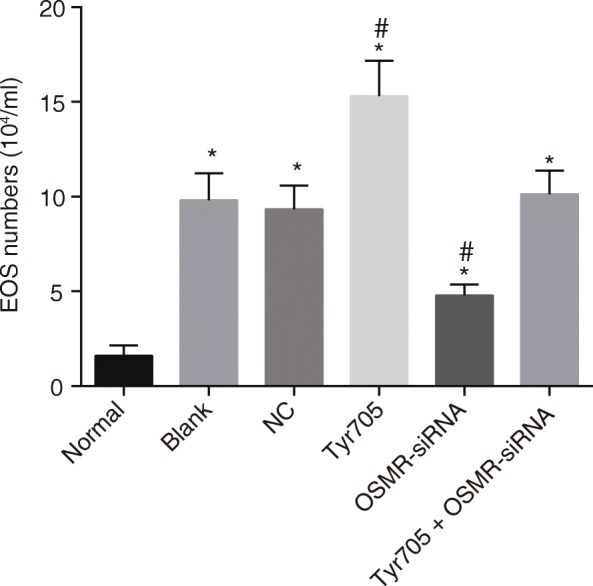
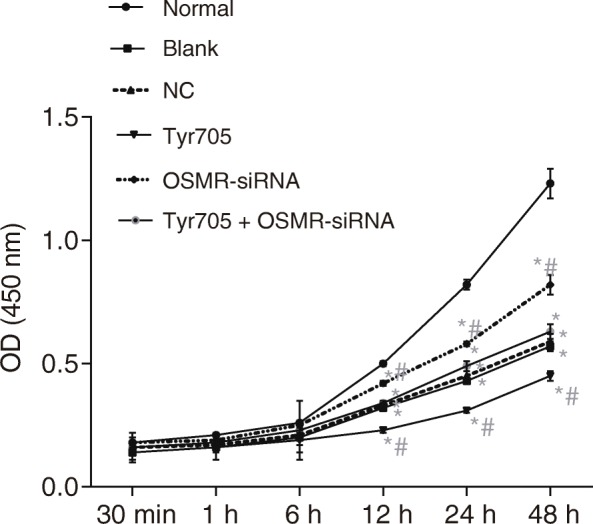
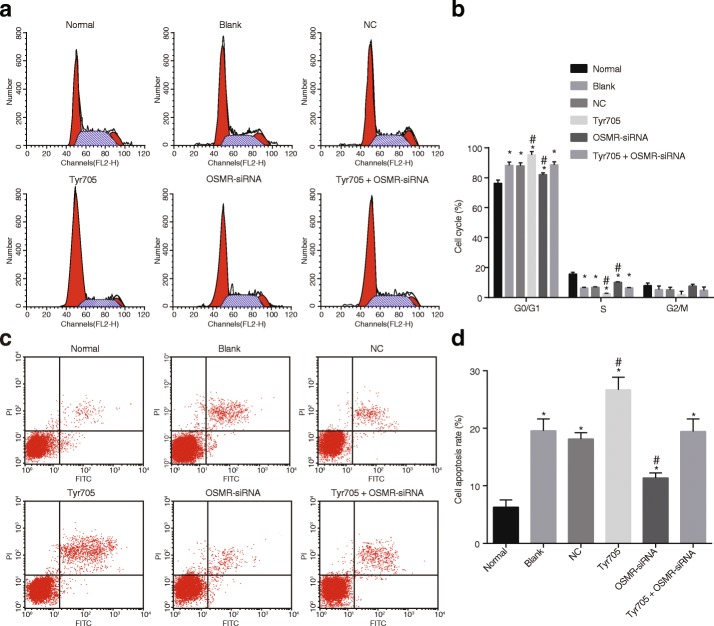
The findings confirm that OSMR protein expression and histamine release rate are highly elevated in human CAU skin tissues, and the expression of the JAK/STAT3 signaling pathway-related genes (OSMR, JAK2, STAT3, ISG15, CRK and IRF9) was up-regulated. OSMR gene silencing in CAU mice significantly decreases the content of inflammatory factors (IL-1, IL-6, IFN-γ, and IgE), the number of eosinophils, and reduces the expression of the JAK/STAT3 signaling pathway related genes, and further enhances cell proliferation, promotes cell cycle entry and inhibits apoptosis of epithelial cells.
All aforementioned results indicate that OSMR gene silencing inhibits the activation of the JAK/STAT3 signaling pathway, thereby suppressing the development of CAU.
慢性自身免疫性荨麻疹(CAU)是一种常见的皮肤病,在绝大多数情况下,其发病机制仍不清楚。为了探索 CAU 的新疗法,本研究通过调节 JAK/STAT3 信号通路,研究了 Oncostatin M 受体(OSMR)基因在 CAU 自身免疫中的可能作用。
收集 24 例 CAU 患者的 CAU 皮肤组织和正常对照者的正常皮肤组织,行苏木精-伊红(HE)染色计数嗜酸性粒细胞,免疫组织化学法检测两种皮肤组织中 OSMR 表达的阳性率。选取 72 只昆明(KM)小鼠,其中 60 只用于建立 CAU 模型,然后转染不同质粒。采用酶联免疫吸附试验(ELISA)评估炎症因子的表达。采用 Western blot 法和逆转录定量聚合酶链反应(RT-qPCR)检测 Janus 激酶(JAK)、信号转导和转录激活因子 3(STAT3)、干扰素刺激基因 15(ISG15)、CT10 调节激酶(CRK)和干扰素调节因子 9(IRF9)的表达。采用 3-[4,5-二甲基噻唑-2-基]-2,5-二苯基四氮唑溴盐(MTT)法评估上皮细胞增殖,采用流式细胞术评估细胞周期分布和细胞凋亡。
研究结果证实,OSMR 蛋白表达和组胺释放率在人类 CAU 皮肤组织中显著升高,JAK/STAT3 信号通路相关基因(OSMR、JAK2、STAT3、ISG15、CRK 和 IRF9)的表达上调。CAU 小鼠 OSMR 基因沉默可显著降低炎症因子(IL-1、IL-6、IFN-γ 和 IgE)含量、嗜酸性粒细胞数,降低 JAK/STAT3 信号通路相关基因表达,进一步增强细胞增殖,促进细胞周期进入,抑制上皮细胞凋亡。
综上所述,OSMR 基因沉默抑制 JAK/STAT3 信号通路的激活,从而抑制 CAU 的发展。