Igarashi Ayumi, Yamamoto-Mitani Noriko, Morita Kojiro, Matsui Hiroki, Lai Claudia K Y, Yasunaga Hideo
Department of Gerontological Home Care and Long-term Care Nursing, School of Health Sciences & Nursing, Graduate School of Medicine, The University of Tokyo, 7-3-1 Hongo, Bunkyo-ku, Tokyo, 113-0033, Japan.
Department of Clinical Epidemiology and Health Economics, School of Public Health, The University of Tokyo, 7-3-1 Hongo, Bunkyo-ku, Tokyo, 113-0033, Japan.
BMC Health Serv Res. 2018 Aug 22;18(1):655. doi: 10.1186/s12913-018-3468-0.
In a rapidly aging society that has promoted extensive reforms of the healthcare system, clarifying functional patterns in long-term care wards is important for developing regional healthcare policies. This study aimed to classify patterns of inpatient characteristics among Japanese long-term care wards and to examine hospital/ward characteristics.
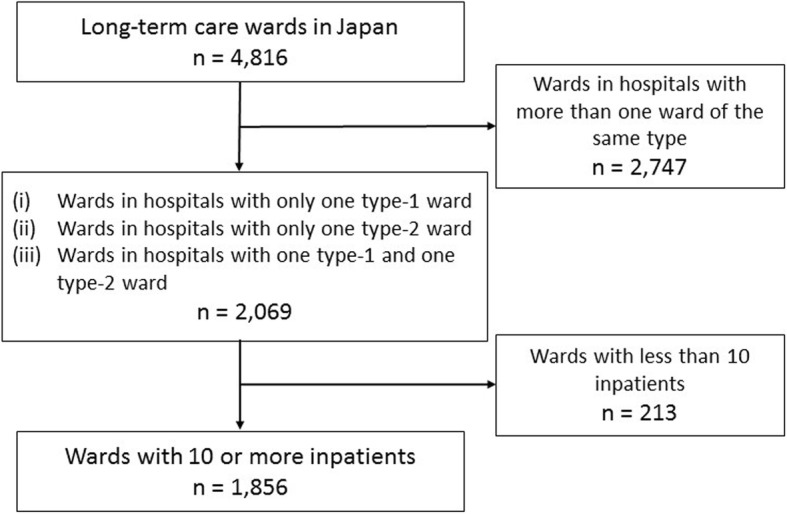
We analyzed data from 1856 long-term care wards extracted from the 2014 Annual Report for Functions of Medical Institutions in Japan. We classified five clusters of long-term care wards based on inpatients' medical acuity/activities of daily living using cluster analysis, and compared hospital/ward characteristics across the clusters with a chi-square test or analyses of variance.
Cluster 1 was low medical acuity/high activities of daily living (n = 175); cluster 2, medium medical acuity/high activities of daily living (n = 340); cluster 3, medium medical acuity/low activities of daily living (n = 461); cluster 4, high medical acuity/low activities of daily living (n = 409); and cluster 5, mixed (n = 471). Although clusters 1 and 2 had similar higher proportions of home discharge (48.1% and 34.6%, respectively), there was a difference in length of hospital stay between the clusters (154.6 and 216.6 days, respectively). On the other hand, clusters 3 and 4 experienced a longer length of hospital stay (295.7 and 239.8 days, respectively) and a higher proportion of in-hospital deaths (42.7% and 50.2%, respectively). Characteristics of cluster 5 were not significantly different from the average of overall wards.
There were distinctive differences across hospitals in their use of long-term care wards. Wards with different functions have different support needs; the clusters with high activities of daily living needed support in promoting home discharge, while those with low activities of daily living needed support in providing quality end-of-life care. Our results can be useful for constructing the future regional healthcare system. This study also suggests introducing a standardized patient classification system in long-term care settings.
在一个推动了广泛医疗体系改革的快速老龄化社会中,明确长期护理病房的功能模式对于制定区域医疗政策至关重要。本研究旨在对日本长期护理病房的住院患者特征模式进行分类,并考察医院/病房特征。
我们分析了从《2014年日本医疗机构功能年度报告》中提取的1856个长期护理病房的数据。我们使用聚类分析根据住院患者的医疗护理需求程度/日常生活活动能力将长期护理病房分为五类,并通过卡方检验或方差分析比较各类别之间的医院/病房特征。
第1组为低医疗护理需求程度/高日常生活活动能力(n = 175);第2组为中等医疗护理需求程度/高日常生活活动能力(n = 340);第3组为中等医疗护理需求程度/低日常生活活动能力(n = 461);第4组为高医疗护理需求程度/低日常生活活动能力(n = 409);第5组为混合型(n = 471)。虽然第1组和第2组的出院回家比例相对较高(分别为48.1%和34.6%),但两组的住院时间存在差异(分别为154.6天和216.6天)。另一方面,第3组和第4组的住院时间较长(分别为295.7天和239.8天),院内死亡比例较高(分别为42.7%和50.2%)。第5组的特征与所有病房的平均特征无显著差异。
不同医院在长期护理病房的使用上存在显著差异。功能不同的病房有不同的支持需求;日常生活活动能力高的类别需要在促进出院回家方面获得支持,而日常生活活动能力低的类别则需要在提供高质量临终关怀方面获得支持。我们的研究结果有助于构建未来的区域医疗体系。本研究还建议在长期护理环境中引入标准化的患者分类系统。