Eltaybani Sameh, Yamamoto-Mitani Noriko, Ninomiya Ayako, Igarashi Ayumi
Department of Gerontological Homecare and Long-term Care Nursing, The University of Tokyo, 7-3-1 Hongo, Bunkyo-Ku, Tokyo, 113-0033, Japan.
Department of Critical Care and Emergency Nursing, Alexandria University, Alexandria, Egypt.
BMC Nurs. 2021 Feb 23;20(1):34. doi: 10.1186/s12912-021-00552-z.
Worldwide, rather few studies have examined the association between burnout and care quality using objectively measured quality indicators, with most of the studies have relied on perceived quality outcomes. This study aimed to examine the association between staff nurses' burnout and selected objective quality metrics in long-term care wards in Japan.
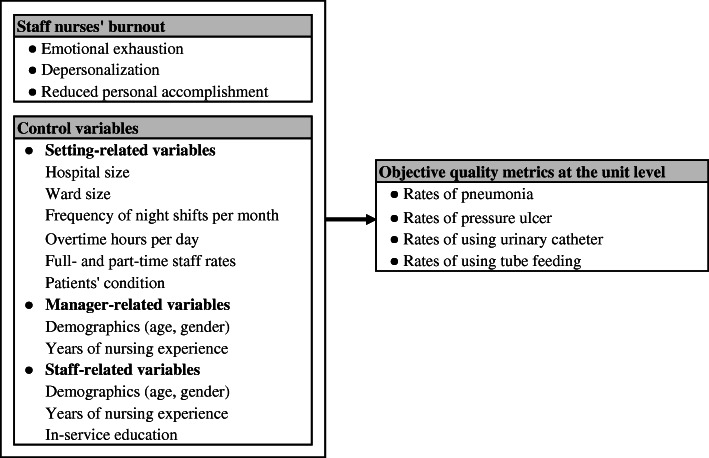
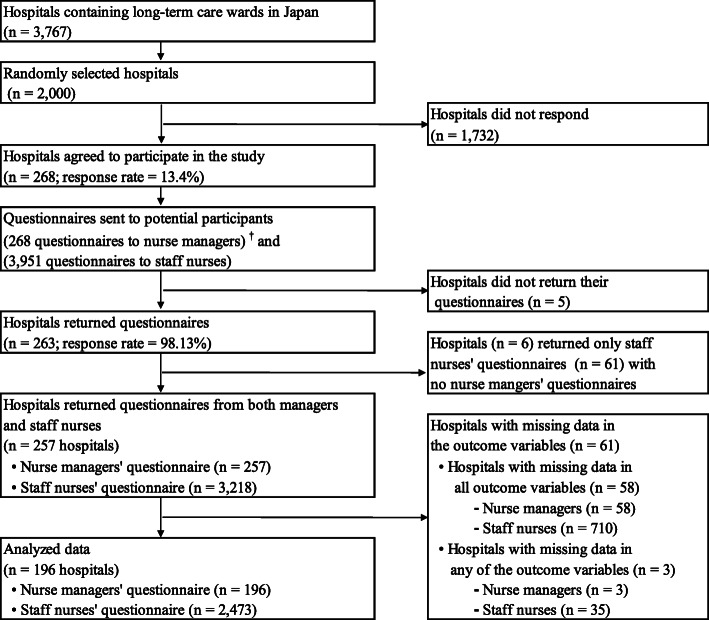
This is a secondary analysis of a cross-sectional survey. Nurse managers and staff nurses working at randomly selected hospitals with long-term care wards-the equivalent of skilled nursing homes in Western countries- completed self-administered, anonymous questionnaires. The questionnaires collected data regarding care quality indicators, staff nurses' burnout, and other confounders (e.g., ward size, participants' years of experience, and patients' conditions). All statistical analyses were conducted at the ward level. A multivariate regression analysis was used to examine associations between burnout and outcome indicators.
Data from 196 wards in 196 hospitals (196 nurse managers and 2473 staff nurses) across Japan were analyzed. Multivariate regression analysis showed that higher emotional exhaustion was associated with higher rates of pneumonia and pressure ulcers (p-value = .036 and .032, respectively), and that reduced personal accomplishment was associated with higher rates of tube feeding (p-value = .018). A larger ward size was also associated with low rates of pneumonia (regression coefficient = -.001, p-value = .019).
Staff nurses' burnout is a significant determinant of care quality in long-term care wards, implying that organizations that implement burnout reducing strategies may see greater benefits in patient outcomes. A large ward size was significantly associated with better care outcomes-specifically, low rates of pneumonia. Future research needs to determine feasible quality improvement measures in small-scale long-term care facilities, and to provide more comprehensive insights on ward-level variables that influence care quality in long-term care settings.
在全球范围内,使用客观测量的质量指标来研究职业倦怠与护理质量之间关联的研究相当少,大多数研究依赖于感知到的质量结果。本研究旨在探讨日本长期护理病房中护士的职业倦怠与选定的客观质量指标之间的关联。
这是一项横断面调查的二次分析。在随机选择的设有长期护理病房(相当于西方国家的专业护理院)的医院工作的护士长和护士完成了自行填写的匿名问卷。问卷收集了有关护理质量指标、护士职业倦怠及其他混杂因素(如病房规模、参与者工作年限和患者状况)的数据。所有统计分析均在病房层面进行。采用多元回归分析来检验职业倦怠与结果指标之间的关联。
对日本196所医院的196个病房(196名护士长和2473名护士)的数据进行了分析。多元回归分析表明,更高的情感耗竭与更高的肺炎和压疮发生率相关(p值分别为0.036和0.032),而个人成就感降低与更高的鼻饲发生率相关(p值 = 0.018)。更大的病房规模也与较低的肺炎发生率相关(回归系数 = -0.001,p值 = 0.019)。
护士的职业倦怠是长期护理病房护理质量的一个重要决定因素,这意味着实施减少职业倦怠策略的组织可能在患者预后方面获得更大益处。较大的病房规模与更好的护理结果显著相关,具体而言,肺炎发生率较低。未来的研究需要确定小型长期护理机构可行地质量改进措施,并对影响长期护理环境中护理质量的病房层面变量提供更全面的见解。