Flasbeck Vera, Moser Dirk, Kumsta Robert, Brüne Martin
Division of Cognitive Neuropsychiatry and Psychiatric Preventive Medicine, Department of Psychiatry, Psychotherapy and Preventive Medicine, LWL University Hospital, Ruhr University Bochum, Bochum, Germany.
Department of Genetic Psychology, Faculty of Psychology, Ruhr University Bochum, Bochum, Germany.
Front Psychiatry. 2018 Aug 8;9:359. doi: 10.3389/fpsyt.2018.00359. eCollection 2018.
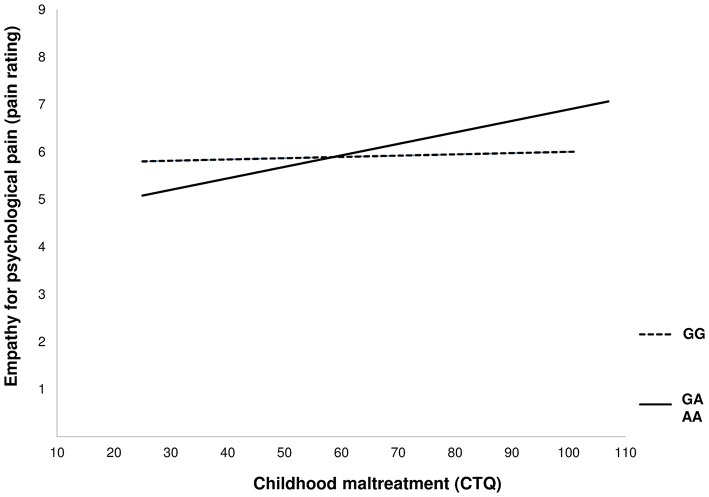
Previous research has associated genetic variations of the oxytocin receptor with individual differences in human social behavior. Specifically, homozygous carriers of the G-allele of the single nucleotide polymorphism rs53576 have been reported to display more trust, empathy, and prosocial behavior and were less sensitive toward stress and maltreatment during childhood when compared to A-allele carriers. With regard to Borderline Personality Disorder (BPD), a psychiatric condition that is often associated with the experience of childhood adversity, it has been suggested that A-allele carriers are more vulnerable to developing psychopathological signs and symptoms. In the present study we investigated whether childhood trauma, as assessed by the Childhood Trauma Questionnaire (CTQ), affects empathy for somatic and psychological pain, and how this is moderated by genotype, in a sample of 302 individuals (148 of whom were diagnosed with BPD). We found a three-way interaction between genotype, group and pain condition. comparisons revealed that patients with BPD carrying at least one A-allele, rated psychological pain as more intense compared to controls, whereas no difference between groups emerged in GG homozygotes. Moreover, a moderating effect of genotype appeared on the impact of childhood trauma on empathy for psychological pain. In addition, a positive correlation of CTQ scores and empathy appeared only in A-allele carriers (GA + AA), independent of diagnosis. Together, A-allele carriers, especially those with BPD, seemed to be responsive to the impact of adversity on empathy-for-pain, while GG homozygotes were not, which is compatible with the idea of differential susceptibility.
先前的研究已将催产素受体的基因变异与人类社会行为的个体差异联系起来。具体而言,据报道,单核苷酸多态性rs53576的G等位基因纯合携带者比A等位基因携带者表现出更多的信任、同理心和亲社会行为,并且在童年时期对压力和虐待的敏感度更低。关于边缘型人格障碍(BPD),这种精神疾病常与童年逆境经历相关,有人提出A等位基因携带者更容易出现精神病理症状。在本研究中,我们调查了通过儿童创伤问卷(CTQ)评估的童年创伤是否会影响对身体疼痛和心理疼痛的同理心,以及在302名个体(其中148人被诊断为BPD)的样本中,基因型如何调节这种影响。我们发现基因型、组别和疼痛状况之间存在三向交互作用。比较结果显示,携带至少一个A等位基因的BPD患者将心理疼痛评为比对照组更强烈,而GG纯合子组之间未出现差异。此外,基因型对童年创伤对心理疼痛同理心的影响具有调节作用。此外,CTQ得分与同理心之间的正相关仅出现在A等位基因携带者(GA + AA)中,与诊断无关。总之,A等位基因携带者,尤其是那些患有BPD的人,似乎对逆境对疼痛同理心的影响有反应,而GG纯合子则没有,这与差异易感性的观点相符。