Shen Guanghui, Yang Shizhuo, Wu Liujun, Chen Yingjie, Hu Yueling, Zhou Fan, Wang Wei, Liu Peining, Wu Fenzan, Liu Yanlong, Wang Fan, Chen Li
Wenzhou Seventh People's Hospital, Wenzhou, China.
School of Mental Health, Wenzhou Medical University, Wenzhou, China.
Front Psychiatry. 2023 Jul 14;14:1085429. doi: 10.3389/fpsyt.2023.1085429. eCollection 2023.
Alcohol use disorder (AUD) is a common mental disorder characterized by repeated withdrawal episodes. Negative emotions during withdrawal are the primary factors affecting successful abstinence. Oxytocin is a critical modulator of emotions. OXTR, the oxytocin receptor, may also be a promising candidate for treating alcohol withdrawal symptoms. Previous studies indicated that people with different genotypes of OXTR rs2254298 were reported to suffer from more significant depressive or heightened anxiety symptoms when experiencing early adversity. The present study aims to explore the modulatory role of the polymorphism OXTR rs2254298 on mood disorders during alcohol withdrawal and to help researchers better understand and develop effective relapse prevention and interventions for alcohol use disorders.
We recruited 265 adult Chinese Han men with AUD. Anxiety and depressive symptoms were measured using the Self-Rating Anxiety Scale and Self-Rating Depression Scale. Alcohol dependence levels were measured using Michigan Alcoholism Screening Test. Genomic DNA extraction and genotyping from participants' peripheral blood samples.
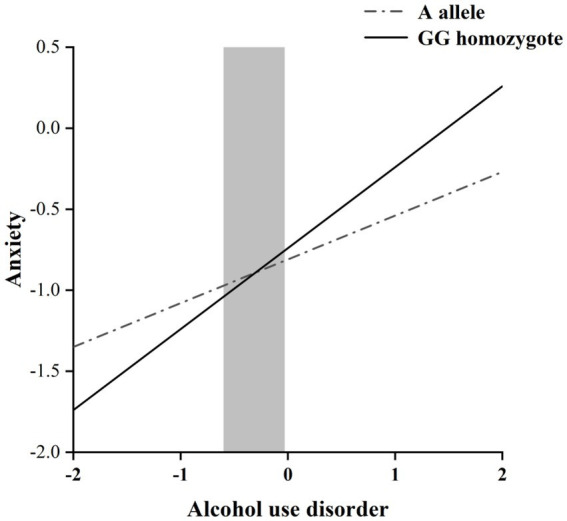
First, a multiple linear regression was used to set the alcohol dependence level, OXTR.rs2254298, interaction terms as the primary predictor variable, and depression or anxiety as an outcome; age and educational years were covariates. There was a significant interaction between OXTR rs2254298 and alcohol dependence level on anxiety ( = 0.23, 95% confidence interval [CI]: 0.01-0.45) but not on depression ( = -0.06, 95% CI: -0.30 - 0.18). The significance region test showed that alcohol-dependent men who are GG homozygous were more likely to experience anxiety symptoms than subjects with the A allele (A allele: = 0.27, < 0.001; GG homozygote: = 0.50, < 0.001). Finally, re-parameterized regression analysis demonstrated that this gene-environment interaction of OXTR rs2254298 and alcohol dependence on anxiety fits the weak differential susceptibility model ( = 0.17, (5,259) = 13.46, < 0.001).
This study reveals a gene-environment interactive effect between OXTR rs2254298 and alcohol withdrawal on anxiety but not depression. From the perspective of gene-environment interactions, this interaction fits the differential susceptibility model; OXTR rs2254298 GG homozygote carriers are susceptible to the environment and are likely to experience anxiety symptoms of alcohol withdrawal.
酒精使用障碍(AUD)是一种常见的精神障碍,其特征为反复出现戒断发作。戒断期间的负面情绪是影响成功戒酒的主要因素。催产素是情绪的关键调节因子。催产素受体(OXTR)也可能是治疗酒精戒断症状的一个有前景的候选因素。先前的研究表明,OXTR rs2254298不同基因型的人在经历早期逆境时,据报道会出现更明显的抑郁或焦虑症状加重。本研究旨在探讨OXTR rs2254298多态性对酒精戒断期间情绪障碍的调节作用,并帮助研究人员更好地理解和制定有效的酒精使用障碍复发预防及干预措施。
我们招募了265名患有AUD的成年中国汉族男性。使用焦虑自评量表和抑郁自评量表测量焦虑和抑郁症状。使用密歇根酒精ism筛查测试测量酒精依赖水平。从参与者的外周血样本中提取基因组DNA并进行基因分型。
首先,采用多元线性回归将酒精依赖水平、OXTR.rs2254298、交互项作为主要预测变量,抑郁或焦虑作为结果;年龄和受教育年限作为协变量。OXTR rs2254298与酒精依赖水平在焦虑方面存在显著交互作用(β = 0.23,95%置信区间[CI]:0.01 - 0.45),但在抑郁方面不存在(β = -0.06,95% CI:-0.30 - 0.18)。显著性区域检验表明,GG纯合子的酒精依赖男性比携带A等位基因的受试者更易出现焦虑症状(A等位基因:β = 0.27,p < 0.001;GG纯合子:β = 0.50,p < 0.001)。最后,重新参数化回归分析表明,OXTR rs2254298与酒精依赖对焦虑的这种基因 - 环境交互作用符合弱差异易感性模型(β = 0.17,F(5,259) = 13.46,p < 0.001)。
本研究揭示了OXTR rs2254298与酒精戒断在焦虑方面而非抑郁方面存在基因 - 环境交互作用。从基因 - 环境交互作用的角度来看,这种交互作用符合差异易感性模型;OXTR rs2254298 GG纯合子携带者对环境敏感,可能会出现酒精戒断的焦虑症状。