Louw Shereen, Makwela Shale, Manas Lorisha, Meyer Lyle, Terblanche Daniele, Brink Yolandi
Department of Health and Rehabilitation Sciences, Stellenbosch University, South Africa.
S Afr J Physiother. 2017 Nov 28;73(1):392. doi: 10.4102/sajp.v73i1.392. eCollection 2017.
Non-specific neck pain is a common health problem of global concern for office workers. This systematic review ascertained the latest evidence for the effectiveness of therapeutic exercise versus no therapeutic exercise on reducing neck pain and improving quality of life (QoL) in office workers with non-specific neck pain.
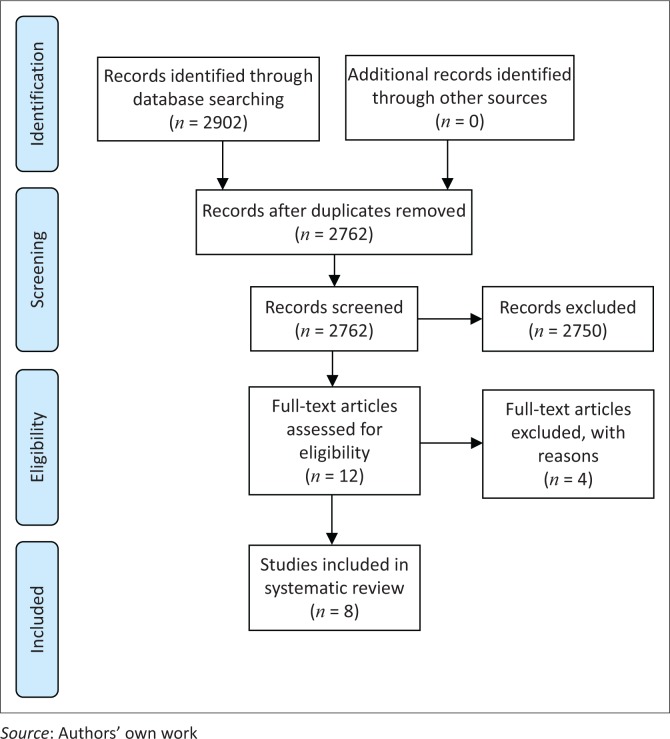
Seven electronic databases using keywords, that is, 'office workers', 'non-specific neck pain', 'exercise' and/or 'exercise therapy', 'QoL', 'strengthening', 'stretching', 'endurance', 'physiotherapy' and/or 'physical therapy', were searched from inception until March 2017. Heterogeneous data were reported in narrative format and comparable homogenous data were pooled using Revman.
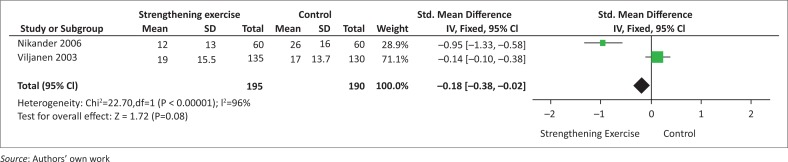
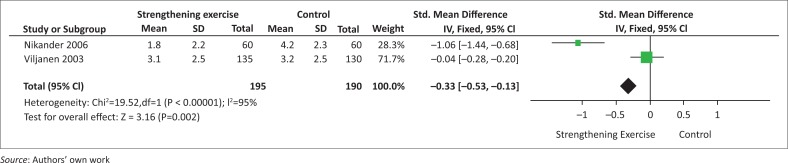
Eight randomised control trials were reviewed and scored on average 6.63/10 on the Physiotherapy Evidence Database (PEDro) scale. Five studies performed strengthening exercise, one study had a strengthening and an endurance exercise group, one study performed stretching exercise and one study had an endurance intervention group and a stretching intervention group. Five and four studies reported significant improvement in neck pain and QoL, respectively, when conducting strengthening exercise. When performing endurance exercises, one and two studies reported significant changes in neck pain and QoL, respectively. The one study incorporating stretching exercise reported significant improvement in neck pain. The meta-analysis revealed that there is a clinically significant difference favouring strengthening exercise over no exercise in pain reduction but not for QoL.
There is level II evidence recommending that clinicians include strengthening exercise to improve neck pain and QoL. However, the effect of endurance and stretching exercise needs to be explored further.
非特异性颈部疼痛是全球上班族普遍关注的健康问题。本系统评价确定了治疗性运动与不进行治疗性运动相比,在减轻非特异性颈部疼痛的上班族颈部疼痛和改善生活质量(QoL)方面有效性的最新证据。
从数据库建立至2017年3月,使用关键词“上班族”“非特异性颈部疼痛”“运动”和/或“运动疗法”“生活质量”“强化”“拉伸”“耐力”“物理治疗”和/或“物理疗法”检索了七个电子数据库。以叙述形式报告异质性数据,并使用Revman汇总可比的同质性数据。
共纳入八项随机对照试验,在物理治疗证据数据库(PEDro)量表上平均得分为6.63/10。五项研究进行了强化运动,一项研究有强化和耐力运动组,一项研究进行了拉伸运动,一项研究有耐力干预组和拉伸干预组。五项和四项研究分别报告了进行强化运动时颈部疼痛和生活质量有显著改善。进行耐力运动时,分别有一项和两项研究报告颈部疼痛和生活质量有显著变化。纳入拉伸运动的一项研究报告颈部疼痛有显著改善。荟萃分析显示,在减轻疼痛方面,强化运动比不运动有临床显著差异,但在生活质量方面没有。
有二级证据建议临床医生采用强化运动来改善颈部疼痛和生活质量。然而,耐力和拉伸运动的效果需要进一步探索。