Indiana University School of Medicine, Indianapolis, IN, USA.
Division of Hematology/Oncology, Department of Medicine, Indiana University School of Medicine, Indianapolis, IN, 46202, USA.
Breast Cancer Res Treat. 2018 Nov;172(2):445-452. doi: 10.1007/s10549-018-4924-6. Epub 2018 Aug 22.
This observational study was designed to measure baseline energy parameters and body composition in early-stage breast cancer patients, and to follow changes during and after various modalities of treatment. This will provide information to aid in the development of individualized physical activity intervention strategies.
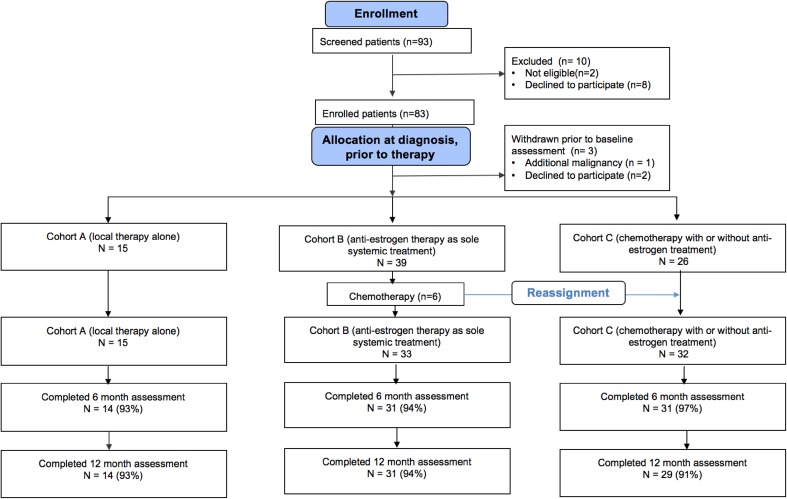
Patients with newly diagnosed stage 0-III breast cancer were enrolled into three cohorts: A (local therapy alone), B (endocrine therapy), or C (chemotherapy with or without endocrine therapy). At baseline, 6 months, and 12 months, subjects underwent a stationary bicycle protocol to assess power generation and DEXA to assess body composition.
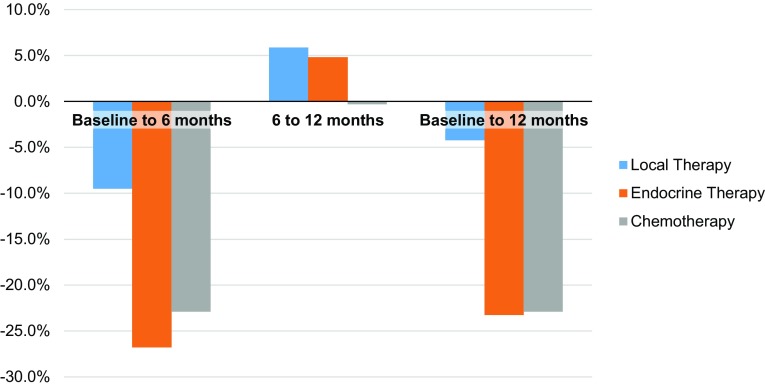
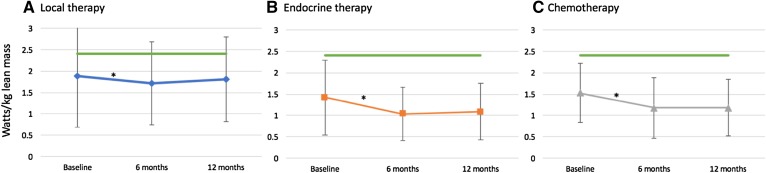
Eighty-three patients enrolled. Patients had low and variable levels of power generation at baseline (mean power per kilogram lean mass 1.55 W/kg, SD 0.88). Power normalized to lean body mass (W/kg) decreased significantly, and similarly, by 6 months in cohorts B (1.42-1.04 W/kg, p = 0.008) and C (1.53-1.18 W/kg, p < 0.001). In all cohorts, there was no recovery of power generation by 12 months. Cohort C lost lean body mass (- 1.5 kg, p = 0.007), while cohort B maintained lean body mass (- 0.2 kg, p = 0.68), despite a similar trajectory in loss of power. Seven patients developed sarcopenia during the study period, including four patients who did not receive any chemotherapy (cohort B).
The stationary bike protocol was feasible, easy, and acceptable to patients as a way to measure energetic capacity in a clinical setting. Early-stage breast cancer patients had low and variable levels of power generation, which worsened following primary therapy and did not show evidence of 'spontaneous recovery' by 12 months. Effective physical activity interventions will need to be personalized, accounting for both baseline ability and the effect of treatment.
本观察性研究旨在测量早期乳腺癌患者的基线能量参数和身体成分,并随访各种治疗方式期间和之后的变化。这将提供信息,以帮助制定个体化的体力活动干预策略。
招募了新诊断为 0-III 期乳腺癌的患者进入三个队列:A(局部治疗)、B(内分泌治疗)或 C(化疗加或不加内分泌治疗)。在基线、6 个月和 12 个月时,患者接受固定自行车方案以评估功率生成,并用 DEXA 评估身体成分。
共纳入 83 例患者。患者的基线功率生成水平较低且变化较大(瘦体重每公斤的平均功率为 1.55W/kg,标准差为 0.88)。功率与瘦体重的比值(W/kg)显著下降,B 队列(1.42-1.04W/kg,p=0.008)和 C 队列(1.53-1.18W/kg,p<0.001)在 6 个月时也同样下降。在所有队列中,12 个月时功率生成均未恢复。C 队列的瘦体重减少(-1.5kg,p=0.007),而 B 队列的瘦体重保持不变(-0.2kg,p=0.68),尽管功率下降的轨迹相似。在研究期间,有 7 例患者发展为肌肉减少症,其中包括 4 例未接受任何化疗的患者(B 队列)。
固定自行车方案可行、简便,患者易于接受,可作为在临床环境中测量能量能力的方法。早期乳腺癌患者的功率生成水平较低且变化较大,原发性治疗后恶化,12 个月时未见“自发恢复”的证据。有效的体力活动干预措施需要个体化,既要考虑基线能力,又要考虑治疗效果。