Department of Medicine, Brigham and Women's Hospital, Boston, Massachusetts.
Department of Medicine, Hôpital Universitaire de Mirebalais, Haiti.
J Infect Dis. 2018 Oct 15;218(suppl_3):S154-S164. doi: 10.1093/infdis/jiy444.
Cholera has caused 7 global pandemics, including the current one which has been ongoing since 1961. A systematic review of risk factors for symptomatic cholera infection has not been previously published.
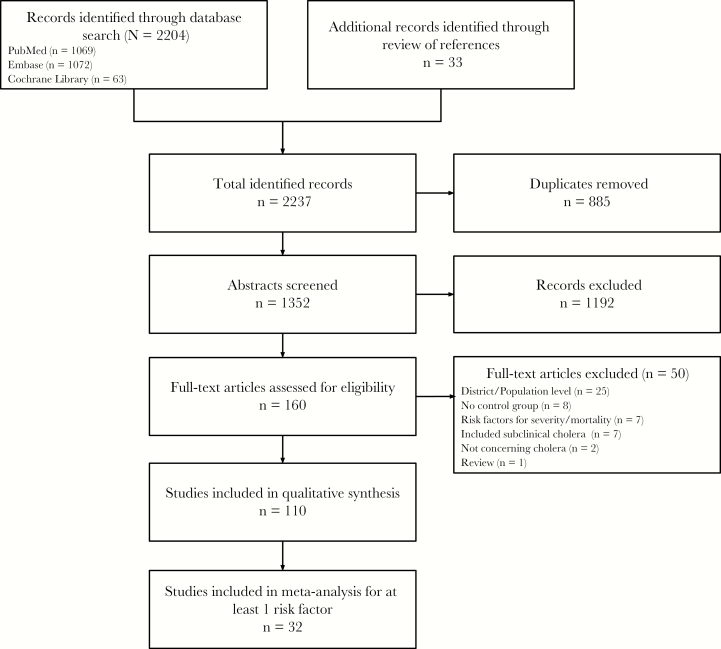
In accordance with PRISMA (Preferred Reporting Items for Systematic Reviews and Meta-Analyses) guidelines, we performed a systematic review and meta-analysis of individual and household risk factors for symptomatic cholera infection.
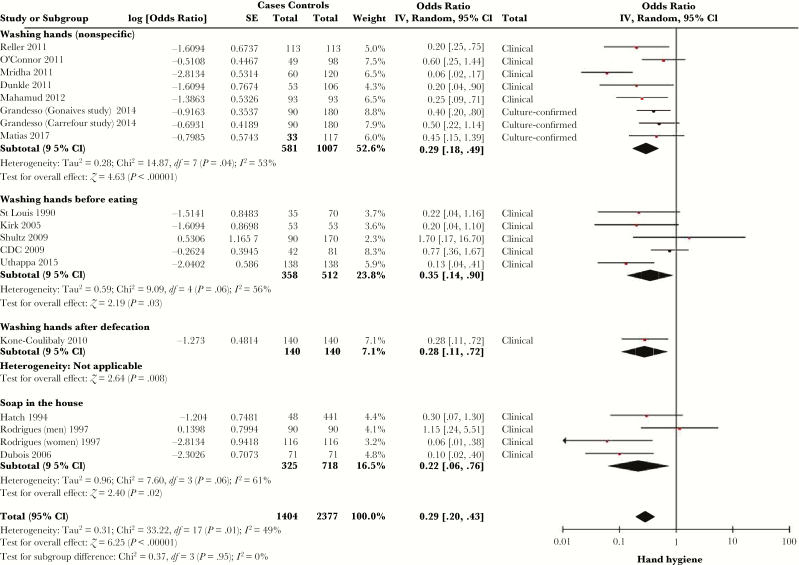
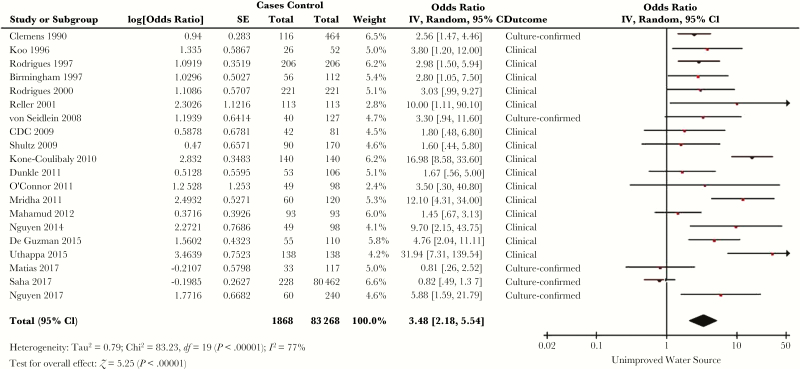
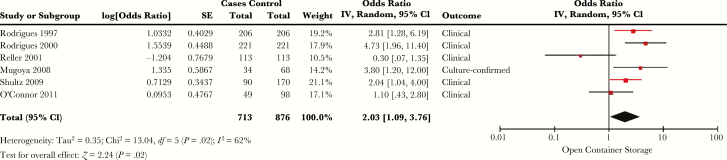
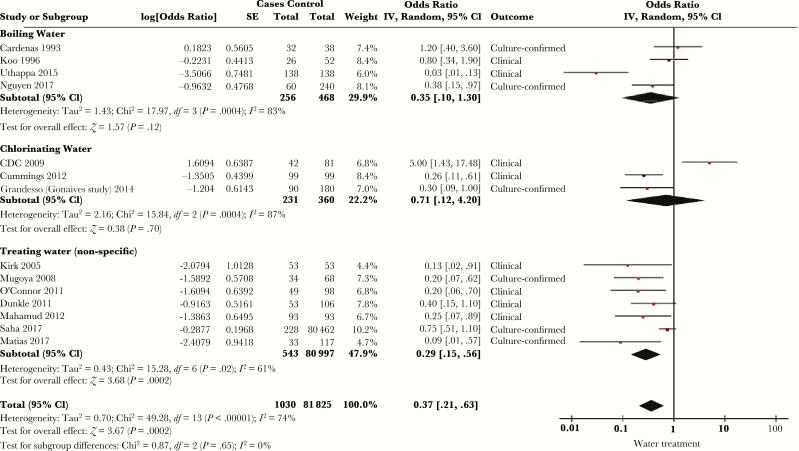
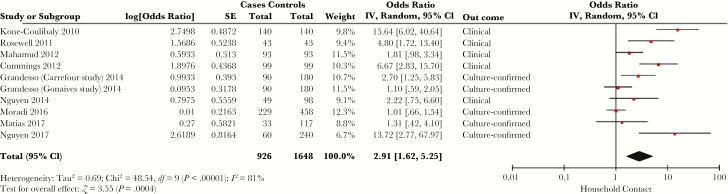
We identified 110 studies eligible for inclusion in qualitative synthesis. Factors associated with symptomatic cholera that were eligible for meta-analysis included education less than secondary level (summary odds ratio [SOR], 2.64; 95% confidence interval [CI], 1.41-4.92; I2 = 8%), unimproved water source (SOR, 3.48; 95% CI, 2.18-5.54; I2 = 77%), open container water storage (SOR, 2.03; 95% CI, 1.09-3.76; I2 = 62%), consumption of food outside the home (SOR, 2.76; 95% CI, 1.62-4.69; I2 = 64%), household contact with cholera (SOR, 2.91; 95% CI, 1.62-5.25; I2 = 89%), water treatment (SOR, 0.37; 95% CI, .21-.63; I2 = 74%), and handwashing (SOR, 0.29; 95% CI, .20-.43; I2 = 37%). Other notable associations with symptomatic infection included income/wealth, blood group, gastric acidity, infant breastfeeding status, and human immunodeficiency virus infection.
We identified potential risk factors for symptomatic cholera infection including environmental characteristics, socioeconomic factors, and intrinsic patient factors. Ultimately, a combination of interventional approaches targeting various groups with risk-adapted intensities may prove to be the optimal strategy for cholera control.
霍乱已引发 7 次全球大流行,包括自 1961 年以来持续至今的当前这一次。此前尚未发表过针对有症状霍乱感染的危险因素的系统评价。
根据 PRISMA(系统评价和荟萃分析的首选报告项目)指南,我们对有症状霍乱感染的个体和家庭危险因素进行了系统评价和荟萃分析。
我们确定了 110 项符合纳入定性综合分析标准的研究。有资格进行荟萃分析的与有症状霍乱相关的因素包括受教育程度低于中学(汇总优势比[SOR],2.64;95%置信区间[CI],1.41-4.92;I²=8%)、未改善的水源(SOR,3.48;95%CI,2.18-5.54;I²=77%)、开放式容器储水(SOR,2.03;95%CI,1.09-3.76;I²=62%)、在家外进食(SOR,2.76;95%CI,1.62-4.69;I²=64%)、与霍乱患者有家庭接触(SOR,2.91;95%CI,1.62-5.25;I²=89%)、水的处理(SOR,0.37;95%CI,0.21-0.63;I²=74%)和洗手(SOR,0.29;95%CI,0.20-0.43;I²=37%)。与有症状感染相关的其他显著关联因素包括收入/财富、血型、胃酸度、婴儿母乳喂养状况和人类免疫缺陷病毒感染。
我们确定了有症状霍乱感染的潜在危险因素,包括环境特征、社会经济因素和内在患者因素。最终,针对具有风险适应性强度的各个群体采取综合干预措施的组合可能被证明是控制霍乱的最佳策略。