Department of Psychology, DePaul University.
Emotion. 2019 Sep;19(6):1035-1043. doi: 10.1037/emo0000505. Epub 2018 Aug 23.
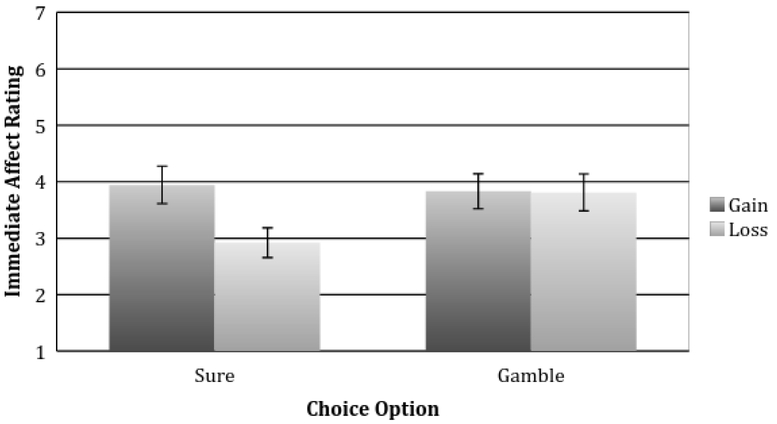
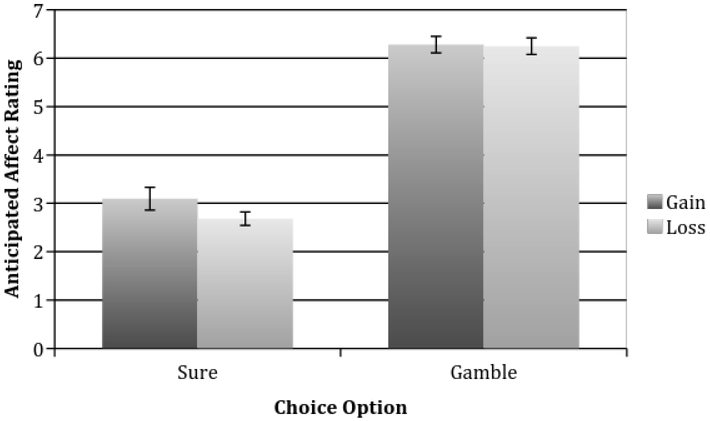
When faced with a decision, certain aspects of the decision itself shape our affective responses to choice options, which, in turn, influence our choices. These integral affective influences manifest as immediate feelings about choice options as well as the feelings that we anticipate we will feel after certain potential outcomes. We examined whether the effect of framing on risk taking can be explained through the mediating roles of immediate and anticipated affect. Two experiments were conducted using a gambling task. On each trial, participants were endowed a sum of money (e.g., $25) then presented with a choice between a sure option (leaving them with a portion of the initial endowment) and a gamble option (that could result in either keeping or losing the entire endowment). The sure option was framed differently across two within-participant conditions: as a gain (keep $20 from $25) or loss (lose $5 from $25). Experiment 1 examined whether immediate feelings toward choice options explain how framing the sure option as a loss versus a gain increases risk taking. Experiment 2 examined whether immediate and/or anticipated affect explain how framing guides risk taking. We found that the tendency to take risks to avoid sure losses was explained by immediate (not anticipated) affective evaluations of the sure option only. Individuals tended to take more risks when faced with sure losses due to greater negative immediate feelings that were evoked by sure losses relative to sure gains. (PsycINFO Database Record (c) 2019 APA, all rights reserved).
当面临决策时,决策本身的某些方面会影响我们对选择选项的情感反应,而这些情感反应反过来又会影响我们的选择。这些内在的情感影响表现为我们对选择选项的即时感受,以及我们对某些潜在结果后的预期感受。我们研究了框架对冒险行为的影响是否可以通过即时和预期情感的中介作用来解释。使用赌博任务进行了两项实验。在每次试验中,参与者都会获得一定数量的钱(例如 25 美元),然后他们可以在确定选项(留下部分初始赠款)和赌博选项(可能导致全部或全部损失)之间做出选择。在两个参与者内部条件下,确定选项的框架不同:一种是收益(从 25 美元中保留 20 美元),另一种是损失(从 25 美元中损失 5 美元)。实验 1 研究了即时选择选项的感觉是否可以解释为什么将确定选项设定为损失而不是收益会增加冒险行为。实验 2 研究了即时和/或预期的情感是否可以解释框架如何引导冒险行为。我们发现,避免确定损失的冒险倾向仅由确定选项的即时(非预期)情感评估来解释。由于确定损失引起的即时负面感受大于确定收益引起的即时负面感受,因此,当人们面临确定损失时,他们更倾向于冒险。(PsycINFO 数据库记录(c)2019 APA,保留所有权利)。