Terrestrial Ecology Section, Department of Biology, University of Copenhagen, Universitetsparken 15, DK-2100, Copenhagen, Denmark.
Center for Permafrost (CENPERM), Department of Geosciences and Natural Resource Management, University of Copenhagen, Øster Voldgade 10, DK-1350, Copenhagen, Denmark.
Nat Commun. 2018 Aug 24;9(1):3412. doi: 10.1038/s41467-018-05824-y.
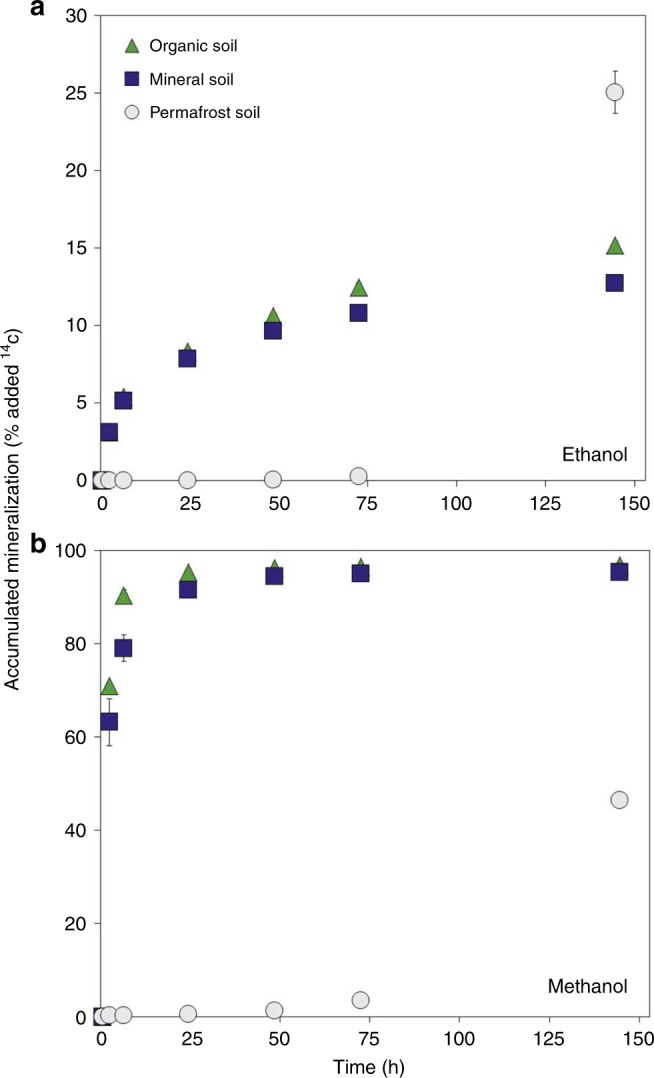
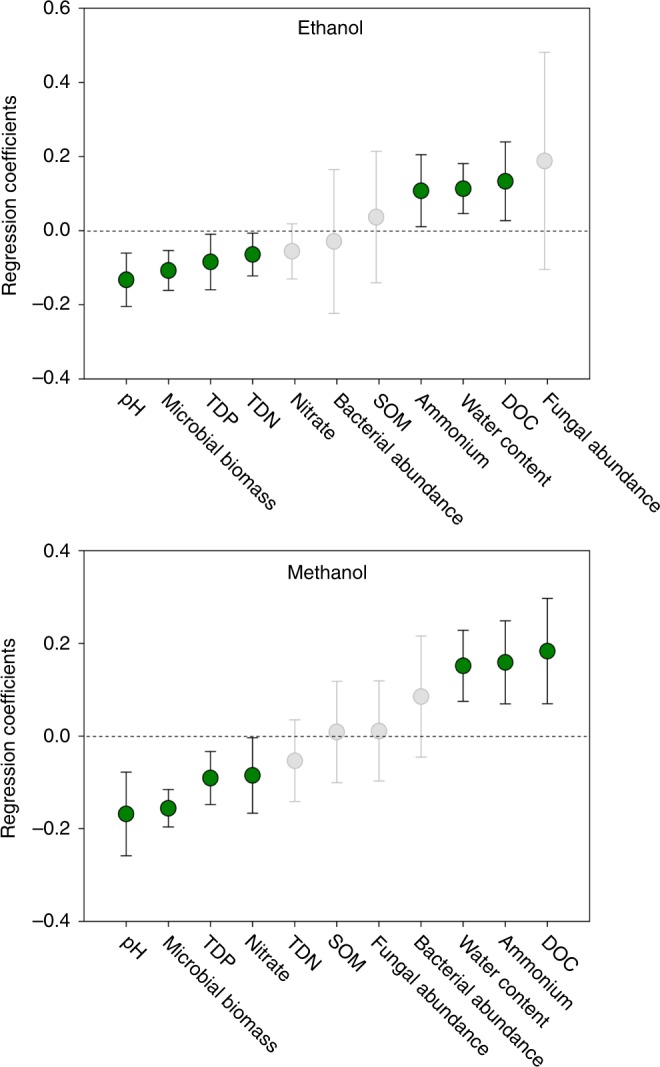
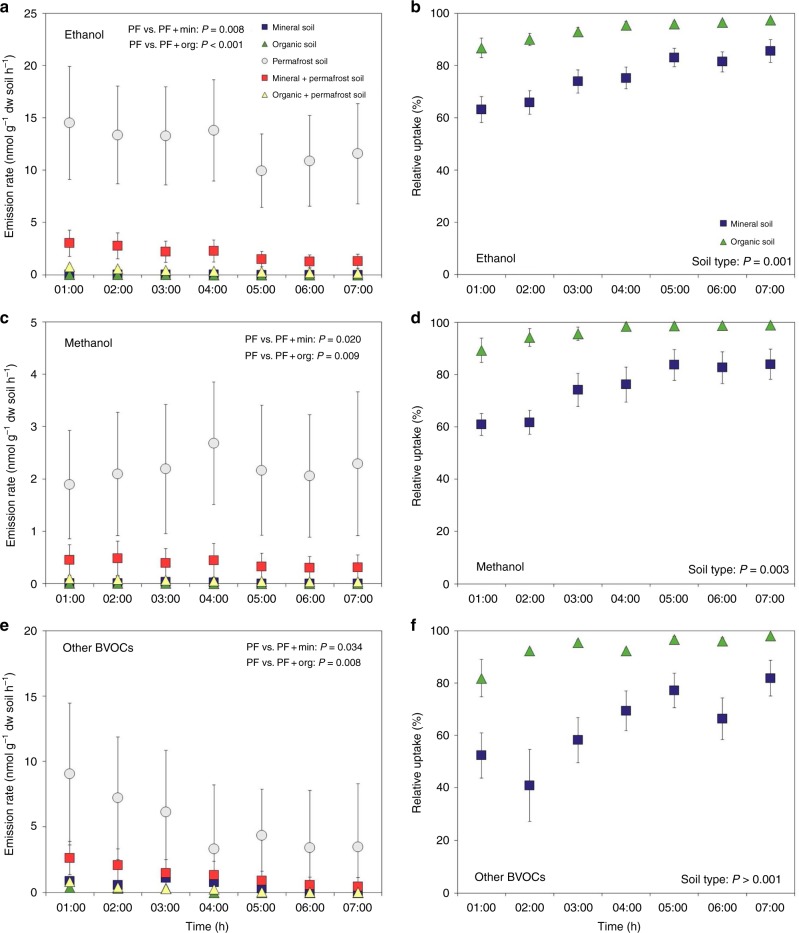
Warming in the Arctic accelerates thawing of permafrost-affected soils, which leads to a release of greenhouse gases to the atmosphere. We do not know whether permafrost thaw also releases non-methane volatile organic compounds that can contribute to both negative and positive radiative forcing on climate. Here we show using proton transfer reaction-time of flight-mass spectrometry that substantial amounts of ethanol and methanol and in total 316 organic ions were released from Greenlandic permafrost soils upon thaw in laboratory incubations. We demonstrate that the majority of this release is taken up in the active layer above. In an experiment using C-labeled ethanol and methanol, we demonstrate that these compounds are consumed by microorganisms. Our findings highlight that the thawing permafrost soils are not only a considerable source of volatile organic compounds but also that the active layer regulates their release into the atmosphere.
北极变暖加速了受永久冻土影响的土壤解冻,导致温室气体释放到大气中。我们不知道永久冻土的融化是否也会释放出非甲烷挥发性有机化合物,这些化合物可能对气候的辐射强迫产生负面影响和正面影响。在这里,我们使用质子转移反应-飞行时间质谱法表明,在实验室培养中,大量的乙醇和甲醇以及总共 316 种有机离子从格陵兰永久冻土中释放出来。我们证明,大部分释放物都被吸收到了上面的活动层中。在使用 C 标记的乙醇和甲醇的实验中,我们证明这些化合物被微生物消耗。我们的研究结果表明,融化的永久冻土不仅是挥发性有机化合物的重要来源,而且活动层还调节着它们向大气中的释放。