Plieninger Tobias, Kohsaka Ryo, Bieling Claudia, Hashimoto Shizuka, Kamiyama Chiho, Kizos Thanasis, Penker Marianne, Kieninger Pia, Shaw Brian J, Sioen Giles Bruno, Yoshida Yuki, Saito Osamu
1Department of Geosciences and Natural Resource Management, University of Copenhagen, Frederiksberg C, Denmark.
2Graduate School of Environmental Studies, Tohoku University, Sendai, Japan.
Sustain Sci. 2018;13(1):219-233. doi: 10.1007/s11625-017-0455-z. Epub 2017 Jul 11.
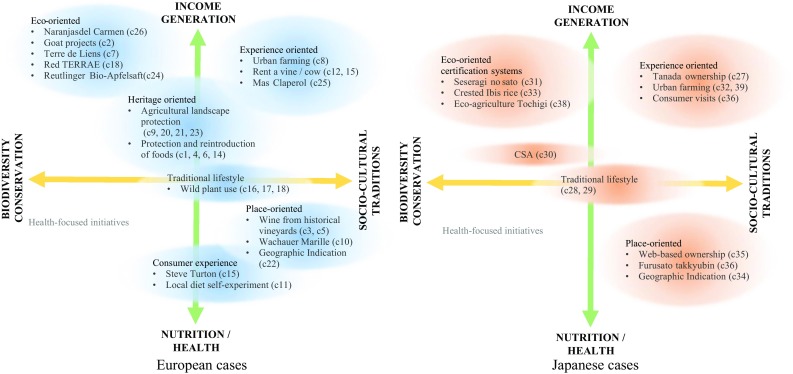
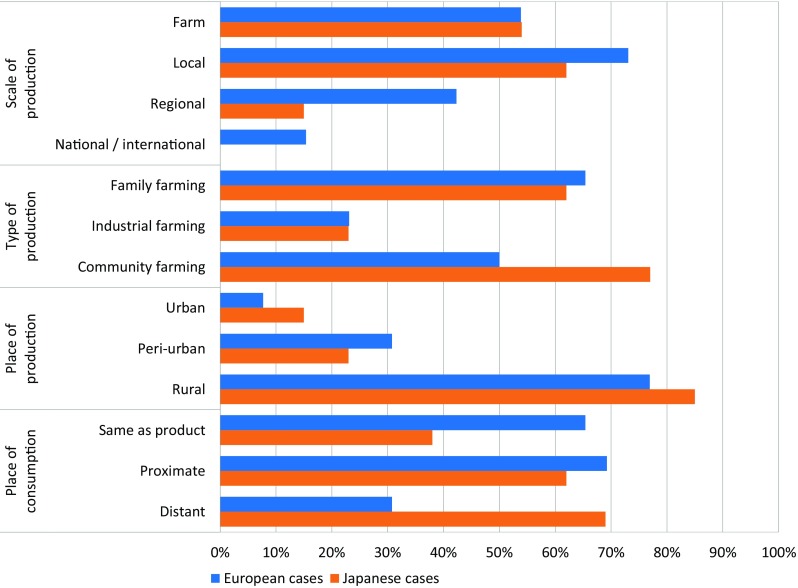
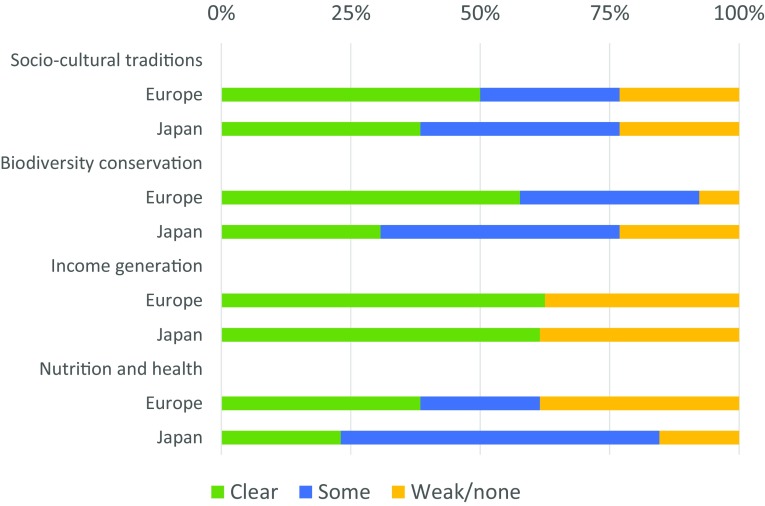
Many Japanese and European landscapes harbor biocultural diversity that has been shaped by human agency over centuries. However, these landscapes are threatened by widespread land abandonment, land-use changes, and urbanization. The aim of this study is to use a "solution scanning" method to identify place-based food networks in Europe and Japan that reinforce linkages between biological and cultural diversity in landscapes. In our analysis of 26 European and 13 Japanese cases, we find that place-based food networks are typically located in heterogeneous landscapes, are driven by civil society (and less by markets), and act at a local scale. Regional identity is the most frequently addressed societal issue. Scenery, rural tourism, and nature conservation are more important motivations in Europe, and physical well-being and revitalization of local economies are more relevant in Japan. European models are typically associated with achieving biodiversity conservation and socio-cultural tradition outcomes, and Japanese models more with public health and nutrition outcomes. We discuss the potential for transfer of approaches from Japan to Europe (e.g., models that tackle the aging of rural societies), and from Europe to Japan (e.g., models that build explicit connections between food production and biodiversity conservation). We conclude with a list of recommended policy measures, e.g., the creation of a flexible legal framework that protects the interests of and reduces political constraints for collaborative efforts to biocultural diversity in landscapes.
许多日本和欧洲的景观蕴含着生物文化多样性,这种多样性是数百年来人类活动塑造而成的。然而,这些景观正受到大面积土地撂荒、土地利用变化和城市化的威胁。本研究的目的是运用一种“解决方案扫描”方法,来识别欧洲和日本基于特定地点的食物网络,这些网络强化了景观中生物多样性与文化多样性之间的联系。在对26个欧洲案例和13个日本案例的分析中,我们发现基于特定地点的食物网络通常位于异质性景观中,由民间社会推动(而非市场),且在地方层面发挥作用。地域认同是最常涉及的社会问题。在欧洲,风景、乡村旅游和自然保护是更重要的动机,而在日本,身体健康和地方经济振兴则更为相关。欧洲模式通常与实现生物多样性保护和社会文化传统成果相关联,而日本模式则更多地与公共卫生和营养成果相关联。我们讨论了从日本向欧洲转移方法的潜力(例如,应对农村社会老龄化的模式),以及从欧洲向日本转移方法的潜力(例如,在粮食生产与生物多样性保护之间建立明确联系的模式)。我们最后列出了一系列建议的政策措施,例如创建一个灵活的法律框架,以保护景观中生物文化多样性的合作努力的利益并减少其政治限制。