Emami Mohammadreza, Behforouz Amir, Jarahi Lida, Zarifian Ahmadreza, Rashidlamir Amir, Rashed Masoud Mahdavi, Khaleghzade Homa, Ghaneifar Zahra, Safarian Mohammad, Azimi-Nezhad Mohsen, Nikroo Hossein, Nematy Mohsen
Biochemistry and Nutrition Department, Mashhad University of Medical Sciences, Mashhad, Iran.
Indian J Endocrinol Metab. 2018 Jul-Aug;22(4):515-519. doi: 10.4103/ijem.IJEM_83_18.
Obesity is associated with several complications like metabolic syndrome. Many professional athletes adopt a sedentary lifestyle after retirement. This study was aimed at assessing the risk of developing obesity, insulin resistance (IR), and metabolic syndrome among former power-sports athletes, compared with age-matched active athletes and nonathletes.
The study was conducted in Mashhad during 2012-2014. The individuals were recruited through announcements and were divided into three groups of active athletes ( = 34), ex-athletes ( = 30), and nonathletes ( = 30). Demographic and anthropometric data were collected and biochemical factors including low-density lipoprotein cholesterol (LDL-C), high-density lipoprotein cholesterol (HDL-C), total cholesterol, triglycerides (TG), fasting plasma glucose, insulin, and high-sensitive C-reactive protein were measured.
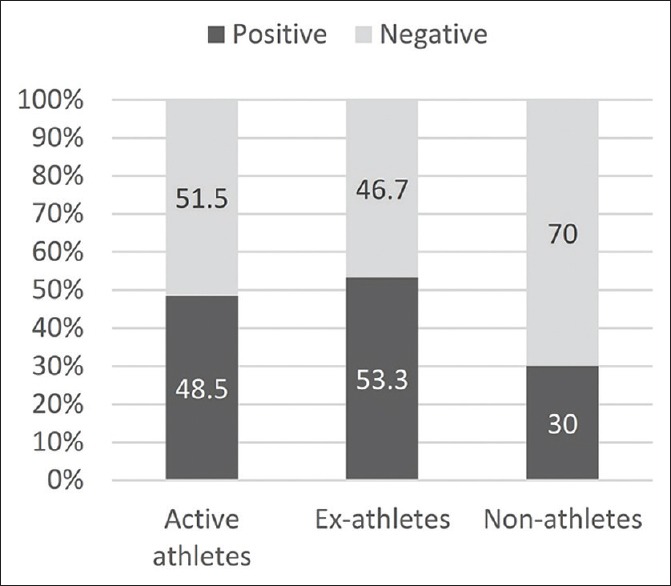
Ex-athletes had significantly higher mean values of weight, body mass index, diastolic blood pressure, LDL-C, insulin, homeostatic model assessment (HOMA) IR, and HOMA β-cell function (HOMA-%β-cell) compared with active athletes and nonathletes ( < 0.001, < 0.001, < 0.001, = 0.03, = 0.01, = 0.02, and = 0.01, respectively). However, mean values of HDL-C was significantly lower in ex-athletes compared with nonathletes ( < 0.001). The prevalence of metabolic syndrome showed no significant difference among three groups, although its mean was higher among ex-athletes.
The results showed that abandoning regular athletic exercise and weight cycling in power sports athletes leads to adverse outcomes such as obesity and IR. Although higher IR might not necessarily result in metabolic syndrome in short term, it could cause metabolic syndrome in the long run.
肥胖与多种并发症相关,如代谢综合征。许多职业运动员在退役后采用久坐不动的生活方式。本研究旨在评估前力量型运动运动员与年龄匹配的现役运动员和非运动员相比,发生肥胖、胰岛素抵抗(IR)和代谢综合征的风险。
该研究于2012年至2014年在马什哈德进行。通过公告招募个体,并将其分为三组:现役运动员(n = 34)、退役运动员(n = 30)和非运动员(n = 30)。收集人口统计学和人体测量数据,并测量生化指标,包括低密度脂蛋白胆固醇(LDL-C)、高密度脂蛋白胆固醇(HDL-C)、总胆固醇、甘油三酯(TG)、空腹血糖、胰岛素和高敏C反应蛋白。
与现役运动员和非运动员相比,退役运动员的体重、体重指数、舒张压、LDL-C、胰岛素、稳态模型评估(HOMA)IR和HOMA β细胞功能(HOMA-%β细胞)的平均值显著更高(分别为P < 0.001、P < 0.001、P < 0.001、P = 0.03、P = 0.01、P = 0.02和P = 0.01)。然而,退役运动员的HDL-C平均值与非运动员相比显著更低(P < 0.001)。三组代谢综合征的患病率无显著差异,尽管退役运动员中的平均值更高。
结果表明,力量型运动运动员放弃规律的体育锻炼和体重循环会导致肥胖和IR等不良后果。虽然短期内较高的IR不一定会导致代谢综合征,但从长远来看可能会引发代谢综合征。