Department of Immunology, Tufts University School of Medicine, 136 Harrison Avenue, Suite J304, Boston, MA, 02111, USA.
Sackler School of Graduate Biomedical Sciences, Tufts Medical Center, Tufts University School of Medicine, Boston, MA, USA.
J Neuroinflammation. 2018 Aug 27;15(1):239. doi: 10.1186/s12974-018-1275-5.
Autism spectrum disorder (ASD) has been associated with brain inflammation as indicated by the activation of microglia, but the triggers are not known. Extracellular vesicles (EVs) are secreted from many cells in the blood and other biological fluids and carry molecules that could influence the function of target cells. EVs have been recently implicated in several diseases, but their presence or function in ASD has not been studied.
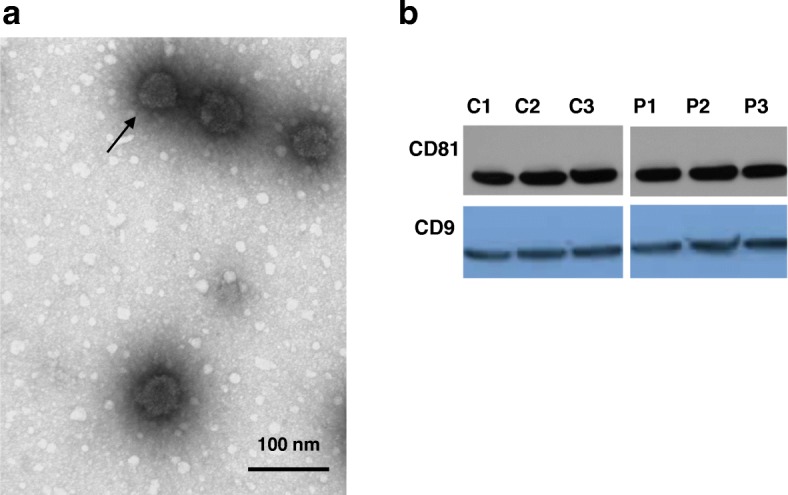
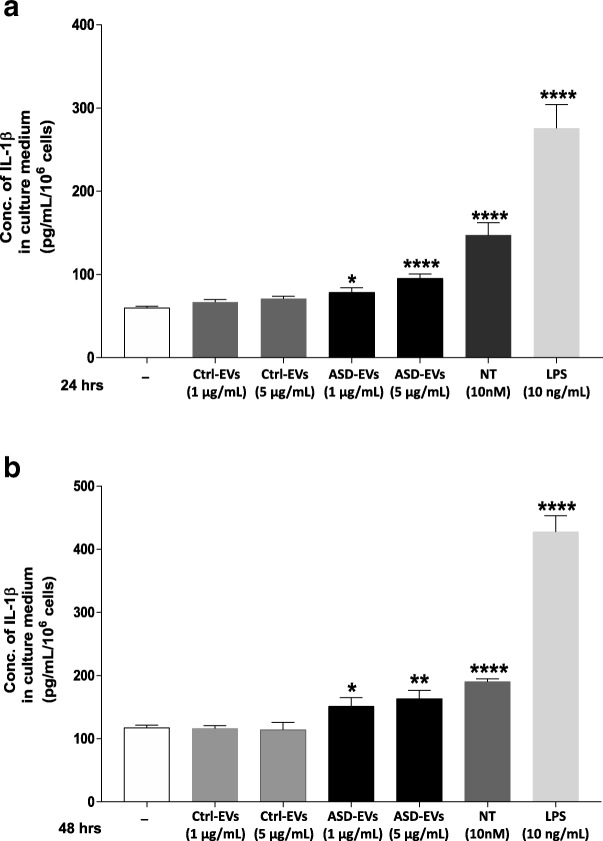
EVs were isolated from the serum of children with ASD (n = 20, 16 males and 4 females, 4-12 years old) and unrelated age and sex-matched normotypic controls (n = 8, 6 males and 2 females, 4-12 years old) using the exoEasy Qiagen kit. EVs were characterized by determining the CD9 and CD81 membrane-associated markers with Western blot analysis, while their morphology and size were assessed by transmission electron microscopy (TEM). Human microglia SV40 were cultured for 24 h and then stimulated with EVs (1 or 5 μg/mL), quantitated as total EV-associated protein, for 24 or 48 h. IL-1β secretion was measured by ELISA. The results were analyzed using the Mann-Whitney U non-parametric test, and all statistical analyses were performed using Graph Pad Prism 5.
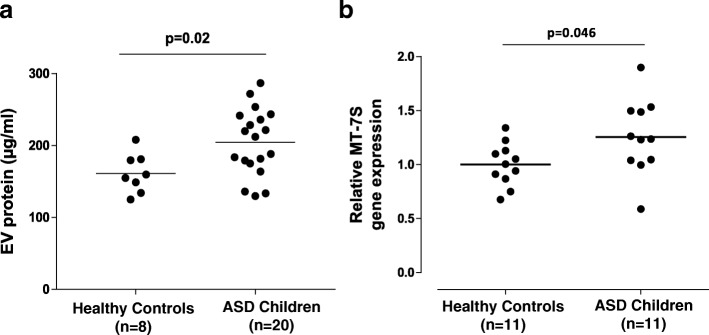
EVs were isolated and shown to be spherical structures (about 100 nm) surrounded by a membrane. Total EV-associated protein was found to be significantly increased (p = 0.02) in patients as compared to normotypic controls. EVs (5 μg/mL) isolated from the serum of patients with ASD stimulated cultured human microglia to secrete significantly more of the pro-inflammatory cytokine interleukin IL-1β (163.5 ± 13.34 pg/mL) as compared to the control (117.7 ± 3.96 pg/mL, p < 0.0001). The amount of mitochondrial DNA (mtDNA7S) contained in EVs from children with ASD was found to be increased (p = 0.046) compared to the normotypic controls.
These findings provide novel information that may help explain what triggers inflammation in the brain of children with ASD and could lead to novel effective treatments.
自闭症谱系障碍(ASD)与小胶质细胞的激活有关,表明存在大脑炎症,但触发因素尚不清楚。细胞外囊泡(EVs)是从血液和其他生物体液中的许多细胞分泌出来的,携带的分子可以影响靶细胞的功能。EVs 最近被牵连到几种疾病中,但它们在 ASD 中的存在或功能尚未得到研究。
使用 exoEasy Qiagen 试剂盒从 ASD 儿童(n=20,男 16 名,女 4 名,4-12 岁)和无相关年龄和性别匹配的正常对照组(n=8,男 6 名,女 2 名,4-12 岁)的血清中分离 EVs。通过 Western blot 分析确定 CD9 和 CD81 膜相关标记物来表征 EVs,而通过透射电子显微镜(TEM)评估其形态和大小。将人小胶质细胞 SV40 培养 24 小时,然后用 EVs(1 或 5μg/mL)刺激 24 或 48 小时,用 ELISA 测量 IL-1β 分泌量。使用 Mann-Whitney U 非参数检验分析结果,所有统计分析均使用 Graph Pad Prism 5 进行。
分离出 EVs,并显示其为球形结构(约 100nm),周围有一层膜。与正常对照组相比,患者的总 EV 相关蛋白显著增加(p=0.02)。与对照组(117.7±3.96pg/mL,p<0.0001)相比,从 ASD 患者血清中分离出的 EVs(5μg/mL)刺激培养的人小胶质细胞分泌出明显更多的促炎细胞因子白细胞介素-1β(163.5±13.34pg/mL)。从 ASD 儿童的 EV 中发现所含的线粒体 DNA(mtDNA7S)量增加(p=0.046),与正常对照组相比。
这些发现提供了新的信息,可能有助于解释是什么触发了 ASD 儿童大脑的炎症,并可能导致新的有效治疗方法。