Department of Colorectal Surgery, Fujian Medical University Union Hospital, Fuzhou, Fujian 350001, P.R. China.
Mol Med Rep. 2018 Oct;18(4):3907-3913. doi: 10.3892/mmr.2018.9423. Epub 2018 Aug 22.
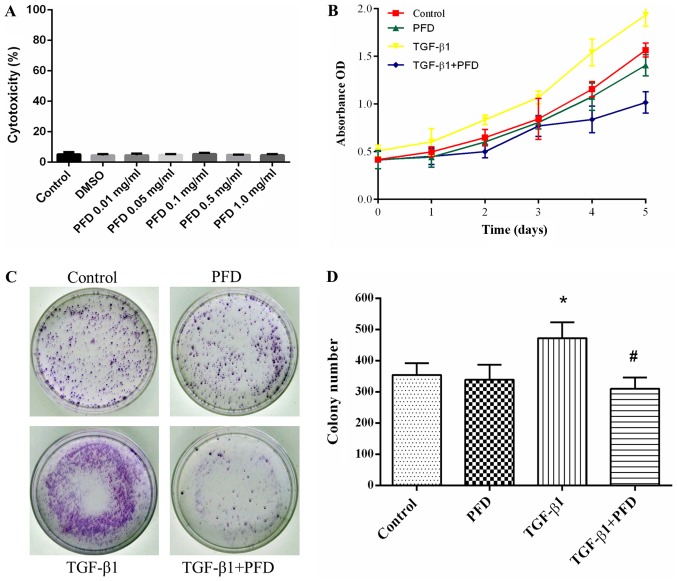
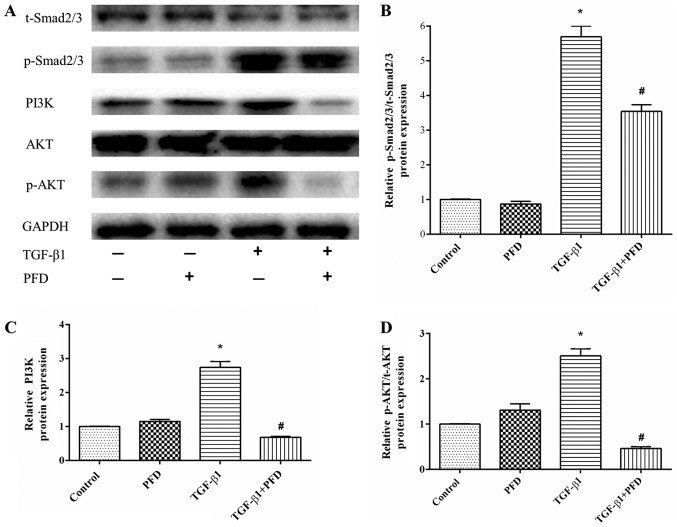
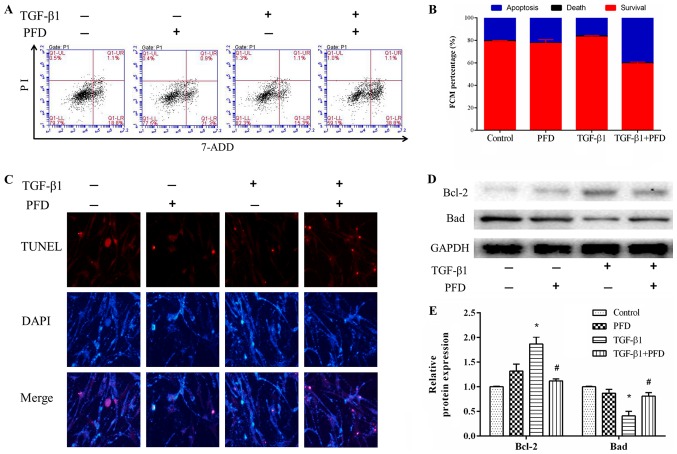
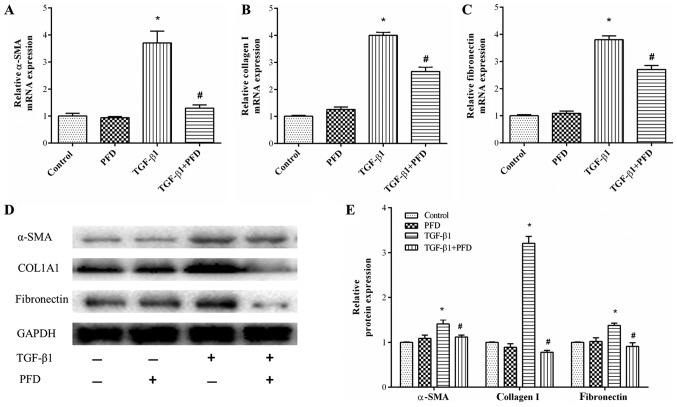
Intestinal fibroblasts, the main effector cells of intestinal fibrosis, are considered to be a good target for anti‑fibrotic therapy. The aim of the present study was to examine the effects of pirfenidone (PFD) on human intestinal fibroblasts (HIFs) stimulated by transforming growth factor (TGF)‑β1 and to explore the potential mechanism. Prior to stimulation with TGF‑β1 (10 ng/ml), HIFs were treated with or without PFD (1 mg/ml). Cell proliferation was determined by Cell Counting Kit (CCK)‑8 and colony formation assays, and cell apoptosis was assessed using flow cytometry and a TUNEL assay. Reverse transcription‑quantitative polymerase chain reaction and western blotting were performed to evaluate the mRNA and protein expressions of α‑smooth muscle actin (α‑SMA), collagen I and fibronectin. The protein expression of TGF‑β1/mothers against decapentaplegic homolog (Smad) and phosphoinositide 3‑kinase (PI3K)/protein kinase B (AKT) signaling pathways was evaluated by western blotting. CCK‑8 and colony formation assays demonstrated that PFD significantly inhibited cell proliferation in HIFs stimulated with TGF‑β1. Flow cytometry and TUNEL assays revealed that PFD treatment significantly enhanced apoptosis in TGF‑β1‑stimulated HIFs. In addition, PFD markedly reduced TGF‑β1‑induced HIF activities, such as myofibroblast differentiation (α‑SMA), and collagen production (collagen I and fibronectin). These effects of PFD were mediated by the inhibition of the TGF‑β1/Smad and PI3K/AKT signaling pathways. Therefore, the present study demonstrated that PFD reduced TGF‑β1‑induced fibrogenic activities of HIFs, suggesting that PFD may be a potential therapeutic agent for intestinal fibrosis.
肠成纤维细胞是肠纤维化的主要效应细胞,被认为是抗纤维化治疗的一个良好靶点。本研究旨在探讨吡非尼酮(PFD)对转化生长因子(TGF)-β1刺激的人肠成纤维细胞(HIF)的作用,并探讨其潜在机制。在用 TGF-β1(10 ng/ml)刺激之前,用或不用 PFD(1 mg/ml)处理 HIF。通过细胞计数试剂盒(CCK)-8 和集落形成实验检测细胞增殖,通过流式细胞术和 TUNEL 检测评估细胞凋亡。采用逆转录-定量聚合酶链反应和蛋白质印迹法检测α-平滑肌肌动蛋白(α-SMA)、I 型胶原和纤维连接蛋白的 mRNA 和蛋白表达。采用蛋白质印迹法检测 TGF-β1/母亲对抗颅足畸形蛋白(Smad)和磷酸肌醇 3-激酶(PI3K)/蛋白激酶 B(AKT)信号通路的蛋白表达。CCK-8 和集落形成实验表明,PFD 显著抑制 TGF-β1 刺激的 HIF 细胞增殖。流式细胞术和 TUNEL 检测显示,PFD 处理可显著增强 TGF-β1 刺激的 HIF 细胞凋亡。此外,PFD 可显著降低 TGF-β1 诱导的 HIF 活性,如肌成纤维细胞分化(α-SMA)和胶原产生(I 型胶原和纤维连接蛋白)。PFD 的这些作用是通过抑制 TGF-β1/Smad 和 PI3K/AKT 信号通路介导的。因此,本研究表明 PFD 可降低 TGF-β1 诱导的 HIF 纤维生成活性,提示 PFD 可能是治疗肠纤维化的潜在药物。