Nivesvivat Thirapa, Piyaraj Phunlerd, Thunyaharn Sudaluck, Watanaveeradej Veerachai, Suwanpakdee Detchvijitr
Department of Pediatrics, Phramongkutklao Hospital, Bangkok, Thailand.
Department of Parasitology, Phramongkutklao College of Medicine, Bangkok, Thailand.
BMC Res Notes. 2018 Aug 29;11(1):624. doi: 10.1186/s13104-018-3729-3.
Extended-spectrum beta-lactamase (ESBL) producing Enterobacteriaceae infection is an emerging problem in paediatric populations leading to increased mortality. The purpose of this study was to determine the prevalence, risk factors and clinical outcomes of ESBL-producing Enterobacteriaceae in paediatric blood stream infections (BSIs). A retrospective review of paediatric patients diagnosed with Enterobacteriaceae bacteremia was performed at Phramongkutklao Hospital from 2010 to 2017.
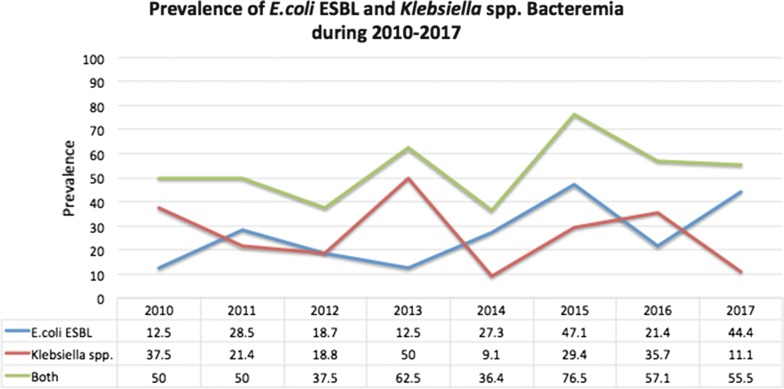
Among 97 non-duplicated blood isolates, the prevalence of ESBL-producing Enterobacteriaceae was 53.6% (28.9% Escherichia coli and 25.8% Klebsiella spp. isolates). The study indicated that the prevalence of ESBL infection was higher among patients with chronic illness, especially hematologic malignancies, than among patients without underlying disease (P = 0.01). No differences were observed in the prior use of any antibiotics, the use of extended-spectrum cephalosporin, neutropaenia or the presence of an indwelling central venous catheter. Mortality in the ESBL group was significantly higher than that in the non-ESBL group, with observed mortalities of 38.9% and 13.3%, respectively (P < 0.05). In conclusion, BSIs with ESBL-producing Enterobacteriaceae tended to increase infection rates and impact survival rates among paediatric patients.
产超广谱β-内酰胺酶(ESBL)的肠杆菌科细菌感染在儿科人群中是一个新出现的问题,会导致死亡率上升。本研究的目的是确定儿科血流感染(BSI)中产ESBL肠杆菌科细菌的患病率、危险因素及临床结局。对2010年至2017年在诗里蒙坤贴医院诊断为肠杆菌科菌血症的儿科患者进行了回顾性研究。
在97株非重复血培养分离株中,产ESBL肠杆菌科细菌的患病率为53.6%(大肠杆菌分离株占28.9%,克雷伯菌属分离株占25.8%)。研究表明,慢性病患者,尤其是血液系统恶性肿瘤患者中ESBL感染的患病率高于无基础疾病的患者(P = 0.01)。在既往使用任何抗生素、使用广谱头孢菌素、中性粒细胞减少或存在中心静脉留置导管方面未观察到差异。ESBL组的死亡率显著高于非ESBL组,观察到的死亡率分别为38.9%和13.3%(P < 0.05)。总之,产ESBL肠杆菌科细菌引起的BSI往往会增加儿科患者的感染率并影响生存率。