Anothaisintawee Thunyarat, Lertrattananon Dumrongrat, Thamakaison Sangsulee, Thakkinstian Ammarin, Reutrakul Sirimon
Department of Family Medicine, Faculty of Medicine Ramathibodi Hospital, Mahidol University, Bangkok, Thailand.
Section for Clinical Epidemiology and Biostatistics, Faculty of Medicine Ramathibodi Hospital, Mahidol University, Bangkok, Thailand.
Front Endocrinol (Lausanne). 2018 Aug 15;9:435. doi: 10.3389/fendo.2018.00435. eCollection 2018.
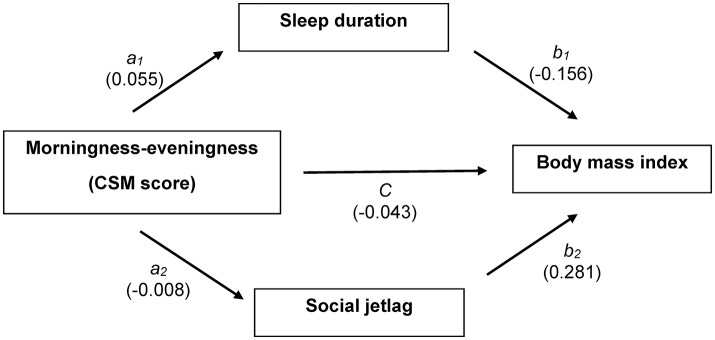
Circadian system is known to influence energy metabolism. Recent evidence suggested that evening preference could be associated with higher body mass index (BMI). Moreover, evening preference is known to be associated with insufficient sleep duration and greater social jetlag, both described to be associated with obesity. This study aimed to explore whether morningness-eveningness was directly associated with BMI or its effect was transmitted through sleep duration or social jetlag in patients with prediabetes. A total 2,133 patients with prediabetes were enrolled. Morningness-eveningness was assessed using a Composite Scale of Morningness (CSM). Average weekly sleep duration and sleep timing were obtained, and social jetlag was calculated. BMI was calculated by weight (kg)/height (m). A mediation analysis was performed based on two pathways, i.e. CSM→sleep→duration→BMI and CSM→social jetlag→BMI. A sequential equation model was used to estimate the direct and indirect effects of CSM on BMI. Mean (SD) age and BMI were 63.6 (9.2) years and 25.8 (4.0) kg/m. For CSM→sleep duration→BMI pathway, every one point decrease in CSM (more evening preference) was associated with a decrease in sleep duration by 0.054 h (95% CI 0.043-0.066), whereas sleep duration was negatively associated with BMI (coefficient = -0.156, 95%CI -0.288, -0.024). Mediation analysis indicated that a change in CSM (from 90th to 10th percentile, more evening preference) was associated with a decrease in sleep duration and an increase in BMI by 0.102 kg/m (95% CI 0.015, 0.207). In addition, this change in CSM was directly associated with an increase in BMI by 0.511 kg/m (95%CI 0.030, 0.952). The CSM→social jetlag→BMI pathway analysis revealed that social jetlag was not significantly associated with BMI. A subgroup analysis in those aged ≤60 years ( = 784) revealed that each hour increase in social jetlag was associated with an increase in BMI by 0.56 kg/m ( = 0.026) while CSM and sleep duration were not. In patients with prediabetes, more evening preference was directly associated with higher BMI and indirectly through insufficient sleep duration, while social jetlag did not mediate the relationship between CSM and BMI. In those ≤60 years, only greater social jetlag was associated with higher BMI. These data could inform further interventional studies to reduce BMI in this high risk group.
已知昼夜节律系统会影响能量代谢。最近的证据表明,晚睡偏好可能与较高的体重指数(BMI)有关。此外,已知晚睡偏好与睡眠时间不足和较大的社会时差有关,而这两者都被认为与肥胖有关。本研究旨在探讨晨型-夜型偏好是否与BMI直接相关,或者其影响是否通过糖尿病前期患者的睡眠时间或社会时差来传递。总共招募了2133名糖尿病前期患者。使用晨型综合量表(CSM)评估晨型-夜型偏好。获取平均每周睡眠时间和睡眠时间,并计算社会时差。BMI通过体重(kg)/身高(m)计算得出。基于两条路径进行中介分析,即CSM→睡眠→时长→BMI和CSM→社会时差→BMI。使用序列方程模型来估计CSM对BMI的直接和间接影响。平均(标准差)年龄和BMI分别为63.6(9.2)岁和25.8(4.0)kg/m²。对于CSM→睡眠时间→BMI路径,CSM每降低1分(更倾向于晚睡)与睡眠时间减少0.054小时相关(95%置信区间0.043 - 0.066),而睡眠时间与BMI呈负相关(系数 = -0.156,95%置信区间 -0.288,-0.024)。中介分析表明,CSM的变化(从第90百分位数到第10百分位数,更倾向于晚睡)与睡眠时间减少以及BMI增加0.102 kg/m²相关(95%置信区间0.015,0.207)。此外,CSM的这种变化与BMI直接增加0.511 kg/m²相关(95%置信区间0.030,0.952)。CSM→社会时差→BMI路径分析显示,社会时差与BMI无显著关联。在年龄≤60岁的人群(n = 784)中进行的亚组分析显示,社会时差每增加1小时与BMI增加0.56 kg/m²相关(P = 0.026),而CSM和睡眠时间则无此关联。在糖尿病前期患者中,更倾向于晚睡与较高的BMI直接相关,且通过睡眠时间不足间接相关,而社会时差并未介导CSM与BMI之间的关系。在年龄≤60岁的人群中,只有较大的社会时差与较高的BMI相关。这些数据可为进一步的干预研究提供参考,以降低这一高危人群的BMI。