Liu Dongfei, Lipponen Katriina, Quan Peng, Wan Xiaocao, Zhang Hongbo, Mäkilä Ermei, Salonen Jarno, Kostiainen Risto, Hirvonen Jouni, Kotiaho Tapio, Santos Hélder A
Drug Research Program, Division of Pharmaceutical Chemistry and Technology, Faculty of Pharmacy, Helsinki Institute of Life Science, HiLIFE, and Department of Chemistry, Faculty of Science, University of Helsinki, Helsinki FI-00014, Finland.
Department of Pharmaceutical Science, School of Pharmacy, Shenyang Pharmaceutical University, 103 Wenhua Road, Shenyang, Liaoning 110016, China.
ACS Biomater Sci Eng. 2018 Jul 9;4(7):2308-2313. doi: 10.1021/acsbiomaterials.8b00343. Epub 2018 Jun 14.
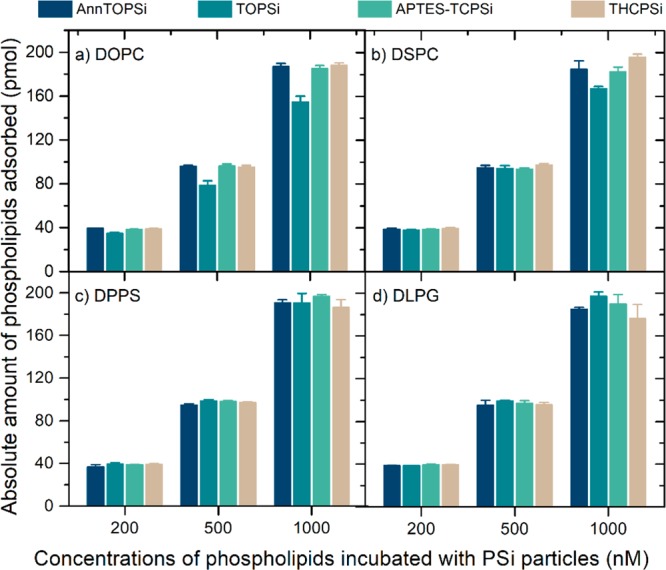
By exploiting its porous structure and high loading capacity, porous silicon (PSi) is a promising biomaterial to fabricate protocells and biomimetic reactors. Here, we have evaluated the impact of physicochemical properties of PSi particles [thermally oxidized PSi, TOPSi; annealed TOPSi, AnnTOPSi; (3-aminopropyl) triethoxysilane functionalized thermally carbonized PSi, APTES-TCPSi; and thermally hydrocarbonized PSi, THCPSi] on their surface interactions with different phospholipids. All of the four phospholipids were similarly adsorbed by the surface of PSi particles, except for TOPSi. Among four PSi particles, TOPSi with hydrophilic surface and smaller pore size showed the weakest adsorption toward phosphatidylcholines. By increasing the pore size from roughly 12.5 to 18.0 nm (TOPSi vs AnnTOPSi), the quantity of phosphatidylcholines adsorbed by TOPSi was enhanced to the same level of hydrophilic APTES-TCPSi and hydrophobic THCPSi. The 1,2-dioleoyl--glycero-3-phosphocholine (DOPC) exhibited the highest release ratio of phospholipids from all four PSi particles, and phosphatidylserine (DPPS) showed the lowest release ratio of phospholipids from PSi particles, except for TOPSi, which adsorbed less phospholipids due to the small pore size. There is consistency in the release extent of phospholipids from PSi particles and the isosteric heat of adsorption. Overall, our study demonstrates the importance of pore size and surface chemistry of PSi particles as well as the structure of phospholipids on their interactions. The obtained information can be employed to guide the selection of PSi particles and phospholipids to fabricate highly ordered structures, for example, protocells, or biomimetic reactors.
通过利用其多孔结构和高负载能力,多孔硅(PSi)是一种用于制造原始细胞和仿生反应器的有前途的生物材料。在此,我们评估了PSi颗粒[热氧化PSi,TOPSi;退火TOPSi,AnnTOPSi;(3-氨丙基)三乙氧基硅烷功能化热碳化PSi,APTES-TCPSi;以及热烃化PSi,THCPSi]的物理化学性质对其与不同磷脂表面相互作用的影响。除TOPSi外,所有四种磷脂都以相似的方式被PSi颗粒表面吸附。在四种PSi颗粒中,具有亲水性表面和较小孔径的TOPSi对磷脂酰胆碱的吸附最弱。通过将孔径从约12.5nm增加到18.0nm(TOPSi与AnnTOPSi相比),TOPSi吸附的磷脂酰胆碱数量增加到与亲水性APTES-TCPSi和疏水性THCPSi相同的水平。1,2-二油酰基-sn-甘油-3-磷酸胆碱(DOPC)在所有四种PSi颗粒中表现出最高的磷脂释放率,而磷脂酰丝氨酸(DPPS)在PSi颗粒中表现出最低的磷脂释放率,但TOPSi除外,由于其孔径小,吸附的磷脂较少。PSi颗粒中磷脂的释放程度与吸附等温热之间存在一致性。总体而言,我们的研究证明了PSi颗粒的孔径和表面化学以及磷脂结构对它们相互作用的重要性。所获得的信息可用于指导选择PSi颗粒和磷脂以制造高度有序的结构,例如原始细胞或仿生反应器。