Center for Advanced Bioanalysis GmbH . Linz , 4020 , Austria.
Institute of Applied Physics , TU Wien , Wien , 1040 , Austria.
Langmuir. 2018 Dec 11;34(49):15021-15027. doi: 10.1021/acs.langmuir.8b01942. Epub 2018 Aug 30.
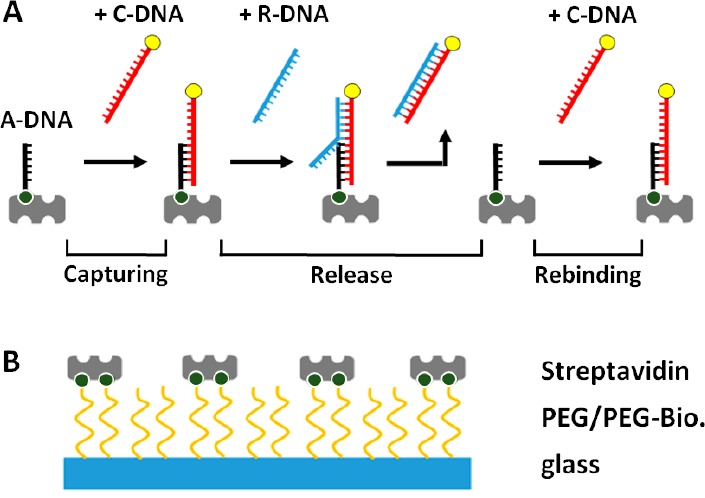
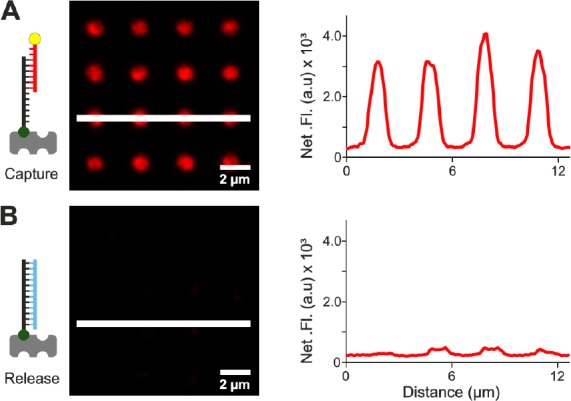
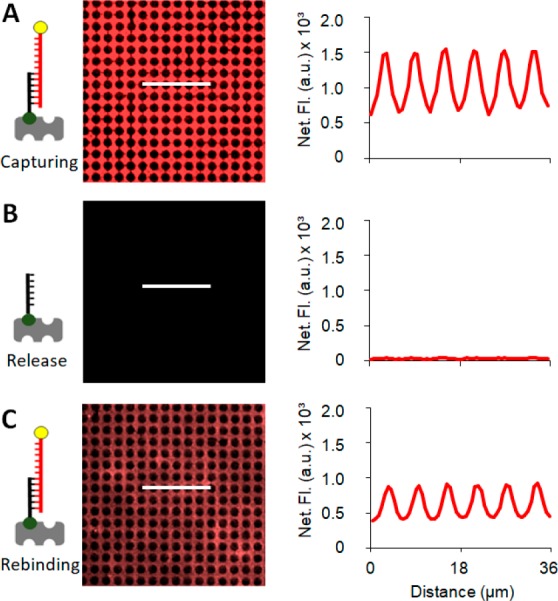
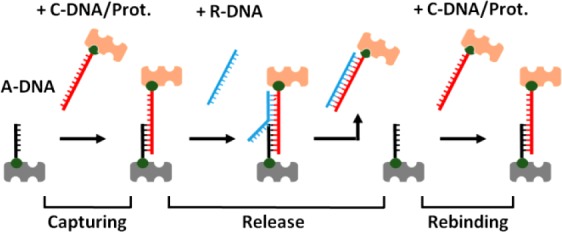
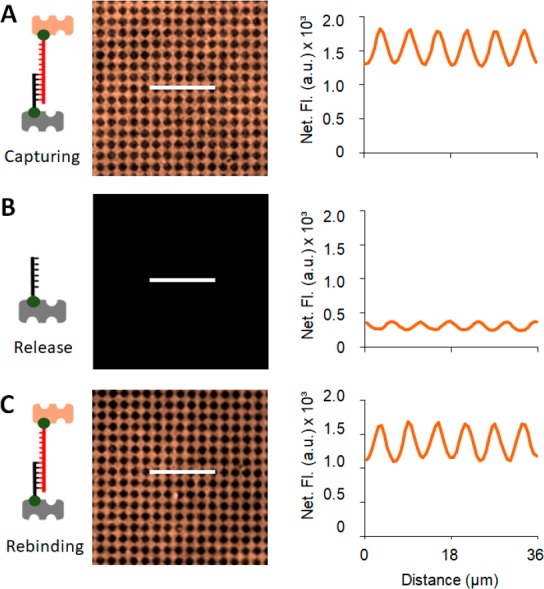
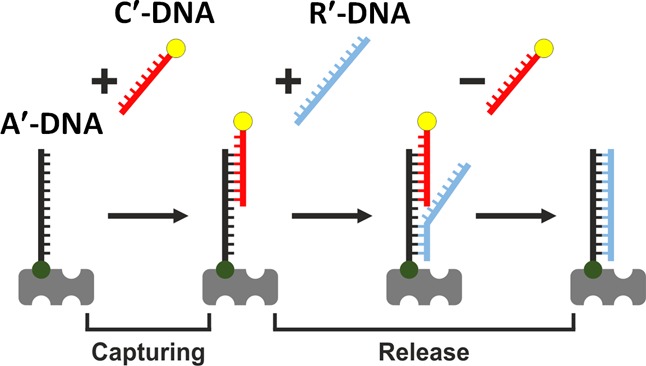
The controlled immobilization of biomolecules onto surfaces is relevant in biosensing and cell biological research. Spatial control is achieved by surface-tethering molecules in micro- or nanoscale patterns. Yet, there is an increasing demand for temporal control over how long biomolecular cargo stays immobilized until released into the medium. Here, we present a DNA hybridization-based approach to reversibly anchor biomolecular cargo onto micropatterned surfaces. Cargo is linked to a DNA oligonucleotide that hybridizes to a sequence-complementary, surface-tethered strand. The cargo is released from the substrate by the addition of an oligonucleotide that disrupts the duplex interaction via toehold-mediated strand displacement. The unbound tether strand can be reloaded. The generic strategy is implemented with small-molecule or protein cargo, varying DNA sequences, and multiple surface patterning routes. The approach may be used as a tool in biological research to switch membrane proteins from a locally fixed to a free state, or in biosensing to shed biomolecular receptors to regenerate the sensor surface.
将生物分子受控地固定在表面上与生物传感和细胞生物学研究相关。通过在微纳尺度图案上表面固定分子来实现空间控制。然而,人们越来越需要对生物分子货物在释放到介质中之前固定的时间进行时间控制。在这里,我们提出了一种基于 DNA 杂交的方法,可将生物分子货物可逆地固定在微图案化表面上。货物与杂交至与表面固定链互补的序列的 DNA 寡核苷酸相连。通过添加破坏双链相互作用的寡核苷酸,通过引发介导的链置换将货物从基底上释放。未结合的固定链可以重新加载。该通用策略适用于小分子或蛋白质货物、不同的 DNA 序列和多种表面图案化途径。该方法可作为生物研究中的工具,将膜蛋白从局部固定状态切换到自由状态,或在生物传感中,将生物分子受体洗脱以再生传感器表面。