Institute of Applied Physics, TU Wien, Wiedner Hauptstrasse 8-10, Vienna 1040, Austria.
Biomolecules. 2018 May 17;8(2):28. doi: 10.3390/biom8020028.
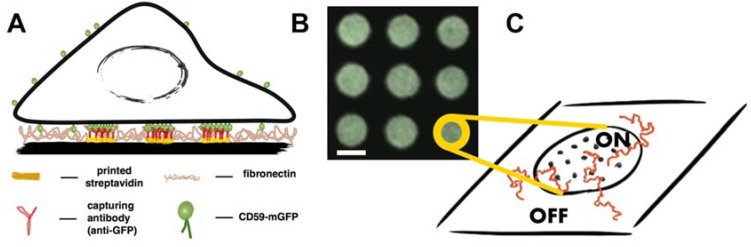
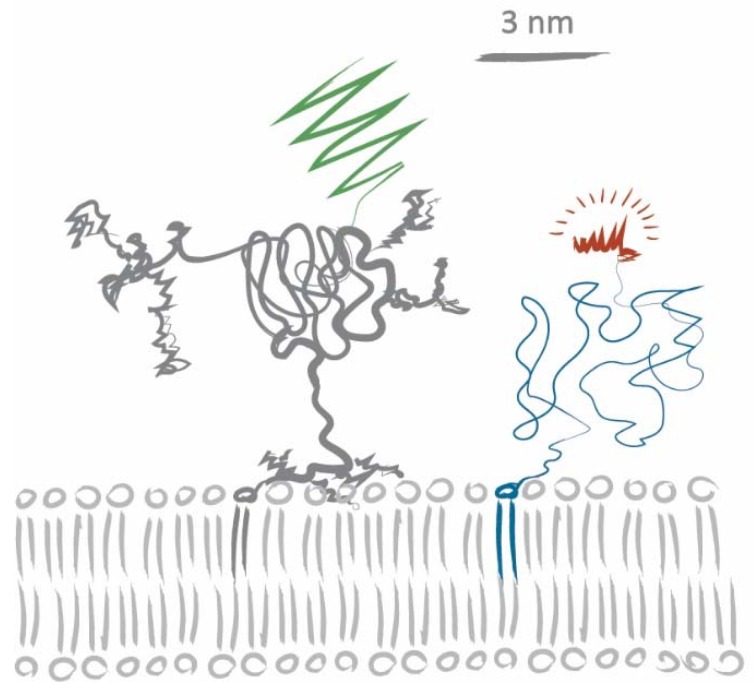
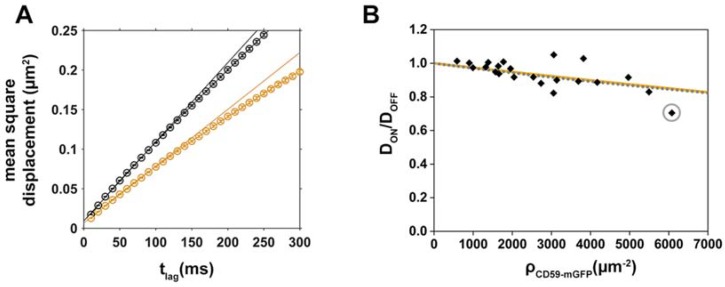
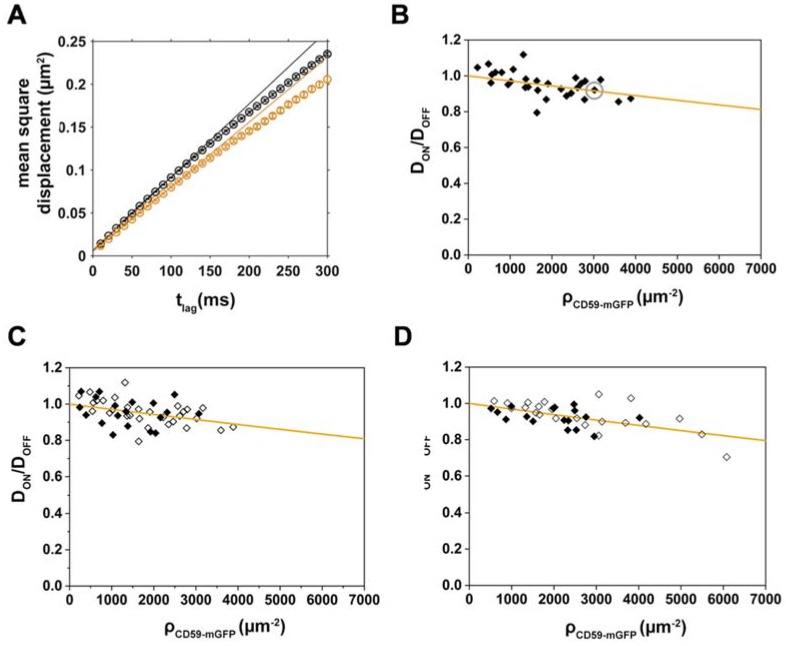
The organization and dynamics of proteins and lipids in the plasma membrane, and their role in membrane functionality, have been subject of a long-lasting debate. Specifically, it is unclear to what extent membrane proteins are affected by their immediate lipid environment and vice versa. Studies on model membranes and plasma membrane vesicles indicated preferences of proteins for lipid phases characterized by different acyl chain order; however, whether such phases do indeed exist in live cells is still not known. Here, we refine a previously developed micropatterning approach combined with single molecule tracking to quantify the influence of the glycosylphosphatidylinositol-anchored (GPI-anchored) protein CD59 on its molecular environment directly in the live cell plasma membrane. We find that locally enriched and immobilized CD59 presents obstacles to the diffusion of fluorescently labeled lipids with a different phase-partitioning behavior independent of cell cholesterol levels and type of lipid. Our results give no evidence for either specific binding of the lipids to CD59 or the existence of nanoscopic ordered membrane regions associated with CD59.
质膜中蛋白质和脂质的组织和动力学及其在膜功能中的作用一直是一个长期存在的争论。具体来说,膜蛋白在多大程度上受到其直接脂质环境的影响,反之亦然,这一点还不清楚。关于模型膜和质膜小泡的研究表明,蛋白质对不同酰链有序性特征的脂质相具有偏好性;然而,在活细胞中是否确实存在这样的相仍然未知。在这里,我们改进了以前开发的一种微图案化方法,结合单分子跟踪,以直接在活细胞质膜中定量测定糖基磷脂酰肌醇锚定(GPI 锚定)蛋白 CD59 对其分子环境的影响。我们发现,局部富集和固定的 CD59 会阻碍具有不同相分离行为的荧光标记脂质的扩散,而与细胞胆固醇水平和脂质类型无关。我们的结果没有证据表明脂质与 CD59 有特异性结合,也没有证据表明与 CD59 相关的纳米级有序膜区域的存在。