Department of Physics, Universidad de Los Andes, Bogotá, 111711, Colombia.
Department of Applied and Engineering Physics, Cornell University, Ithaca, NY, 14853, USA.
Nat Commun. 2018 Aug 30;9(1):3538. doi: 10.1038/s41467-018-05750-z.
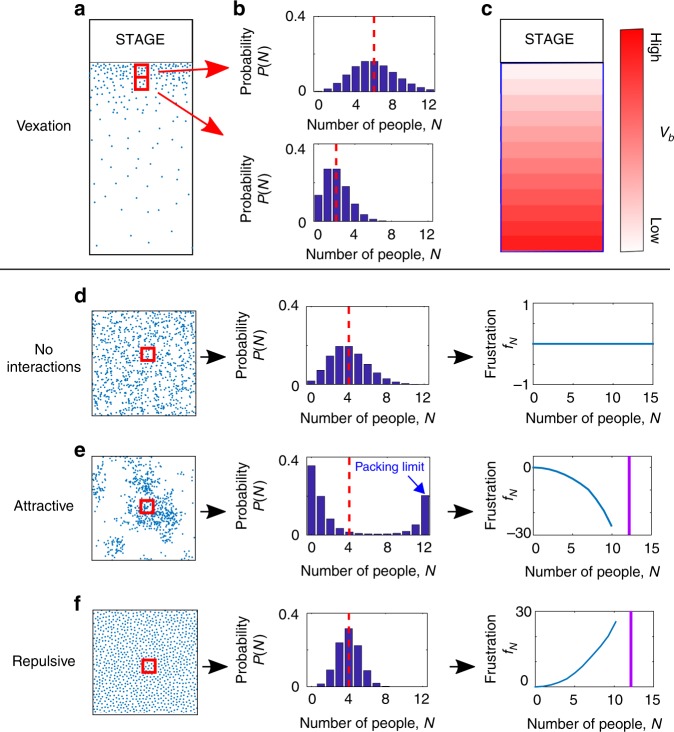
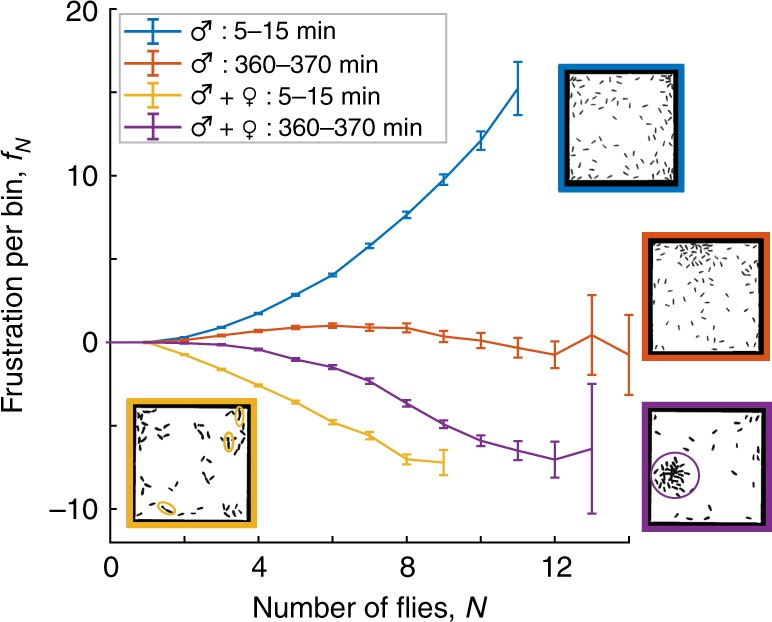
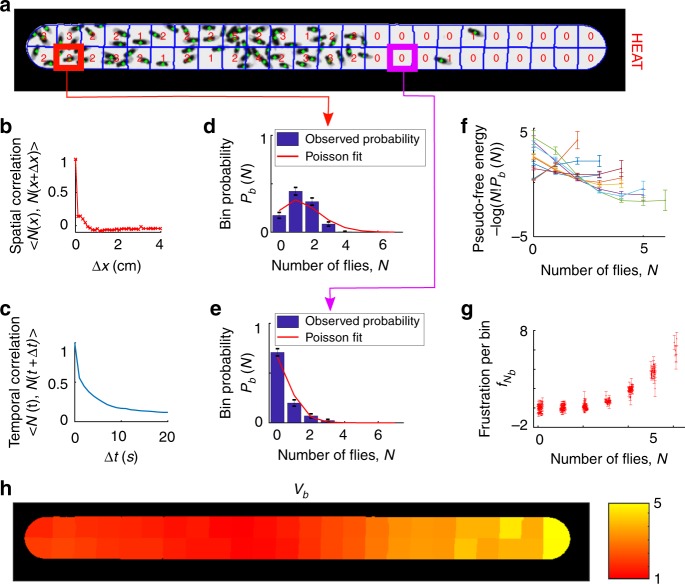
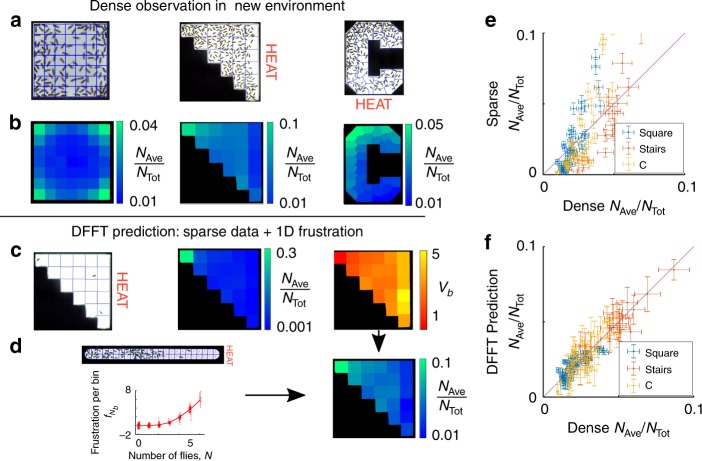
A primary goal of collective population behavior studies is to determine the rules governing crowd distributions in order to predict future behaviors in new environments. Current top-down modeling approaches describe, instead of predict, specific emergent behaviors, whereas bottom-up approaches must postulate, instead of directly determine, rules for individual behaviors. Here, we employ classical density functional theory (DFT) to quantify, directly from observations of local crowd density, the rules that predict mass behaviors under new circumstances. To demonstrate our theory-based, data-driven approach, we use a model crowd consisting of walking fruit flies and extract two functions that separately describe spatial and social preferences. The resulting theory accurately predicts experimental fly distributions in new environments and provides quantification of the crowd "mood". Should this approach generalize beyond milling crowds, it may find powerful applications in fields ranging from spatial ecology and active matter to demography and economics.
集体群体行为研究的主要目标是确定控制人群分布的规则,以便预测新环境中的未来行为。当前的自上而下的建模方法描述的是特定的涌现行为,而不是预测,而自下而上的方法则必须假设,而不是直接确定,个体行为的规则。在这里,我们采用经典的密度泛函理论(DFT),直接从对局部人群密度的观测中确定在新情况下预测质量行为的规则。为了展示我们基于理论、数据驱动的方法,我们使用由行走的果蝇组成的模型人群,并提取两个分别描述空间和社会偏好的函数。得到的理论准确地预测了新环境中实验蝇的分布,并对人群的“情绪”进行了量化。如果这种方法能够推广到其他人群,它可能会在从空间生态学和活性物质到人口统计学和经济学等领域找到强大的应用。