Division of Human Nutrition, Wageningen University (WU), Stippeneng 4, building 124, 6708 WE, Wageningen, The Netherlands.
Department of Physiology, Radboud University Nijmegen, Nijmegen, The Netherlands.
Eur J Appl Physiol. 2018 Nov;118(11):2349-2357. doi: 10.1007/s00421-018-3961-5. Epub 2018 Aug 23.
The aim of the present study was to assess the effect of prolonged and repeated exercise on iron metabolism in middle-aged adults and to compare differences between sexes.
50 male (58.9 ± 9.9 year) and 48 female (50.9 ± 11.2 year) individuals were monitored on 4 consecutive days at which they walked on average 8 h and 44 min per day at a self-determined pace. Blood samples were collected 1 or 2 days prior to the start of the exercise (baseline) and every day immediately post-exercise. Samples were analysed for iron, ferritin, haemoglobin, and haptoglobin concentrations.
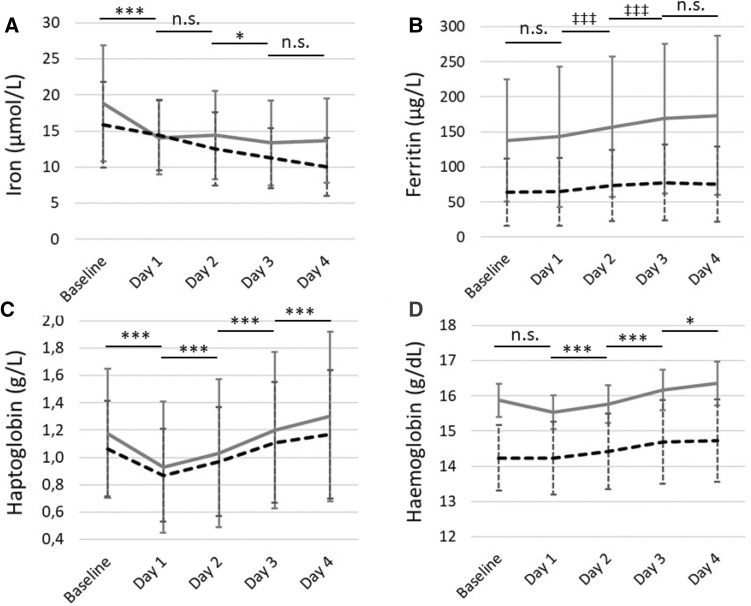
Plasma iron decreased across days, while ferritin increased across days (both p < 0.001). Haptoglobin showed a decrease (p < 0.001) after the first day and increased over subsequent days (p < 0.001). Haemoglobin did not change after the first day, but increased during subsequent days (p < 0.05). At baseline, 8% of the participants had iron concentrations below minimum reference value (10 µmol/L), this increased to 43% at day 4. There was an interaction between sex and exercise days on iron (p = 0.028), ferritin (p < 0.001) and haemoglobin levels (p = 0.004), but not on haptoglobin levels.
This study showed decreases in iron, increases in ferritin, a decrease followed by increases in haptoglobin and no change followed by increases in haemoglobin. This is most likely explained by (foot strike) haemolysis, inflammation, and sweat and urine losses. These processes resulted in iron levels below minimum reference value in a large number of our participants.
本研究旨在评估中年人群长时间、重复运动对铁代谢的影响,并比较男女之间的差异。
连续 4 天,50 名男性(58.9±9.9 岁)和 48 名女性(50.9±11.2 岁)以自我设定的速度平均每天行走 8 小时 44 分钟。在运动开始前 1 天或 2 天(基线)和每天运动后立即采集血液样本。样本分析铁、铁蛋白、血红蛋白和触珠蛋白浓度。
血浆铁浓度在整个研究期间逐渐降低,而铁蛋白浓度逐渐升高(均 p<0.001)。触珠蛋白在第 1 天下降(p<0.001),随后几天逐渐升高(p<0.001)。血红蛋白在第 1 天没有变化,但在随后的几天逐渐升高(p<0.05)。基线时,8%的参与者铁浓度低于最低参考值(10 μmol/L),第 4 天增加到 43%。性别和运动天数对铁(p=0.028)、铁蛋白(p<0.001)和血红蛋白水平(p=0.004)有交互作用,但对触珠蛋白水平没有交互作用。
本研究显示铁浓度降低,铁蛋白浓度升高,触珠蛋白浓度先降低后升高,血红蛋白浓度先无变化后升高。这很可能是由(足部冲击)溶血、炎症、汗液和尿液丢失引起的。这些过程导致我们的许多参与者的铁水平低于最低参考值。