Quality of Medical Laboratories, Institute of Public Health, Sciensano, Brussels, Belgium.
Institute of Tropical Medicine, Antwerp, Belgium.
PLoS One. 2018 Aug 31;13(8):e0201622. doi: 10.1371/journal.pone.0201622. eCollection 2018.
In non-endemic settings, expertise in malaria microscopy is limited and rapid diagnostic tests (RDTs) are an adjunct to malaria diagnosis.
We performed an External Quality Assessment (EQA) on reading and interpretation of malaria RDTs in a non-endemic setting.
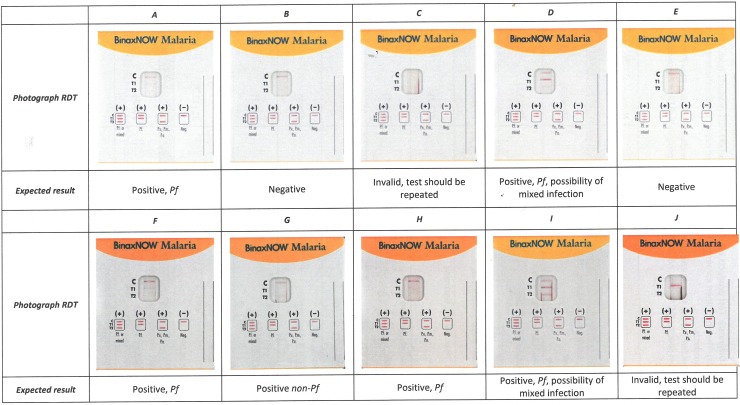
Participants were medical laboratories in Belgium and the Grand Duchy of Luxembourg using malaria RDTs; they received (i) 10 high-resolution photographs presenting test line combinations of RDTs with interpretations listed in a multiple choice format and (ii) a questionnaire about their practices of malaria diagnosis.
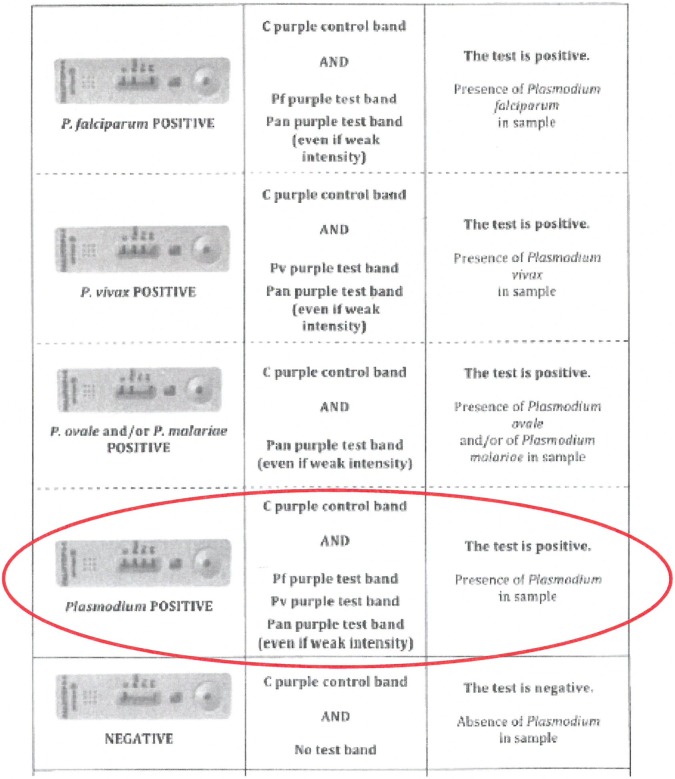
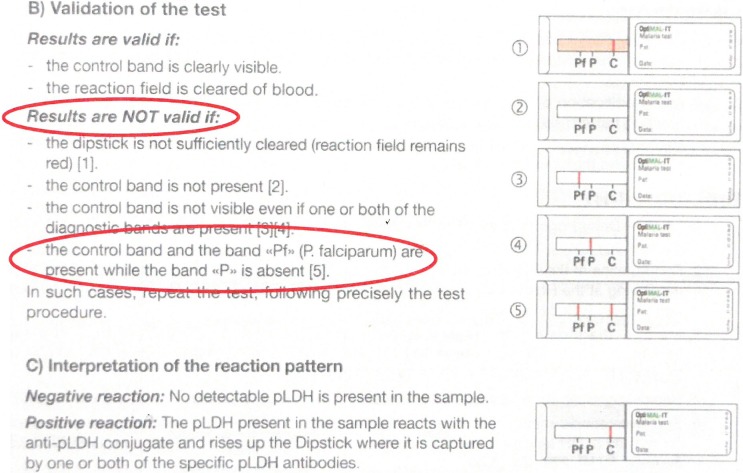
Among 135 subscribing laboratories, 134 (99.3%) used 139 RDT products (11 different products from 8 brands). After exclusion of the results of one laboratory, analysis was done for 133 laboratories using 137 RDT products. Scores of 10/10, 9/10 and 8/10 were achieved for 58.4%, 13.1% and 8.0% of 137 RDT products respectively. For three-band P. falciparum-pan-Plasmodium RDTs (113 (82.5%) products, 6 brands), most frequent errors were (1) disregarding faint test lines (18.6%), (2) reporting invalid instead of P. falciparum (16.8%) and (3) reporting "Plasmodium spp., no further differentiation possible" without mentioning the presence or absence of P. falciparum (11.5%). For four-band RDTs (21 (15.3%) products, 1 brand), errors were (4) disregarding faint P. vivax test lines (47.6%) and (5) reporting "Plasmodium spp., no further differentiation possible" without mentioning the presence of P. falciparum and P. vivax (28.6%). Instructions for use (IFU) of only 4 out of 10 RDT products mentioned to interpret faint-intensity test lines as positive (conducive to errors 1 and 4) and IFU of 2 products displayed incorrect information (conducive to errors 2 and 5). Outside of office hours, 36.1% of participants relied on RDTs as the initial diagnostic test; 13.9% did not perform microscopic confirmation.
Reading and interpretation of malaria RDTs was satisfactory, but errors were embedded in the instructions for use of the products. Relying on RDTs alone for malaria diagnosis (about one third of participants) is not a recommended practice.
在非疟疾流行地区,疟疾显微镜检查方面的专业知识有限,快速诊断检测(RDT)是疟疾诊断的辅助手段。
我们在非疟疾流行地区对疟疾 RDT 的读取和解释进行了外部质量评估(EQA)。
参与者是比利时和卢森堡大公国的医学实验室,他们使用疟疾 RDT;他们收到了(i)10 张高分辨率照片,呈现了 RDT 的测试线组合,并以多项选择格式列出了解释,以及(ii)一份关于他们疟疾诊断实践的问卷。
在 135 家订阅实验室中,有 134 家(99.3%)使用了 139 种 RDT 产品(来自 8 个品牌的 11 种不同产品)。排除一家实验室的结果后,对 133 家实验室使用的 137 种 RDT 产品进行了分析。137 种 RDT 产品中,10/10、9/10 和 8/10 的得分分别为 58.4%、13.1%和 8.0%。对于三带 P. falciparum-pan-Plasmodium RDT(113 种产品,6 个品牌),最常见的错误是(1)忽略微弱的测试线(18.6%),(2)报告无效而不是 P. falciparum(16.8%),以及(3)报告“疟原虫属,无法进一步区分”,而不提是否存在 P. falciparum(11.5%)。对于四带 RDT(21 种产品,1 个品牌),错误是(4)忽略微弱的 P. vivax 测试线(47.6%)和(5)报告“疟原虫属,无法进一步区分”,而不提是否存在 P. falciparum 和 P. vivax(28.6%)。10 种 RDT 产品中只有 4 种产品的使用说明书(IFU)提到将弱强度测试线解释为阳性(易犯错误 1 和 4),并且 2 种产品的 IFU 显示了不正确的信息(易犯错误 2 和 5)。在办公时间之外,36.1%的参与者依赖 RDT 作为初始诊断检测;13.9%的人不进行显微镜确认。
读取和解释疟疾 RDT 的结果令人满意,但错误嵌入了产品的使用说明书中。仅依靠 RDT 进行疟疾诊断(约三分之一的参与者)不是推荐的做法。