Division of Analytical Biosciences, LACDR, Leiden University, Leiden, The Netherlands.
Mimetas BV, Leiden, The Netherlands.
Angiogenesis. 2019 Feb;22(1):157-165. doi: 10.1007/s10456-018-9647-0. Epub 2018 Aug 31.
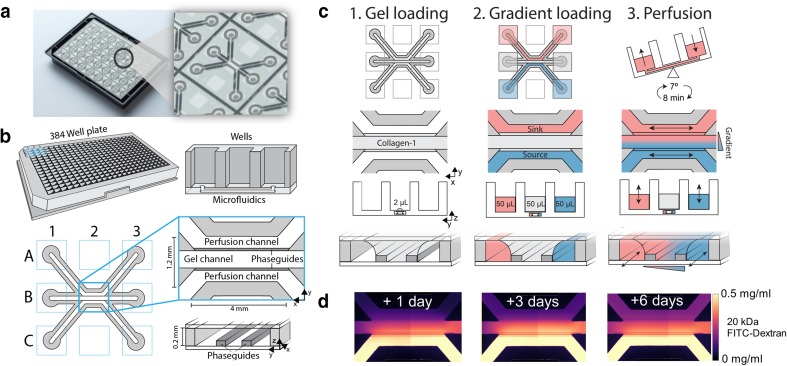
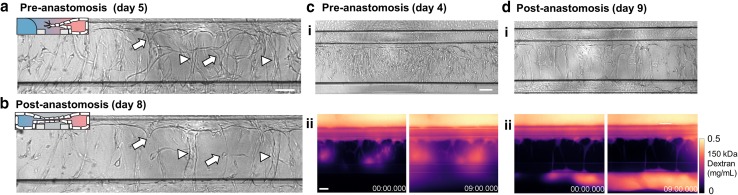
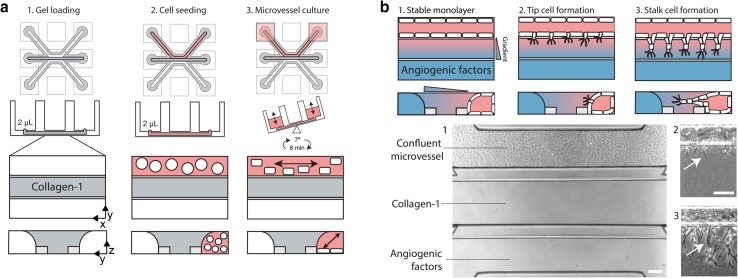
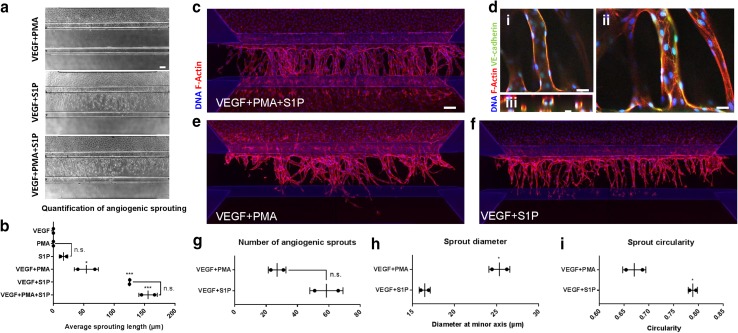
Angiogenic sprouting, the growth of new blood vessels from pre-existing vessels, is orchestrated by cues from within the cellular microenvironment, such as biochemical gradients and perfusion. However, many of these cues are missing in current in vitro models of angiogenic sprouting. We here describe an in vitro platform that integrates both perfusion and the generation of stable biomolecular gradients and demonstrate its potential to study more physiologically relevant angiogenic sprouting and microvascular stabilization. The platform consists of an array of 40 individually addressable microfluidic units that enable the culture of perfused microvessels against a three-dimensional collagen-1 matrix. Upon the introduction of a gradient of pro-angiogenic factors, the endothelial cells differentiated into tip cells that invaded the matrix. Continuous exposure resulted in continuous migration and the formation of lumen by stalk cells. A combination of vascular endothelial growth factor-165 (VEGF-165), phorbol 12-myristate 13-acetate (PMA), and sphingosine-1-phosphate (S1P) was the most optimal cocktail to trigger robust, directional angiogenesis with S1P being crucial for guidance and repetitive sprout formation. Prolonged exposure forces the angiogenic sprouts to anastomose through the collagen to the other channel. This resulted in remodeling of the angiogenic sprouts within the collagen: angiogenic sprouts that anastomosed with the other perfusion channel remained stable, while those who did not retracted and degraded. Furthermore, perfusion with 150 kDa FITC-Dextran revealed that while the angiogenic sprouts were initially leaky, once they fully crossed the collagen lane they became leak tight. This demonstrates that once anastomosis occurred, the sprouts matured and suggests that perfusion can act as an important survival and stabilization factor for the angiogenic microvessels. The robustness of this platform in combination with the possibility to include a more physiological relevant three-dimensional microenvironment makes our platform uniquely suited to study angiogenesis in vitro.
血管生成发芽,即新血管从预先存在的血管中生长,是由细胞微环境中的信号协调的,如生化梯度和灌注。然而,目前的血管生成发芽体外模型中缺少许多这些信号。我们在这里描述了一个整合了灌注和稳定生物分子梯度生成的体外平台,并展示了其研究更具生理相关性的血管生成发芽和微血管稳定的潜力。该平台由 40 个单独寻址的微流控单元阵列组成,可在三维胶原-1 基质上培养灌注微脉管。在引入促血管生成因子梯度后,内皮细胞分化为尖端细胞,侵入基质。持续暴露会导致侧支细胞持续迁移并形成管腔。血管内皮生长因子-165(VEGF-165)、佛波醇 12-肉豆蔻酸 13-醋酸酯(PMA)和鞘氨醇-1-磷酸(S1P)的组合是触发强烈、定向血管生成的最佳鸡尾酒,S1P 对于引导和重复发芽形成至关重要。长时间暴露会迫使血管生成芽通过胶原与另一个通道吻合。这导致了胶原内血管生成芽的重塑:与另一个灌注通道吻合的血管生成芽保持稳定,而那些没有吻合的芽则退缩和降解。此外,用 150 kDa FITC-葡聚糖灌注显示,尽管血管生成芽最初是渗漏的,但一旦它们完全穿过胶原通道,它们就会变得紧密。这表明一旦吻合发生,芽就成熟了,并表明灌注可以作为血管生成微血管的重要存活和稳定因素。该平台的稳健性与纳入更具生理相关性的三维微环境的可能性相结合,使我们的平台非常适合体外研究血管生成。