Einthoven Laboratory for Vascular and Regenerative Medicine, Department of Internal Medicine (Nephrology), Leiden University Medical Center, 2333ZA Leiden, The Netherlands.
Department of Analytical BioSciences and Metabolomics, Division of Systems Biomedicine and Pharmacology, Leiden University, 2333CC Leiden, The Netherlands.
Int J Mol Sci. 2020 Jul 7;21(13):4804. doi: 10.3390/ijms21134804.
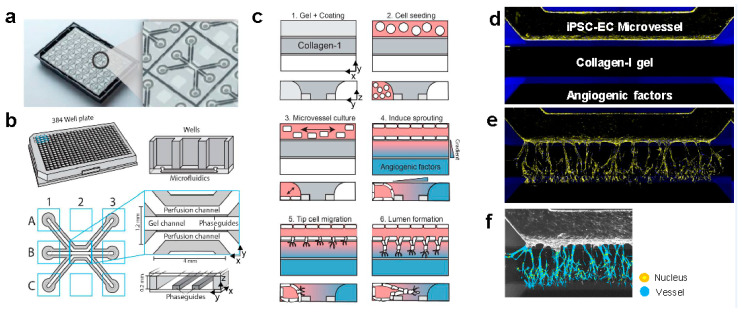
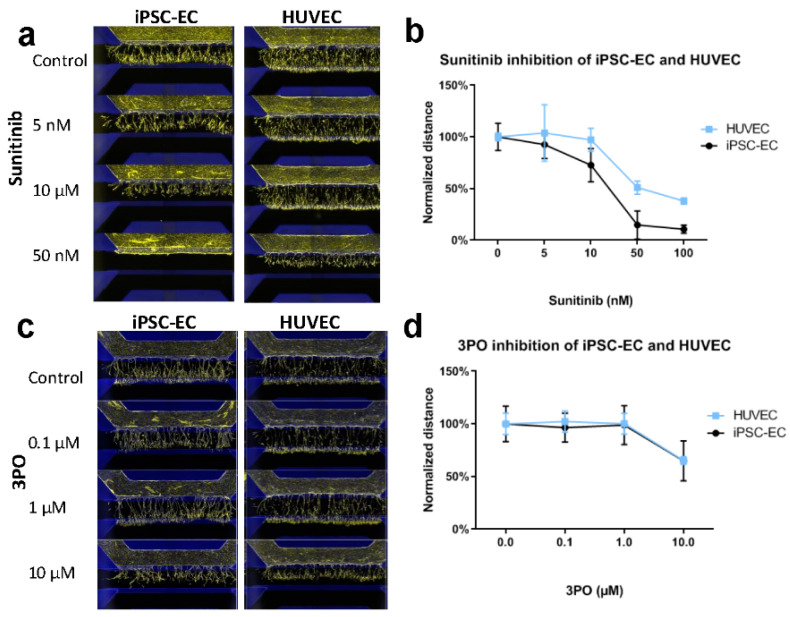
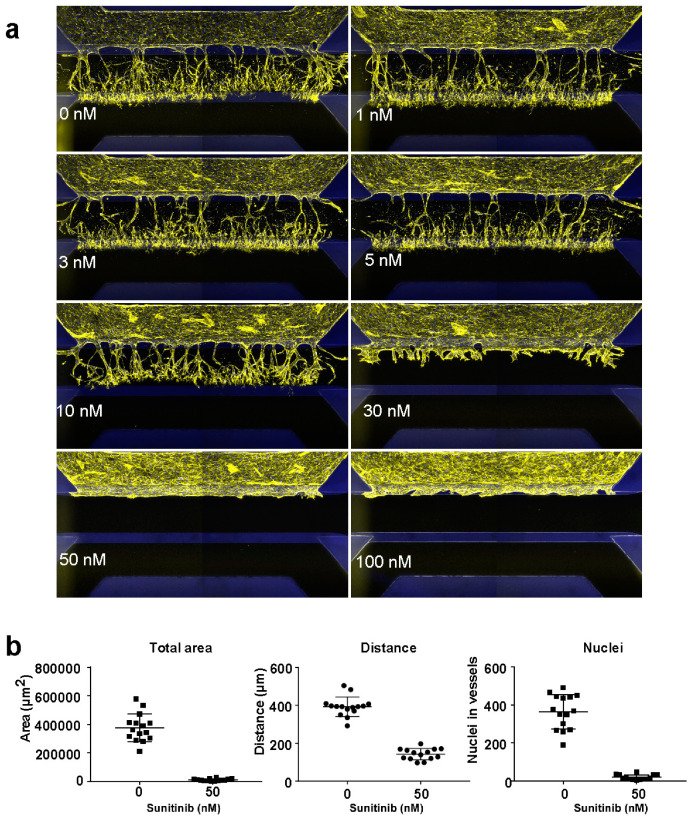
To advance pre-clinical vascular drug research, assays are needed that closely mimic the process of angiogenesis . Such assays should combine physiological relevant culture conditions with robustness and scalability to enable drug screening. We developed a perfused 3D angiogenesis assay that includes endothelial cells (ECs) from induced pluripotent stem cells (iPSC) and assessed its performance and suitability for anti-angiogenic drug screening. Angiogenic sprouting was compared with primary ECs and showed that the microvessels from iPSC-EC exhibit similar sprouting behavior, including tip cell formation, directional sprouting and lumen formation. Inhibition with sunitinib, a clinically used vascular endothelial growth factor (VEGF) receptor type 2 inhibitor, and 3-(3-pyridinyl)-1-(4-pyridinyl)-2-propen-1-one (3PO), a transient glycolysis inhibitor, both significantly reduced the sprouting of both iPSC-ECs and primary ECs, supporting that both cell types show VEGF gradient-driven angiogenic sprouting. The assay performance was quantified for sunitinib, yielding a minimal signal window of 11 and Z-factor of at least 0.75, both meeting the criteria to be used as screening assay. In conclusion, we have developed a robust and scalable assay that includes physiological relevant culture conditions and is amenable to screening of anti-angiogenic compounds.
为了推进血管药物的临床前研究,需要能够模拟血管生成过程的检测方法。这些检测方法应结合生理相关的培养条件,具有稳健性和可扩展性,从而能够进行药物筛选。我们开发了一种灌注的 3D 血管生成检测方法,其中包括诱导多能干细胞(iPSC)来源的内皮细胞(EC),并评估了其性能和用于抗血管生成药物筛选的适用性。比较了血管生成的出芽情况,发现 iPSC-EC 来源的微血管表现出类似的出芽行为,包括尖端细胞的形成、定向出芽和管腔形成。用索拉非尼(一种临床使用的血管内皮生长因子(VEGF)受体 2 抑制剂)和 3-(3-吡啶基)-1-(4-吡啶基)-2-丙烯-1-酮(3PO)(一种短暂的糖酵解抑制剂)进行抑制,均显著减少了 iPSC-EC 和原代 EC 的出芽,支持这两种细胞类型均表现出 VEGF 梯度驱动的血管生成出芽。对索拉非尼进行了检测方法性能的量化,得到了最小信号窗口为 11 和 Z 值至少为 0.75,均符合作为筛选检测的标准。总之,我们开发了一种稳健且可扩展的检测方法,其中包括生理相关的培养条件,并且适用于抗血管生成化合物的筛选。