Bae Ju Yong, Shin Ki Ok, Woo Jinhee, Woo Sang Heon, Jang Ki Soeng, Lee Yul Hyo, Kang Sunghwun
Laboratory of Exercise Biochemistry, Department of Physical Education, Dong-A University, Busan Republic of Korea.
Laboratory of Exercise physiology, Division of Sport Science, Kangwon National University, Chuncheon Republic of Korea.
J Exerc Nutrition Biochem. 2016 Jun;20(2):28-33. doi: 10.20463/jenb.2016.06.20.2.4. Epub 2016 Jun 30.
The purpose of this study was to investigate the effect of exercise and dietary change on obesity and insulin resistance and mTOR signaling protein levels in skeletal muscles of obese rats.
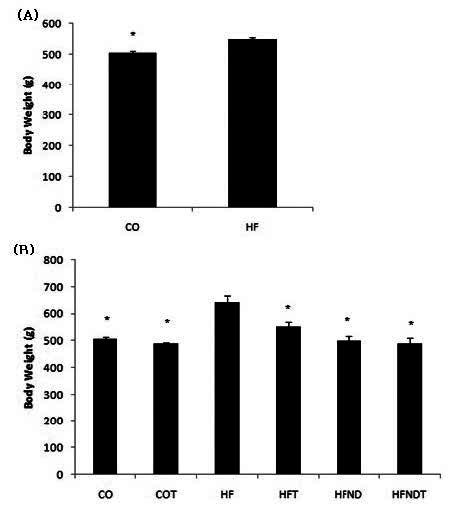
Sixty male Sprague-Dawley rats were divided into CO (Normal diet) and HF (High Fat diet) groups in order to induce obesity for 15 weeks. The rats were then subdivided into CO, COT (CO + Training), HF, HFT (HF + Training), HFND (Dietary change), and HFNDT (HFND + Training) groups (10 rats / group). The training groups underwent moderate-intensity treadmill exercise for 8 weeks, after which soleus muscles were excised and analyzed. Data was statistically analyzed by independent t-test and One-way ANOVA tests with a 0.05 significance level.
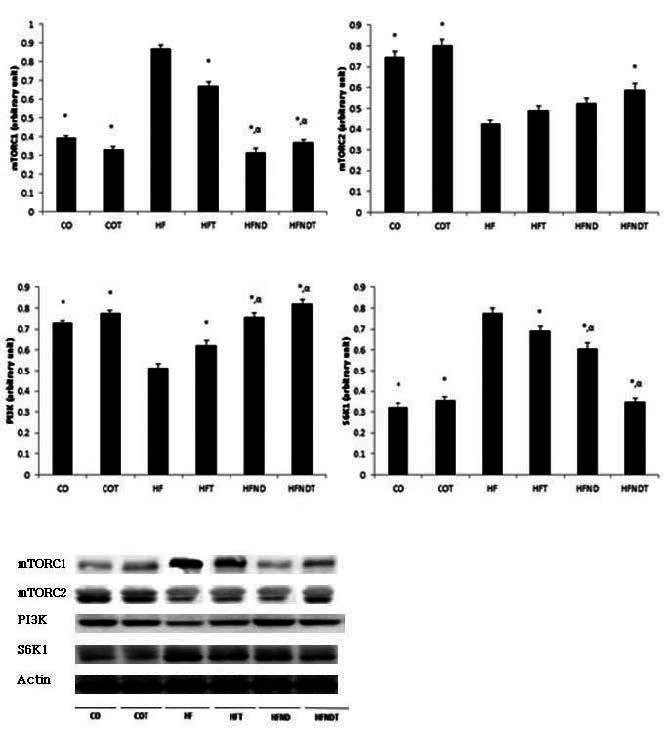
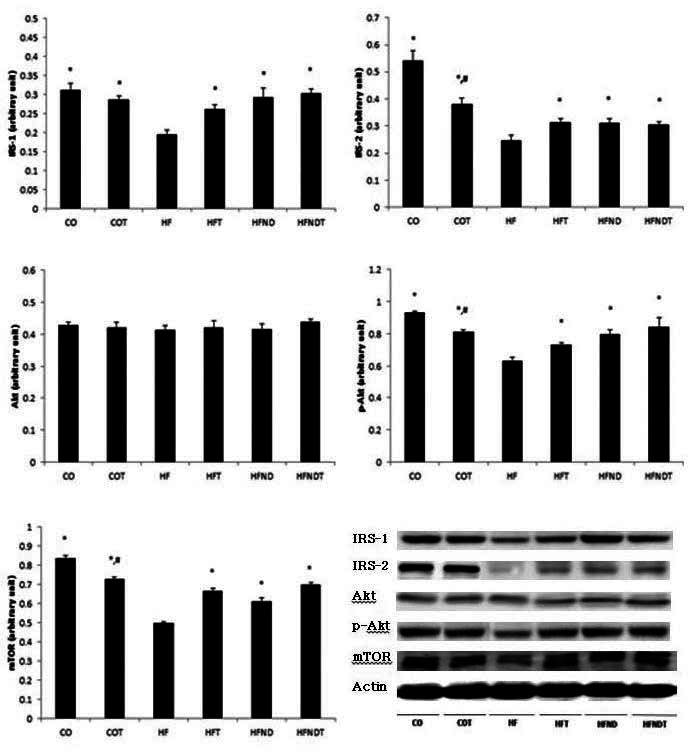
Fasting blood glucose, plasma insulin, and HOMA-IR in the HF group were significantly higher, as compared with other groups (p <.05). Protein levels of insulin receptor subunit-1 (IRS-1), IRS-2, and p-Akt were significantly higher in the HFT, HFND, and HFNDT groups, as compared with HF group. In addition, the protein levels of the mammalian target of rapamycin complex 1 (mTORC1) and ribosomal S6 protein kinase 1 were significantly decreased by exercise and dietary change (p <.05). However, mTORC2 and phosphoinositide 3-kinase were significantly increased (p <.05).
In summary, despite the negative impact of continuous high fat intake, regular exercise and dietary change showed a positive effect on insulin resistance and mTOR signaling protein levels.
本研究旨在探讨运动和饮食改变对肥胖大鼠骨骼肌中肥胖、胰岛素抵抗及mTOR信号蛋白水平的影响。
将60只雄性Sprague-Dawley大鼠分为正常饮食(CO)组和高脂饮食(HF)组,诱导肥胖15周。然后将大鼠再细分为CO组、COT组(CO + 训练)、HF组、HFT组(HF + 训练)、HFND组(饮食改变)和HFNDT组(HFND + 训练)(每组10只大鼠)。训练组进行8周中等强度的跑步机运动,之后切除比目鱼肌并进行分析。数据采用独立t检验和单因素方差分析进行统计学分析,显著性水平为0.05。
与其他组相比,HF组的空腹血糖、血浆胰岛素和HOMA-IR显著更高(p <.05)。与HF组相比,HFT组、HFND组和HFNDT组中胰岛素受体亚基-1(IRS-1)、IRS-2和p-Akt的蛋白水平显著更高。此外,运动和饮食改变使雷帕霉素复合物1(mTORC1)和核糖体S6蛋白激酶1的蛋白水平显著降低(p <.05)。然而,mTORC2和磷酸肌醇3激酶显著增加(p <.05)。
总之,尽管持续高脂肪摄入有负面影响,但规律运动和饮食改变对胰岛素抵抗和mTOR信号蛋白水平显示出积极作用。