Winter Kerstin, Born Johannes, Pfeifer Felicitas
Microbiology and Archaea, Department of Biology, Technische Universität Darmstadt, Darmstadt, Germany.
Front Microbiol. 2018 Aug 17;9:1897. doi: 10.3389/fmicb.2018.01897. eCollection 2018.
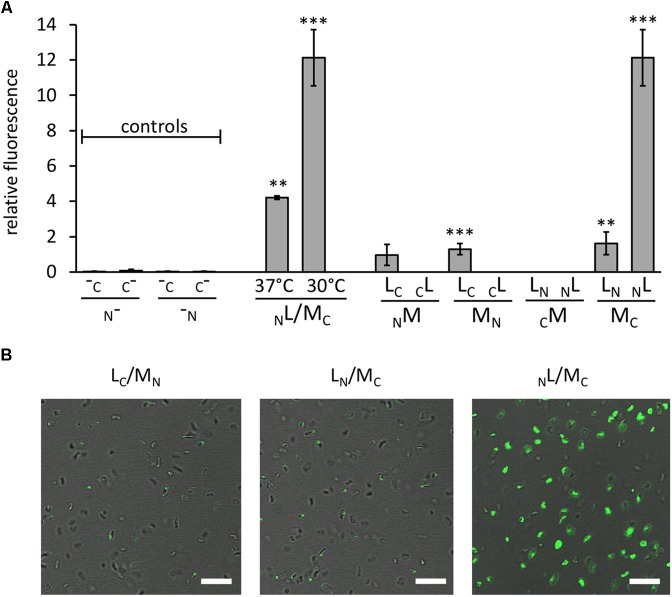
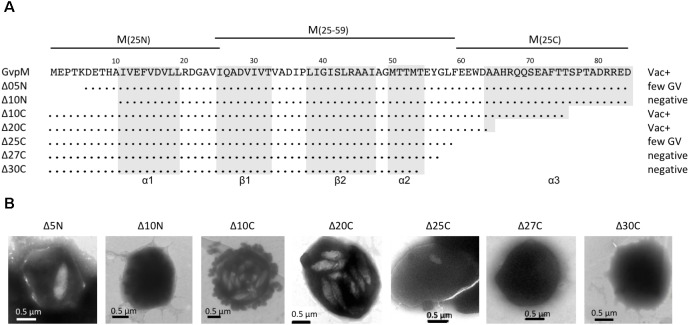
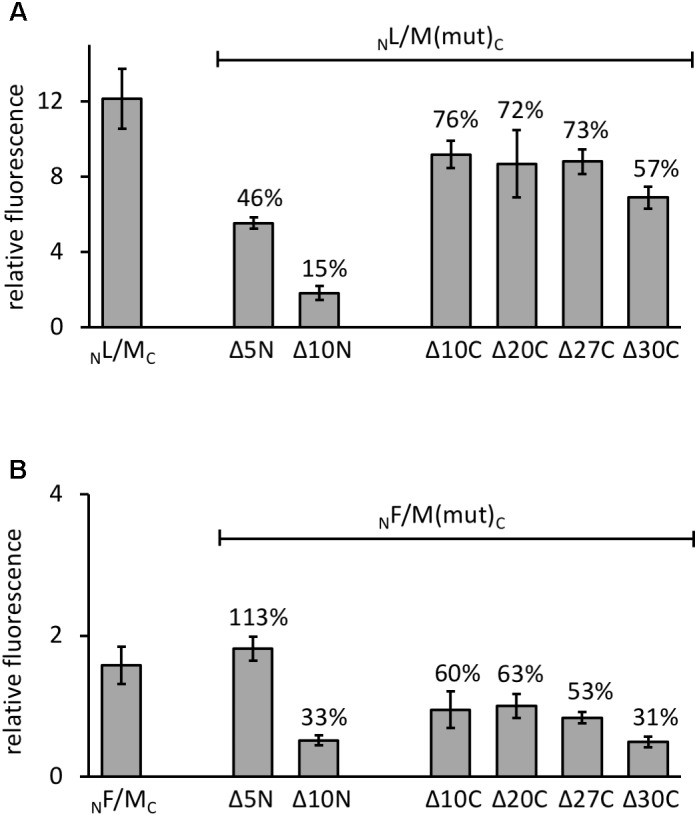
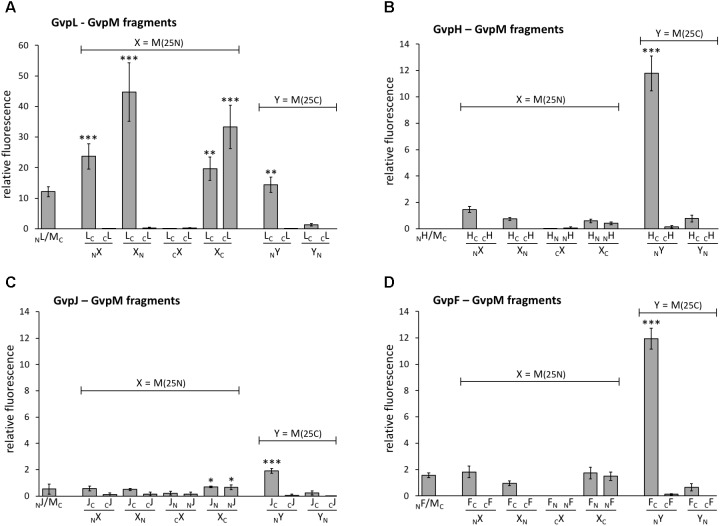
Several extremely halophilic archaea produce proteinaceous gas vesicles consisting of a gas-permeable protein wall constituted mainly by the gas vesicle proteins GvpA and GvpC. Eight additional accessory Gvp are involved in gas vesicle formation and might assist the assembly of this structure. Investigating interactions of halophilic proteins requires a method functioning at 2.5-5 M salt, and the split-GFP method was tested for this application. The two fragments NGFP and CGFP do not assemble a fluorescent GFP protein when produced , but they assemble a fluorescent GFP when fused to interacting proteins. To adapt the method to high salt, we used the genes encoding two fragments of the salt-stable mGFP2 to construct four vector plasmids that allow an N- or C-terminal fusion to the two proteins of interest. To avoid a hindrance in the assembly of mGFP2, the fusion included a linker of 15 or 19 amino acids. The small gas vesicle accessory protein GvpM and its interaction partners GvpH, GvpJ, and GvpL were investigated by split-GFP. Eight different combinations were studied in each case, and fluorescent transformants indicative of an interaction were observed. We also determined that GvpF interacts with GvpM and uncovered the location of the interaction site of each of these proteins in GvpM. GvpL mainly interacted with the N-terminal 25-amino acid fragment of GvpM, whereas the other three proteins bound predominately to the C-terminal portion. Overall, the split-GFP method is suitable to investigate the interaction of two proteins in haloarchaeal cells. In future experiments, we will study the interactions of the remaining Gvps and determine whether some or all of these accessory Gvp proteins form (a) protein complex(es) during early stages of the assembly of the gas vesicle wall.
几种极端嗜盐古菌会产生蛋白质性的气体包囊,其由主要由气体包囊蛋白GvpA和GvpC构成的透气蛋白壁组成。另外八种辅助性Gvp参与气体包囊的形成,可能有助于这种结构的组装。研究嗜盐蛋白的相互作用需要一种能在2.5 - 5 M盐浓度下发挥作用的方法,为此对分裂GFP方法进行了测试。两个片段NGFP和CGFP在产生时不会组装成荧光GFP蛋白,但当与相互作用的蛋白融合时会组装成荧光GFP。为使该方法适用于高盐环境,我们使用编码盐稳定型mGFP2两个片段的基因构建了四种载体质粒,可实现与两种目标蛋白的N端或C端融合。为避免mGFP2组装受阻,融合部分包含15或19个氨基酸的接头。通过分裂GFP研究了小气体包囊辅助蛋白GvpM及其相互作用伙伴GvpH、GvpJ和GvpL。每种情况研究了八种不同组合,观察到了指示相互作用的荧光转化体。我们还确定GvpF与GvpM相互作用,并揭示了这些蛋白在GvpM中各自相互作用位点的位置。GvpL主要与GvpM的N端25个氨基酸片段相互作用,而其他三种蛋白主要与C端部分结合。总体而言,分裂GFP方法适用于研究嗜盐古菌细胞中两种蛋白的相互作用。在未来的实验中,我们将研究其余Gvps的相互作用,并确定这些辅助性Gvp蛋白中的一些或全部是否在气体包囊壁组装的早期阶段形成蛋白复合物。